



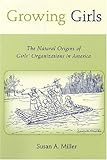
Susan A. Miller. Growing Girls: The Natural Origins of Girls' Organizations in America. New Brunswick: Rutgers University Press, 2007. x + 270 pp. $68.00 (cloth), ISBN 978-0-8135-4063-4; $23.95 (paper), ISBN 978-0-8135-4064-1.
Reviewed by Jennifer Helgren
Published on H-Childhood (November, 2008)
Commissioned by Patrick J. Ryan (University of Western Ontario)
Girls' History and Nature
Susan A. Miller’s Growing Girls is the first full-length monograph to situate the founding of U.S. girls’ organizations, especially the Camp Fire Girls and the Girl Scouts, in their cultural and historical context. Part of a wave of attention to girls’ cultures that has included books on consumer culture, as well as on relationships with dads, diaries, and dolls, Miller’s book adds another thread to the tapestry of twentieth-century girls’ history. In doing so, she makes welcome contributions not only to girls’ history but also, interestingly, to environmental history.
Miller examines why girls’ leaders equated camping with healthy girlhood between 1910 and the 1930s. Similar to historian Leslie Paris’s recent Children’s Natures: The Rise of the American Summer Camp (2008), Miller explores the reasons that summer camp became a popular, if not definitive, American pastime for urban middle-class children. Whereas Paris views the camp experience as a time and space set aside from other childhood institutions, Miller situates girls’ camps as an essential part of year-round girls’ organizations. She argues that leaders of girls’ organizations imagined nature, especially the landscape of the summer camp, as a curative (or at least a preventative) to whatever modern ailments (physical, moral, and emotional) might befall girls. In the book, nature is a socially constructed concept that meant the qualities innate to girls as well as the out-of-doors life.
The book begins with chapters that explore the philosophy of girls’ organizations and of camping. We learn why two major organizations emerged for girls while boys were served by only one (the Boy Scouts of America) and that the squabbles between Girl Scout and Camp Fire leaders were not the results of mere rivalry, but of different conclusions about the nature of girls. The leadership (national and local) of Girl Scouts maintained that girls could do what boys could do while the leadership of Camp Fire developed a complicated philosophy that maintained “scouting” as the purview of boys. Next, we view how the First World War propelled the growth of these two organizations. As girls took over canning, bought and sold liberty loans, and even interacted with soldiers at military camps, girls took on new citizenship roles. Roles that brought girls into the streets had their critics, but above all, girls’ organizations defined a space for girls as “citizens in the moment,” not merely future wives and mothers, who needed character building institutions as much as boys (p. 80).
In chapter 3, one of Miller’s most interesting chapters, we wander around the camp itself. Miller contends that an “eclectic mix” of architecture and meanings made camps seem like the ideal landscape for developing girls’ nature (p. 87). To explain how leaders avoided coupling the ruggedness and adventure of camp with an uncomfortable association with masculinity, Miller uses Leo Marx’s concept of the “middle-landscape.” Camp could seem at once primitive and refined, safe and rugged: “Nature was not the opposite of civilization; it was a balance between an uncomfortable and inhospitable wildness and an overly accommodating civilization” (p. 97). Leaders incorporated colors found in nature, pioneer heritage, and “indigenous” motifs into the camp landscape. Use of the term “indigenous,” a catchall term for local resources, arts and crafts, and history, gave mythic power and authenticity to everything from pageants to architecture. With insight, Miller shows how the image of country purity only broke down as campers and leaders encountered real locals. Displaying ambivalence, camp leaders feared contamination from supposedly backward country folk even as the leaders hired them as cooks and handymen, and as the country folk sought to uplift their own daughters.
The remaining chapters analyze three central components of girls’ programming: “Naturecraft,” “Homecraft,” and “Healthcraft.” “Naturecraft” builds on chapter 3 to show how camp leaders hoped to promote girls’ supposed natural affinity for nature and to help them reclaim the heritage of female pioneers who were self-reliant and imaginative. This chapter’s extensive analysis of Girl Scouts’ use of axes and hatchets demonstrates that many leaders wanted to empower girls by giving them training in seemingly masculine chores. “Homecraft” explains that leaders tried to make housework fun by bringing it out of doors. Housework, particularly maintaining “tidy” cabins and serving “dainty” portions, also helped feminize camp spaces, thereby neutralizing the potential disruption that dirt and primitive themes might have on gender roles. Finally, “Healthcraft” shows how the concept of health changed over time. Although early on health charts standardized girls’ health and emphasized self-control, by the 1930s emphasis on weight loss, desire for beauty, and even cosmetics had replaced the focus on proper meals, fresh air, and vigorous exercise.
Among the many strengths of this book are Miller’s terrific and sustained comparisons between the two major organizations for girls. In her discussion of homecraft, for example, we see clearly how Camp Fire delivered a more complicated theoretical justification for making housework seem fun--a contradictory, eugenic based, feminine version of G. Stanley Hall’s recapitulation theory--while Girl Scouts more practically wanted girls to feel like pioneers in their own homes, doing housework with ingenuity and resolve. Miller also convincingly argues that the khaki uniforms of the Girl Scouts held greater transformative power than the red, white, and blue service costumes of the Camp Fire Girls. Feminist scholars might dismiss the uniform as militarized, but khaki unmoored the boys who saw girls wear it and enabled girls to claim “a more equal part with soldiering men” (p. 42). While Miller is careful to point out that girls got to wear khaki because the public understood that girls were clearly not soldiers, for the girls who wore it, the serviceman’s role was demystified.
Growing Girls is a pleasure to read. Miller clearly enjoys her subject and has a keen eye for detail and humor. The text is filled with lively imagery of the quotidian life of girls at camp. Girls swam to waltz music to perfect the rhythm of their strokes, learned to observe like naturalists as they earned Flower Finder honors, and diligently recorded their baths and bowel movements on health charts. They also annoyed leaders by bringing ukuleles and bad jokes to campfires, displayed poor manners at the table, and smoked cigarettes and flirted with male helpers. Of the latter Miller quips, “they might have been having a good time, but they were definitely not having ... a ‘Scouting time’” (p. 157).
Still, as a former camper who usually felt somewhat ambivalent toward camp counselors, I longed for greater analysis of girls’ agency. Most of Miller’s sources, the published tracts from organization leaders, their letters, and their addresses, help her tell the story of the rhetorical claims of girls’ organizations. But her copious research also includes scrapbooks, journals, health charts, and photographs of and by girls. The book, therefore, includes tantalizing glimpses into how the girls themselves negotiated the messages leaders gave them. Here, the analysis is thinner than Miller's examination of how these organizations reflected early twentieth-century definitions of girlhood. Girls’ part in shaping the organization and the discourse of their lives deserves more time and space. Similarly, although Camp Fire and Girl Scouts overwhelmingly served white, middle-class, urban girls, more work could follow on the role that race and ethnicity played in these organizations, especially given their emphasis on the “indigenous.” While Miller partially unpacks this theme, it, and her provocative examples of Camp Fire Girls in Indian-style gowns and Girl Scouts performing black face in pageants, also merits more space.
But my comments on what the book does not do should not take away from the overall accomplishments of this work. Miller makes an important contribution to girls’ history with her detailed research and nuanced understanding of how girls’ leaders coupled ideas about nature and female youth to articulate a solution to what they believed threatened girls’ innate qualities. Moreover, she recognizes that Americans constructed female childhood as distinct from both boyhood and from female adulthood. Scholars interested in the history of childhood as well as women historians will find much to admire in Growing Girls, and its accessible style and subject matter lend it to discussions in undergraduate classrooms about the construction of nature, childhood, and gender.
If there is additional discussion of this review, you may access it through the network, at: https://networks.h-net.org/h-childhood.
Citation:
Jennifer Helgren. Review of Miller, Susan A., Growing Girls: The Natural Origins of Girls' Organizations in America.
H-Childhood, H-Net Reviews.
November, 2008.
URL: http://www.h-net.org/reviews/showrev.php?id=22819
 | This work is licensed under a Creative Commons Attribution-Noncommercial-No Derivative Works 3.0 United States License. |

