



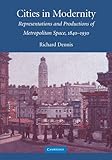
Richard Dennis. Cities in Modernity: Representations and Productions of Metropolitan Space, 1840-1930. Cambridge: Cambridge University Press, 2008. xvii + 436 pp. $120.00 (cloth), ISBN 978-0-521-46470-3; $44.99 (paper), ISBN 978-0-521-46841-1.
Reviewed by Angharad Saunders
Published on H-HistGeog (September, 2008)
Commissioned by Robert J. Mayhew (University of Bristol)
Building Bridges across Modernity
Cities in Modernity begins and ends with two very powerful metaphors. The first is one of bridges, and the last is one of networks. In a book that spans the period from 1840 to 1930 and criss-crosses between London, New York, and Toronto, both as material and representational spaces, these metaphors of connection serve to illuminate Richard Dennis’s overarching argument that urban experiences and understandings of modernity are far from distinct or discrete. While there certainly are geographies of modernity, it is often the case that differences are emphasized to the marginalization of similarities. Yet, the two, as Dennis points out, often go hand in hand. Differences in form and function are manifest, but when cities are examined closely as a complex of people leading everyday lives, commonalities in ways of life, thought, and value begin to emerge.
This book is the most recent within a long tradition of urban histories, but where earlier works have tended to develop rigorous theoretical frameworks (such as Lewis Mumford's The City in History [1958]), regard certain cities as icons or exemplars of particular phases of development (for example, Tristram Hunt's Building Jerusalem: The Rise and Fall of the Victorian City [2005], Asa Briggs's Victorian Cities [1968], and Peter Waller's Town, City and Nation [1983]), or offer overarching analyses of urban change (such as Martin Daunton's edited collection, The Cambridge Urban History of Britain Volume III, 1840-1950 [2000]), Dennis articulates a shared modernity, which blends the theoretical and the material. As he asserts, his intention with Cities in Modernity is “not to add to the weight of social and cultural theory of modernity ... [but] to build bridges connecting cultural and economic interpretations of urbanisation, and between qualitative and quantitative modes of analysis, abstract theory and the wealth of often untheorised or differently theorised empirical studies of nineteenth- and early twentieth-century cities” (p. 3).
Dennis facilitates this not only in his choice of content but also in the way he structures this very content. Cities in Modernity is divided into twelve chapters, which appear to fall into two, albeit unequal, sections. The first section is concerned with new forms of representing space and examines how artistic conceptualizations of space shared similarities with more documentary forms of spatial organization and understanding. The remaining section attends to the production of new urban spaces within the period, which range from the refashioning of streetscapes through the creation of new residential forms and the emergence of novel "downtown" geographies of employment and consumption. While it may appear that Dennis is establishing a distinction between the representation and production of space, he is rather enabling the reader to see how the former is intimately interwoven within the latter.
While far from exhaustive, Cities in Modernity is an ambitious work in the way it offers a highly nuanced reading of the complexities of modernist urban geographies. In a process of "bridge building," Dennis is not content merely to illuminate singular aspects of change; street improvement is not only a process of enhancing material quality, or heightening mobility, circulation, and sensory awareness, but it also simultaneously gives rise to new spatial practices of gender, class, and occupation. In this way, Dennis blends a depth of historical analysis with a systemic thought process that establishes multiple connections within and between material and representational spaces. Such an approach allows Dennis to develop a spectrum of presences within, and presentations of, the street. The growing illumination of the street is at once a practice of regulation, emancipation, and spectacle (pp. 129-136); middle-class women and prostitutes are joined by working-class women (pp. 157-159); and masculine visions of the street are juxtaposed with feminine ones while simultaneously crosscut by degrees of social status (pp. 156-163).
The very ambitiousness of Dennis’s work can, at first, seem a little disorientating and fragmented, for it moves between in-depth and overarching analysis. For instance, a detailed reading of Manhattan Transfer, which elaborates Marc Brosseau’s earlier examination of how the sociality of the city is exemplified in the textual form, is matched by more traditional interpretations of how the work of those like Arnold Bennett and George Gissing represents the social life of particular places (pp. 94-100).[1] This contrast in approach can be frustrating, leaving behind it a sense of non-completion and a want for something more profound. Yet, this latter comes in the very purposefulness of Dennis’s method, as he tries to balance the competing voices of the omnipotent narrator with the subjectivity of modernist voices. Thus, it is not only in content but also in form that Dennis is representing and producing urban modernity.
That Cities in Modernity attends to both the modernist and realist artistic traditions is pleasing for it rearticulates the continuities, and not just the changes, of the period. It suggests that the innovation of modernist art was only one within a whole range of representational and productive practices. This is important because, since being so contemptuously maligned by Virginia Woolf (The Common Reader Volume I [2003]), the work of realist artists has met with a certain intellectual marginalization that has seemingly been perpetuated within geographic traditions of late.[2] At the same time, this scope of vision is emblematic of the broader intention of Cities of Modernity, to interrogate the various meanings of modernity. Dennis does this explicitly in his search for similarities as opposed to difference, in his analysis of the contradictions in fin de siècle notions of progress, and in his explorations across the social spaces of the city. This is neatly demonstrated in the chapter on "Mansion Flats and Model Dwellings," where the multiplicities of "modernity" clearly coalesce. Apartments transform and modernize concepts of home; engage new technologies; develop novel forms of ownership and marketing; give rise to new tenants, like the modern working woman; and alter the geography of the city by creating new residential districts and shifting the relationship between public and private space (pp. 224-262).
It is at such moments that the more conventional theorizations of the modern city are enriched by highly original reflections, and where a sense of the circulations of modernity within space becomes most apparent. While Dennis emphasizes the distant cohesion between London, New York, and Toronto and appears to create a seamless modern geography, at times his functional approach to the city can create a sense of fragmentation within space. Through a lens that explores the city as a site of working, living, and enjoying leisure, it can become difficult to see the inevitable intrusions of one area on another. The city and the West End, midtown and downtown Manhattan, and commercial and suburban Toronto can seem quite distant from each other. Dennis addresses this absence in the final chapter’s discussion of connections and circulations, and “rather than conceive of a functional break between one area and another,” he earlier encourages the reader to “imagine different combinations of functions in each part of the modern city” (p. 320). Yet, where he does offer detailed examinations of the social complexity of modernity, as in the aforementioned chapter, it is the presence and practice of businesses like marketing and construction that help destabilize spatial divisions between suburbia and the city.
It is likewise in such instances that the relationship between representation and production receives very lucid articulation. Yet, Dennis navigates awkward terrain in his attention to these two interwoven cultures, not least because mimetic approaches have come in for intense criticism over the validity and solidity of their meaningfulness.[3] Dennis negates much of this problematic in the way he links the representational with the productive, emphasizing the agency, creativity, and circularity of the former. This is again assisted by the expansiveness and flexibility of his analysis, which identifies the various hues within modernity. There are times when this connectivity appears more tenuous; for example, contrast the chapter on "Building Suburbia" with that on "Consuming Suburbia." Here an evident disjuncture is created between the production and consumption of these spaces. Although this is, in many ways, a narrative device that allows Dennis to distil and differentiate the complexities of suburban ways of life from suburban imaginations, it does lend an air of fragility to the work.
This does not detract from what is a very erudite and incisive piece of work, which draws strength from the rich and diverse research that informs it. It expertly negotiates and synthesizes work within architectural history, geography, building, cultural and feminist studies, sociology, business, and finance, creating an accessible, engaging, and informative work, of interest to a broad spectrum of scholars, researchers, and students. In its breadth, it suggests some interesting questions for future study, which examine how modernity is shared not only internationally but also nationally. How do the connections between the production and representation of space in London, New York, and Toronto coincide and differ across their national spaces? There are examples of this kind of work (for example, the edited collections of Martin Daunton and Bernhard Riegar, Meanings of Modernity: Britain from the Late Victorian Era to World War II [2001] and of Felix Driver and David Gilbert, Imperial Cities: Landscapes, Display, Identity [1999]), but few have the scope or richness of Cities in Modernity. More specifically, Dennis notes the absences in his own work; the elderly, the young, the poor, and the "other" all have varied places within modernity, which have yet to be fully explored.
Cities in Modernity is a thoroughly modern book. It is a deftly crafted kaleidoscope of the city, whose power lies in the way it juxtaposes and weaves together what are often considered distinct histories, spaces, and ways of representation and production. The work, as a whole, is given potency by the sophistication of Dennis’s approach to writing, which in mixing modernist and realist forms of representation produces a many-textured idea of the modernist city. At times, this can be a little bewildering, for one is left to wonder whether the very gazetteer style that Dennis sometimes adopts is purposeful or not. Yet, in a book that blends the objective and the subjective gaze, the reader needs to be alert to the flexible tenor of the writing and the very "modern" meanings this produces.
Notes
[1]. Marc Brosseau, “The City in Textual Form: Manhattan Transfer’s New York,” Ecumene 2 (1995): 89-144.
[2]. Peter Brooker, Andrew Thacker, eds, Geographies of Modernism: Literatures, Cultures, Spaces (London: Routledge, 2005); Gerry Kearns, "The Spatial Poetics of James Joyce,” New Formations 57 (2005-06):107-125; and Jeri Johnson, "Literary Geography: Joyce, Woolf and the City,” in The Blackwell City Reader, ed. Gary Bridge and Sophie Watson (Oxford: Blackwell, 2002), 60-70.
[3]. Miles Ogborn, "Mapping Words,” New Formations 57 (2005-06): 145-149; and Patrick Joyce, The Rule of Freedom: Liberalism and the Modern City (London: Verso, 2003).
If there is additional discussion of this review, you may access it through the network, at: https://networks.h-net.org/h-histgeog.
Citation:
Angharad Saunders. Review of Dennis, Richard, Cities in Modernity: Representations and Productions of Metropolitan Space, 1840-1930.
H-HistGeog, H-Net Reviews.
September, 2008.
URL: http://www.h-net.org/reviews/showrev.php?id=22794
 | This work is licensed under a Creative Commons Attribution-Noncommercial-No Derivative Works 3.0 United States License. |

