



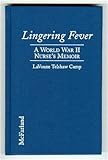
LaVonne Telshaw Camp. Lingering Fever: A World War II Nurse's Memoir. Jefferson, N.C.: McFarland, 1997. viii + 176 pp. $23.95 (cloth), ISBN 978-0-7864-0322-6.
Reviewed by Katherine Burger Johnson (University of Louisville)
Published on H-Minerva (July, 1998)
A Young Nurse in CBI
In the introduction to her memoirs Laverne Telshaw Camp states that this "is a story of nursing sick and wounded soldiers in the heat, muck, and mud of the jungle, of dealing with loneliness and isolation, of trying to work effectively in an organization where morale had hit rock bottom" (p. 5). Camp very effectively fulfills any reader expectations raised by the latter two statements; there is less information about the actual nursing and medical care itself.
When the war began, Camp was a student nurse in Scranton, Pennsylvania. Her first job out of training was as a staff nurse at the New York Hospital. When she had just turned 21, she roller-skated to the recruiting office on Fifth Avenue to enlist. She did one-month of basic training at Fort Dix, then was sent to Camp Upton on Long Island. There she received orders to the China-Burma-India theater, traveled to Camp Beale, California, where she learned the truth of the famous Army adage, "hurry up and wait."
Together with her best friend from basic training, Camp spent forty-one days on the USS General H.B. Freeman crossing the Pacific Ocean. Her first assignment in Burma was at the 14th Evacuation Hospital on the Ledo Road (aka as Pick's Pike and Stilwell Road) in Burma. There she joined a hospital staff that had come over as a unit, with wards where the majority of the patients were Chinese, making her adjustment doubly difficult. The suffocating heat and humidity made everything even worse. When the Japanese surrendered in August 1945, the fighting may have ended, but work for the doctors and nurses did not end. Eventually the 14th Evac was shut down and some of the medical personnel were sent home; but Camp and her friend were sent for temporary duty to the 20th General Hospital in Ledo, and then on to the 142nd General Hospital in Calcutta, India, before finally getting their orders back to the states.
Camp is a very good writer; the story flows as if written by a professional author, which she may be. She gives the reader a wonderful picture of the living conditions at an evacuation hospital in the jungle. There are particularly good descriptions of the little straw houses, called bashas, which served as homes for the nurses. She writes colorfully about the Chinese patients, Army life, and her impressions of the setting and the culture. She writes with clarity about the emotions of a nurse suffering from loneliness and frustration, while at the same time in the throes of young love. The reader learns a great deal about the few, but oh-so welcomed opportunities for recreation: dances, horseback riding, trips with a pilot friend. Camp states it well in the epilogue: "Although we suffered a multiplicity of miseries in our wartime assignments, there had also been times when life had been a lark" (p. 170). In addition, there are over twenty-five clear photographs to illustrate the book, all of which add to the story.
When looking back fifty years later, Camp reiterates a common theme from the writings of women who have served in American wars across two centuries: "It was not possible to pick up where we left off, as was sometimes expected of us, because we had changed....It became clear that my professional colleagues who had remained in civilian positions had little appreciation for the liberating effect the war had on those of us who served our country" (p. 170).
Camp's story is a welcome addition to the collection of works on women's experiences in World War II. She served in a theater of war that is less well known than Europe, Africa, or the Pacific. The reader is reminded that most of these nurses were young and inexperienced, often away from home for the first time, and certainly not prepared for life in the Army or in a war zone. They were surrounded by young men vying for their affections, which just added to their emotional confusion.
The one thing that is missing in this book is much detail about actual nursing and medical care. It is really a coming-of-age saga and a love story. If the reader is looking for information about the day-to-day work of a medical unit, this is not the place to find it. What one will find is clear strong writing about the feelings of a young nurse from rural Pennsylvania and the after hours life of those who served. Camp emphasizes that she was young, naive, and unsure of herself and she is probably representative of those who served. Maybe this is the most important message of all!
Copyright 1998 by H-Net and Minerva: Quarterly Report on Women and the Military. All rights reserved. This work may be copied for non-profit educational use if proper credit is given. For other permission, please contact <MinervaCen@aol.com>.
If there is additional discussion of this review, you may access it through the network, at: https://networks.h-net.org/h-minerva.
Citation:
Katherine Burger Johnson. Review of Camp, LaVonne Telshaw, Lingering Fever: A World War II Nurse's Memoir.
H-Minerva, H-Net Reviews.
July, 1998.
URL: http://www.h-net.org/reviews/showrev.php?id=2169
Copyright © 1998 by H-Net, all rights reserved. H-Net permits the redistribution and reprinting of this work for nonprofit, educational purposes, with full and accurate attribution to the author, web location, date of publication, originating list, and H-Net: Humanities & Social Sciences Online. For any other proposed use, contact the Reviews editorial staff at hbooks@mail.h-net.org.

