

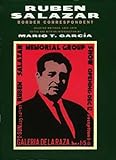
Ruben Salazar. Border Correspondent: Selected Writings, 1955-1970. Berkeley: University of California Press, 1995. xx + 283 pp. $28.00 (cloth), ISBN 978-0-520-20125-5.
Reviewed by William Schell (Murray State University)
Published on H-LatAm (November, 1995)
Corrido de Rubin Salazarby Jesus Sanchez
Con infinita tristeza El 29 de Agosto Mis versos voy a cantar Fecha tan particular y perpetuar la memoria La policia asesino de Don Ruben Salazar. A Don Ruben Salazar
On that date in 1970, Salazar, popular news director for KMEX Spanish-language TV and LA Times columnist, was shot through the head by a 10-inch tear-gas projectile fired into the Silver Dollar Cafe by county sheriffs who had followed him after his TV crew filmed their police riot against 20,000 demonstrators at the Chicano Anti-War Moratorium earlier. Salazar died instantly. There was what might be called an investigation, and a hearing. No charges were filed against the officers responsible. Oscar Zeta Acosta (aka the "Brown Buffalo, an activist Chicano defense attorney whom Hunter Thompson once described as arriving at court, soap scum on his boots and smelling of gasoline, to defend clients accused of fire-bombing) "accused authorities of criminal conspiracy to commit political assassination (and) ... was forcibly ejected from the hearing room" (p. 5). Twenty-two California State legislators, presumably more credible critics, called for a Justice Department investigation; it was refused. Danny Villanueva, then KMEX station manager agreed: "If it wasn't a conspiracy, then it is an incredible set of circumstances."
In death, Salazar became a martyr of the Chicano movement, a role he would never have envisioned. In his graceful introduction to this edited collection of Salazar's journalism, Mario T. Garcia writes: "Salazar was neither a martyr nor a politico, but a hardworking reporter whose career needs to be appreciated beyond his tragic death" and that "a full biography of Ruben Salazar will no doubt be written some day." (p. 5, 37) I urge him to do it. His keen telling of Salazar's life is a fine miniature history of the Chicano movement, alone almost worth the price of the book.
Garcia describes Salazar as "a "border correspondent," not only because he himself was literally a product of the US-Mexican border or because he covered the border at one point in his career but symbolically as well .. (because he) was the first journalist of Mexican-American background to cross over into mainstream English-language journalism." (p.5) Salazar, whose family crossed the Rio Grande when he was a an infant, grew up in a middle class El Paso neighborhood, graduated high school, served in the US Army in Germany from 1950-52, and then attended Texas Western College, a rarity for Mexican-Americans at the time, majoring in journalism. He learned his craft on the El Paso Herald Post as an investigative reporter covering the dark side of Chicano life. "25 Hours in Jail -- I lived in a chamber of Horrors," and "La Nacha, the dope queen of the border" have a classic spare, controlled, just-the-facts-mam style with a proto-gonzo quality.
"Hypo, who says he wants to be cured, cannot live without heroin. It costs him about $10 a day -- or hours of excruciating pain.. Hypo prefers heroin to pain and get the $10 a day anyway he can. ... He has stolen, borrowed, and has now given me his story for $15 dollars which he spent on heroin." La Natcha's house, Salazar notes, "has all the conveniences of a modern home: gas stove, nice living room furniture, TV and a saint's statue on the wall" while in Hypo's apartment, stripped to feed his habit, sits his wife and baby on a blanket on the floor. (p.44)
After paying his dues in El Paso, Salazar moved to LA and, in 1959, signed on with the LA Times, which was then struggling to shake its reputation as the worst big-city paper in the U.S. Under Otis Chandler, Jr. the Times began to cover the Mexican and African-American communities sympathetically for the first time. Salazar was not keen to be typed as a "Mexican" reporter but, as he covered his beat, "he became quite committed to the Mexican American community." (p. 12) He wrote compassionately about the social inequities and injustice but most movingly about problems of identity and belonging. Pablo Mendez, a 17 year-old high school drop-out. "He's an American, but he doesn't think of himself as one, and in many respects is not looked upon as one by Non-Mexican-Americans. Pablo's speech would sound ridiculous in a group of Tijuana high school students. And Pablo's English causes snickers among his "gringo" acquaintances." (p. 72) He began to struggle with questions of his own identity as "A Mexican-American Hyphen" pulled by two cultures and identities that "can leave you with only the Hyphen." (p.33)
By the time he made the move to KMEX in 1970, he had come to view the media "as a political instrument ... to be used to bring about a better life for his people." (p. 30) Salazar began as a centrist and remained one even as he moved toward political activism. He managed to "bug the establishment" yet still give Chicano's "some shred of hope that the system might possibly work. There was a great soul in his writing, a gentle irony that could chide the gabacho [Anglo] and Chicano with equal and unfailing affection." Even the "most angry militant Brown Beret ... knew .. Ruben's heart .. was always beating at the very core of la raza." (p. 31) But those who knew him warned that "Ruben was watching and observing the movement, but the movement was not Ruben." "I'm a newsman. I'm a journalist who happens to be a Chicano. Don't you ever call me a Chicano newsman!" (pp. 33-34)
One of the first things that struck me about this collection is how fresh Salazar's work is. The same issues and problems of social and institutional injustice are before us more than ever, notwithstanding the of declarations by D'Souza and others of the pseudo-economic, pseudo-intellectual right, that racism is dead or doesn't matter or at least is economically marginalized by the triumphant free market. These are the days of the culture wars, California is the frontline, and the immigrant (real or imagined) is the enemy.
In 1962, Salazar reported on the bracero program then under attack. The program was opposed by the Mexican-American community as, in the words of one Archbishop, "an international racket" that subsidized local agribusiness by providing cheap semi-servile labor and depressed the wages of local farm workers. (pp. 72 and passim) Despite a concerted disinformation campaign by the growers, the bracero program was ended. Salazar never lived to see the brief glory of Cesar Chavez of the 1970s when the UFW had 60,000 members, nor its disintegration under the non-enforcement of illegal immigration laws allowing farmers to employ exploitable illegals with little change of being caught and little damage if they are. Farm wages have fallen 54% from their UFW high; pickers legal (and il) live in appalling conditions. The collapse what (for lack of a better word) can be called traditional agriculture in Mexico (especially in the south), and the flight north to the specialty fruit fields of California, means that more Mexicans than ever are "peasants" -- on both sides of the border.
Salazar did a brief turn as a foreign correspondent. The Times planned to send him to Vietnam to season him for his assignment to Mexico as it Latin American correspondent. But in April of 1965 the US invaded the Dominican Republic and Salazar covered it and was sucked into the action as a participant ("1,000 Thwarted by Junta Guns Appeal to U.S. Newspaperman for Help). Among the Dominican, he Salazar was confronted by slippery questions of race, ethnicity and nationality noting that his Dominican source "calls me "yankee" when he's mad at me and "Mexican" when we're on good terms." (pp. 164-165) So too in Vietnam in a story filed from Bien Hoa that told of a black soldier KIA refused burial in his town's "all white" cemetery. In Mexico of 1968, Salazar reported growing dissatisfaction with Diaz Ordaz, his repression of the students, the Tlateloclo massacre, and smoothly switched gears to the Olympics, much as Mexico itself did, celebratory but sad. (pp. 174 and passim)
Salazar returned to LA in 1967 to cover the Mexican-American movement then rapidly evolving into the Chicano movement a "constellation of youth protest, countercultural assertions, and separatist tendencies, combined with a struggle on the traditional issues affecting Mexican-Americans in the United States: racism, poverty, educational discrimination, and police oppression (and) ... a significant anti-Vietnam War movement." (p. 26) Salazar characterized the radical Chicano as "bato loco" -- or "a zoot suiter with a social conscience. He may be an ex-con, a marijuana smoker and dangerously defiant ... (but he is) experiencing a social revolution .. (and) learning and liking political power (and thus)... can be dealt with on a political basis." In "Why Does Standard July Fourth Oratory Bug Most Chicanos" written shortly before his death, Salazar published the Spiritual Plan of Aztlan of the Chicano Youth Liberation Conference. "Brotherhood units us, and love for our brother (as we) .. struggle against the foreigner "gabacho" who exploits our riches and destroys our culture. ... We declare the independence of our mestizo nation. We are a bronze people with a bronze culture." (pp. 264 and passim)
The LAPD and FBI files on Salazar (a "slanted, left-wing oriented reporter," p. 32) grew rapidly after he joined KMEX and began producing tough reports on police abuse in the Chicano community, and was known to be writing a book. Police visited him at his office and studio. Chief Ed Davis pressured KMEX to fire him. The day before the Chicano Anti-War demonstration, Salazar wrote his final column "The Mexican-Americans NEDA Much Better School System," cleaned out his office and left telling Villanueva "If I survive, you'll see me."
Ruben's friends say he would have laughed at being martyrized. He "would have responded to the efforts to canonize him ... with one of his favorite phrases: "This is ridiculous." On the tenth anniversary of Ruben's death, his wife Sally wrote: "My memories are confused by the murals and memorials and a creation built in the public mind --someone other people call Ruben Salazar, but someone to this day I don't fully recognize ... someone he himself may have just been in the process of discovering." (p. 36) Mario Garcia is to be thanked for rescuing Salazar the man from Salazar the myth.
List of Articles (selected)
I: El Paso, 1955-1956 Speakeasies Sell "Atomic" Booze in South El Paso II: Mexican-Americans, the Border, and Braceros, 1961-1965 Mexican-Americans Move into New Era of Political Awakening Murder of a Crusader Underlines Tijuana Choice: Reform or Go Red Civic Leaders Troubled by School Drop Outs Spanish Speaking Angelenos: a Culture in Search of a Name Latins Here to Protest Bracero Law Growers Hit "Meddling" with Bracero Program Mexican-American Lag in Schooling Income
III. Foreign Correspondent, 1965-1968 Dominican Leader Denies Red Charge Who Would Get U.S. Fire, Junta, Rebels? Students, Army Troops Battle in Mexico City Wonderland of Color Welcomes Olympics
IV: The Chicano Movement, 1969-1970 Militants Fight to Retain Spanish as their Language Chicanos Hold 5-State Event in Colorado United Farm Workers to Hold Rally, Woo Mexican Farm Workers Brown Berets Hail "La Raza" and Scorn the Establishment Bilingual Texas Public School Gains Support Latins Form Distinct Class, U.S. Aid says Maligned Word: Mexican The "Wetback" Problem Has More Than Just One Side Chicano's Long Love Affair with Democratic Party Ends Mexican-American School Walkout Focused on Problem
If there is additional discussion of this review, you may access it through the network, at: https://networks.h-net.org/h-latam.
Citation:
William Schell. Review of Salazar, Ruben, Border Correspondent: Selected Writings, 1955-1970.
H-LatAm, H-Net Reviews.
November, 1995.
URL: http://www.h-net.org/reviews/showrev.php?id=213
Copyright © 1995 by H-Net, all rights reserved. H-Net permits the redistribution and reprinting of this work for nonprofit, educational purposes, with full and accurate attribution to the author, web location, date of publication, originating list, and H-Net: Humanities & Social Sciences Online. For any other proposed use, contact the Reviews editorial staff at hbooks@mail.h-net.org.

