

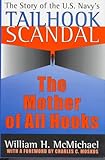
William H. McMichael. The Mother of All Hooks: The Story of the U.S. Navy's Tailhook Scandal. New Brunswick, N.J. and London: Transaction Publishers, 1997. xvi + 377 pp. $32.95 (cloth), ISBN 978-1-56000-293-2.
Reviewed by Francine J. D'Amico (independent scholar)
Published on H-Minerva (May, 1998)
Whose Story of Tailhook?
Journalist William McMichael decided to write The Mother of All Hooks after the final trial in the government investigation of charges of sexual misconduct at the 1991 convention of the Tailhook Association. As a reporter for the Daily Press of Newport News, Virginia, he felt media coverage was not exploring "the gray areas" and was missing "the bigger picture of whether the Navy was ever going to right itself in terms of the treatment of women," so he set out "to tell the whole story" (p. ix).
In readable prose and with painstaking detail, McMichael paints a candid picture of naval aviation culture--a culture in which pilots live "on the edge" in a hard-driving/hard-partying atmosphere and routinely engage in physical/sexual one-upmanship, seeing themselves as a "unique fraternity" at the apex of an exclusive and masculinity-defining institution (p. 22). While McMichael condemns their excesses, he seems to admire their courage and patriotism as military pilots and to sympathize with what he sees as their bewilderment at being prosecuted for behavior that before Tailhook '91 was de rigueur. For example, McMichael writes, "While an odd custom, ballwalking didn't cause anyone physical harm" (p. 45). "Ballwalking" means walking around with fly unzipped and genitals exposed--a "custom" which is criminally prosecutable in civilian society. Yet McMichael also acknowledges that the Navy had sought to change the institutional culture in which sexual harassment and abuse were rampant prior to the '91 convention (p. 26), suggesting that aviators perhaps saw themselves as exempt from the "Zero Tolerance" policy--at least, that is, when off-base and off-duty, with the Las Vegas Hilton as a "port of call" (pp. 21-28).
A Comparative Analysis
The release date for Mother of All Hooks is February 1997. Since Jean Zimmerman's book, Tailspin, was released in July 1995, [1] McMichael would have done well to examine and respond explicitly to Zimmerman's analysis of Tailhook. Given the timing of the two volumes, I must ask: What do we learn from McMichael that we didn't from Zimmerman?
Both McMichael and Zimmerman base their analyses on author-conducted personal interviews, and hence present valuable original research (see section on methodology, below). Both also rely upon media reports of events and accounts of trials as well as recordings and transcripts of interrogations, trials, and hearings. Both examine events up through the final trial connected with Tailhook '91 and present a "where they are now" rundown of the major protagonists, so McMichael's effort does not "update" Zimmerman's in this sense. However, McMichael attended that final trial and provides an interesting first-person narrative of his impression of the proceedings.
McMichael and Zimmerman offer similar arguments regarding how we got to Tailhook '91, but they examine the event and its consequences from very different perspectives and take different lessons from it. While both are "outsiders" to the military, McMichael appears to be a sympathetic "beat" reporter, whereas Zimmerman is a more critical academic researcher who explicitly specifies her theoretical framework of analysis, which McMichael fails to do. Further, McMichael's analysis lacks the broad and deep historical contextualization which Zimmerman provides to interpret Tailhook and its wake.
Both McMichael and Zimmerman observe that the guilty went free because investigators offered immunity to junior officers in order to pursue the higher ranking officers who may have participated in misconduct or at least turned a blind eye. But McMichael and Zimmerman perceive this effort to go to the top differently. For McMichael (and Moskos in the Foreword), this was a political witch hunt, whereas Zimmerman sees it as part of the traditional doctrine of command responsibility. McMichael (and Moskos) apparently seek to draw the line on the extent of command responsibility by distinguishing "public" from "private" behavior: senior officers are not to be held responsible for the off-duty misbehavior of junior officers, even if the senior officers are present where the misbehavior is occurring. Because of this failure to act, junior officers were not held responsible for their own misbehavior at Tailhook. Yet the quasi-official nature of the Tailhook convention challenges the public/private dichotomy embedded in McMichael's/Moskos' interpretation, and the military frequently ignores or conveniently erases this public/private distinction, as, for example, in the pursuit of gay/lesbian service personnel. The concept of "conduct unbecoming" suggests one must ALWAYS be "an officer AND a gentleman"--not just when on-base and on-duty.
Both McMichael and Zimmerman link the abuse at Tailhook not only to the culture of military aviation but also to post-Gulf War euphoria, to male pilots' opposition to women's efforts to enter military aviation, and to the political frame of the Clarence Thomas confirmation hearings in which Anita Hill accused the Supreme Court nominee of egregious sexual harassment. Zimmerman goes on to consider the connections between Tailhook and the controversy over gays/lesbians in the military as well as the longer history of women's entry to the military institution as a whole, particularly in the context of the resumption of the post-Cold War downsizing and restructuring which had paused during the Gulf War (pp. 195-204 and passim). In contrast, McMichael interprets funding cuts subsequent to Tailhook '91 not as part of this larger picture but as a punishment meted out by Congress "in protest over the Tailhook scandal" (p. 82).
The differences in McMichael's and Zimmerman's perspectives lead them to different interpretations of key events. For example, they disagree regarding the dismissal of charges in October 1993 in the court-martial trial of Marine Captain Gregory Bonam, whom Lt. Paula Coughlin had identified as one of her attackers. McMichael supports the interpretation of the court, that is, that Coughlin had misidentified Bonam because friends/fellow officers corroborated his story that he was present in the third floor party suites but did not participate in "the gauntlet" and was wearing a different color shirt that night than she recalled (pp. 59-65, 182-5, 233, 323). Zimmerman believes NIS investigator Bill Hudson's assertion that Bonam was guilty, based on Coughlin's testimony, Bonam's confirmed presence on the third floor, and Bonam's failure of two polygraph tests (pp. 258-64).
They also see the role of investigators differently. McMichael characterizes DOD-Inspector General (IG) investigator Peter T. Black as overzealous, crusading, abusive, angry, and frustrated at the lack of cooperation from Navy aviators in the investigation (pp. 142-3, 210-11, 284). He depicts Vice Admiral J. Paul Reason, the original CDA (Consolidated Disposition Authority--a prosecution choice McMichael criticizes) for Tailhook Navy cases, as bending to pressure "from above to produce some convictions to assuage Congress and the public" to assert "undue command influence" in the investigation and prosecution of alleged abuses (pp. 175-76). Reason was relieved of the CDA position but found not to have exerted undue command influence (p. 285), yet McMichael believes he did so, based on the arguments of a defense attorney for one of the junior officers accused of misconduct (pp. 175-93). Similarly, McMichael portrays Lt. General Charles C. Krulak, the Marine CDA, as a "screamer" who "loved to chew people out," a "ground-pounder" (infantry officer) who "had a general dislike for the aviation community," and a "deeply religious" man who played the role of CDA as "the Confessor" (pp. 100, 118-20, 124-5). McMichael presents as truth a junior officer's unsubstantiated accusation that in the course of the proceedings, Krulak improperly interfered with the promotion process of a Marine officer, though McMichael does note that Krulak had a reputation as a fair man (p. 100). Zimmerman makes only one peripheral mention of Black, depicting him as a tough investigator (p. 243), and praises Reason and Krulak as "men of unassailable character," noting that "if you believed that the Navy had the institutional capacity to prosecute the Tailhook offenders (and some on the outside doubted that it did), then they were the ones to do it" (p. 257).
And most tellingly, their versions of Kara Hultgreen's crash diverge. McMichael supports Moskos' version (p. xii), linking the crash to the Navy's chagrin over Tailhook, which they argue prompted the Navy to push unqualified women pilots through a training program (p. 336). Zimmerman endorses the findings of the Navy's official investigation, that is, that the crash was caused by technical malfunction, not pilot error (pp. 293-95). So rather than taking McMichael at his word, that is, that he intends to tell "the whole story" of Tailhook (p. ix), we need to consider whose story he is telling.
Both McMichael and Zimmerman discuss the impact of Tailhook investigation and its aftermath on the working relationship of military men and women and the work environment in the Navy. Both interviewed servicemen and women, but McMichael's focus is on how men are coping with the "uncertainty" of where their careers are headed and how they are to behave. Zimmerman, on the contrary, focuses on how women have survived and continue to struggle in the hostile environment of the military institution. She concludes, as I have elsewhere, that Tailhook seems to have changed official policy but has had little impact on the practice of sexual harassment in the U.S. military, making harassment a less visible tool of resistance to women's presence in the ranks--and therefore less open to challenge--and widening the chasm of suspicion, hostility, and isolation between military men and women.[2]
McMichael concludes that the "ugly aftermath" of Tailhook '91 continues "to have a powerfully detrimental effect on the Navy and Marine Corps," as the Senate "continues to flog the Navy Department...long past the time the whole matter should have been dropped--liars and gropers notwithstanding" (pp. 325-6). He continues, "Tailhook was and continues to be an overreaction by the nation's civilian leadership that has forced social changes down the military's throat--some good, some detrimental" and that it has created "a climate of political correctness that has in some cases lowered training standards, sometimes endangering others and dulling morale" (p. 326). McMichael, echoing Moskos, mourns the "politicization" of civil-military relations evidenced, from their perspective, by Congress' "interference" with the promotions of Navy and Marine Corps officers post-Tailhook, pending the outcome of the investigations. This critique assumes that civil-military relations and the military institution itself are not already political. Zimmerman, on the other hand, explores the institution's gender, race, and sex/uality politics, suggesting that Tailhook '91 did not so much politicize civil-military relations as reveal the politics which underlie them.
Some Notes on Methodology
In his quest for "the whole story," McMichael interviewed some seventy people, among them some of Tailhook's main protagonists, including Cmdr. Thomas Miller, Lt. David Samples, and Cmdr. Gregory Tritt, the final three defendants whose cases were thrown out on 8 February 1994 by Capt. William T. Vest, who presided at their court-martial. McMichael also interviewed Vest as well as investigators, prosecutors, policymakers, and other active duty and retired Navy and Marine Corps officers, some of whom attended Tailhook '91 and others of whom gave him insight into what he calls the "macho" military culture (p. 325). McMichael also lists Lt. Paula Coughlin and former Assistant Secretary of Defense Barbara Spyridon Pope among his interviewees. Zimmerman "conducted 400 sit-down interviews" (p. xiv) of military men and women, investigators, and policymakers between June 1992 and December 1994 (p. 321), including Coughlin, Pope, and investigator Bill Hudson, among others, as well as Rear Admiral Marsha Evans and aviators Lt. Kara Hultgreen, Lt. Loree Draude, and Capt. Rosemary Mariner about the climate for women in the military and especially military aviation.
McMichael notes that some people "were interviewed at length; others for but a few minutes" (p. 339). He includes the dates of interviews in his first notes but does not specify the lengths of the interviews or where they took place. I found subsequent citations confusing regarding the source of information. For example, the distinction between a personal interview by the author and an official interview by investigators is lost after the first citation. The text itself sometimes reveals the source of information explicitly; such "flagging" consistently throughout would have made McMichael's effort more useful for researchers.
As an academic researcher, I found myself wondering what constitutes an "interview" to a reporter? Are arranged interviews taped with the permission of the source--Zimmerman's methodology--the same as firing questions at a person en route from car to courtroom? Further, I would have liked to have seen the "who and whom" of interviewer and interviewee addressed: social scientists are acutely aware of the importance of how questions are asked and answered and of the difference identity and interpretation make in the outcome of an interview.
Also troubling is that many of McMichael's source citations are unconventional. For example, much information is attributed to an unidentified "Retired Navy official" (pp. 348-50). Is this the same source throughout, or is there a retired Admiral X, a retired Captain Y? The same question arises for his "Senior Navy official close to the investigation" vs. "Senior Navy official" source(s) (p. 348)--are these one person or several? one interview or more? Other citations list "numerous other sources," "various sources and reports," or "consensus" as the basis for the information cited or conclusions made (pp. 344-64). Regarding these citations, McMichael writes, "In a perfect world, every source used to develop this story would be identified in the notes" (p. 343). In his quest "to produce a book that is as close to the truth as an outsider can get," (pp. 343-44), he protected anonymity--possibly allowing some to speak more freely--and sacrificed reliability, key to a social scientist who might seek to retrace his steps. Zimmerman identifies all sources fully save one: a "senior NIS official (retired)" (p. 317). The question of anonymity for sources is a difficult call, as I have found in my research on sexuality and military service...yet I wonder why and from whom retired officers especially need protection?
In Tailspin, Zimmerman includes forty-three photos and illustrations of Tailhook events and protagonists, including Lt. Paula Coughlin, ASD Barbara Spyridon Pope, and CNO Admiral Frank Kelso, as well as some of the pictorial evidence of the "conduct unbecoming" revealed in the IG's Tailhook report. These pictures make palpable the climate at Tailhook '91 and make real the people described, interviewed, and affected by the event and its wake. Zimmerman's photos also trace the history of women in the U.S. military, her larger frame of reference, and she provides an extensive bibliography. In Mother of All Hooks, McMichael provides neither illustrations nor a bibliography of sources, which impoverishes his presentation as compared to Zimmerman's. Indeed, McMichael's source citations include references to just three monographs: Gregory Vistica's Fall From Glory (1995), mentioned only as Sam Donaldson's source for his query about former Navy Secretary John Lehman's attendance at a 1981 Tailhook convention in an ABC program broadcast on 26 May 1996 (p. 345, note 9); James Stevenson's The Pentagon Paradox (1993); and Michael Gordon and Bernard Trainor's The General's War (1995), mentioned regarding the services' participation in the Gulf War (p. 346, note 25).
So McMichael's Mother of All Hooks provides a window on military culture and some moderate critique of that culture, but does not challenge the gendered foundations of the military institution or naval aviation culture within that institution, as his choice of title clearly suggests. After a second reading, I found myself asking if McMichael's intent was to entertain as much as to inform, because in places the book reads like a docudrama movie script: McMichael tells a story with heroes and villains and no shades of gray. There is not much new in his presentation to those already familiar with the event's details, with Zimmerman's analysis, and with Moskos' interpretation of Tailhook's wake.
Notes
[1]. Jean Zimmerman, Tailspin: Women at War in the Wake of Tailhook (New York: Doubleday, 1995).
[2]. Francine D'Amico, "Tailhook: Deinstitutionalizing the Military's 'Woman Problem,'" in Wives and Warriors: Women and the Military in the U.S. and Canada, eds. Laurie Weinstein and Christie White (Westport, Conn., and London: Bergin & Garvey/Greenwood, 1997) 235.
Copyright 1998 by H-Net and Minerva: Quarterly Report on Women and the Military. All rights reserved. This work may be copied for non-profit educational use if proper credit is given. For other permission, please contact <MinervaCen@aol.com>.
If there is additional discussion of this review, you may access it through the network, at: https://networks.h-net.org/h-minerva.
Citation:
Francine J. D'Amico. Review of McMichael, William H., The Mother of All Hooks: The Story of the U.S. Navy's Tailhook Scandal.
H-Minerva, H-Net Reviews.
May, 1998.
URL: http://www.h-net.org/reviews/showrev.php?id=2076
Copyright © 1998 by H-Net, all rights reserved. H-Net permits the redistribution and reprinting of this work for nonprofit, educational purposes, with full and accurate attribution to the author, web location, date of publication, originating list, and H-Net: Humanities & Social Sciences Online. For any other proposed use, contact the Reviews editorial staff at hbooks@mail.h-net.org.

