



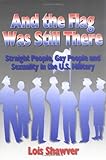
Lois Shawver. And the Flag Was Still There: Straight People, Gay People, and Sexuality in the U.S. Military. New York: Haworth Press, 1996. xiv + 262 pp. $24.95 (paper), ISBN 978-1-56023-851-5; $59.95 (cloth), ISBN 978-1-56024-909-2.
Reviewed by Miriam Ben-Shalom (Independent Scholar)
Published on H-Minerva (April, 1998)
The Military and Sexuality
Dr. Lois Shawver has done a super job of bringing most, if not all, of the current research about homosexual persons, the United States military establishment, and military service by homosexual individuals together in one book. It is astounding to see how much research has been produced on this topic since 1992 and the fiasco of "Don't Ask/Don't Tell/Don't Pursue" (the current policy of the U.S. military). The actual citations and research tell readers that the very things which gay veterans have been saying for years are, in fact, valid: that gays and lesbians can serve their country very well, indeed. Given the formidable scope of the references, a reader will have to conclude that gays and lesbians, in fact, can be integrated into the military and that they can serve without all the silliness and difficulty which some military experts suggest will occur. Dr. Shawver's book will be a good starting point for those just beginning on the educational journey to understand the nuances of this sensitive topic; it is a good basic "101 Introduction to the Issue of Gays In the Military." Given that Dr. Shawver's expertise is in the area of bodily modesty, she certainly has the credentials to strip the xenophobia of American society and military bare for all to see.
For the more knowledgeable person, unfortunately, Dr. Shawver's book contains little that is new. Further, in spite of stellar referencing, a serious flaw of the book is that Dr. Shawver seems to think that the move to include gays in military service began, somehow, after 1993. She ignores, for example, the 1957 Crittendon report done for the Navy and the 1987-1988 MILPERSEN and PERSEREC reports, all of which support the idea that homosexual individuals could serve with heterosexual individuals with little disturbance and certainly with no detriment to morale or the good order of the service. She ignores cases challenging oppressive military policies prior to 1993, which leaves the research presented lacking in the contextual and societal connections so necessary to understand this issue in the aggregate. While Dr. Shawver is writing as a psychologist, it is unwise to present such a wealth of research without the historical connection and foundation which allows readers to see the validity of content and position.
Dr. Shawver's presentation of certain individual cases is also flawed. Where she might have given the reader a detailed insight into how military intelligence works and how military gays cope with the daily stress, we get a handful of mild anecdotes with no deep analysis and little probing beyond bland quotes and a cursory, almost whimsical, presentation for each case. Indeed, the cases cited add little to the text; it is as if they were added later as an afterthought.
An additional defect is the language level which Dr. Shawver has employed for her text. Curiously, the text of this book is written at a 5.8 to 6.7 grade level. There is a difference between explaining something simply and effectively and writing in overly-simple language. As an example, on page 140 of the text, Dr. Shawver is describing "Edward's" investigation and interview by military interrogators:
Edward longed to surrender to this accuser, just to say, 'Oh, it's true! I am a homosexual!' But he steeled himself. Only a homosexual would be so soft. He would not do it. And the day went on and on. On the fourth day, Edward began to formulate a plan. He would fake a heart attack. It was a scary thing to do, but he needed a plan. And on the fifth day, Edward stood up, grabbed his chest, and cried out that he couldn't breathe. 'This is terrible!' he gasped as the interrogators rushed him into a car. 'We just want to get at the truth. We don't want to kill you,' he heard them say as they raced him to the hospital.
Frankly, anyone who has ever undergone a military (or any sort of) interrogation knows that investigators just don't speak that way. And when a person is describing an event, rarely are speech patterns in the form of simple sentences. Obviously, Dr. Shawver knows her stuff. It is equally obvious that she is looking to attract a broad audience, one beyond just those who might deal with or who have directly experienced military discrimination. It is most appreciated that Dr. Shawver did not write her text in the turgid academic and psychological jargon so familiar to researchers. But the use of simplified and colloquial language is disarming and detracts from the seriousness of the issues at hand. It siphons away the power of Dr. Shawver's objective challenges to fear and prejudice. The use of simple sentences, which seems to be a hallmark of style in this book, is intrusive and almost insulting; the use of child-like and elementary language for an adult audience is simply not appropriate.
And the Flag Was Still There is, nevertheless, a good text to have at hand if only for the research presented. The book is useful as a research tool, due to the very specific list of sources cited and the wonderfully detailed notes (which were more valuable, perhaps, than the text itself). The current nature and the concentrated presentation of the sources is useful for college students, writers, and individuals researching this topic who do not have a great amount of research time. Unfortunately, due to the textual level of English, unless one is a master teacher at an extremely liberated middle school, it really is not useful as a book which might be added as a text to a course at either the high school level or the university level.
Dr. Shawver ably takes the U.S. military and American society to task for their hurtful biases and xenophobic bents and forces peccavi on their part. False modesty has no place in the Doctor's world and she does not allow it either on the part of the public institution of the U.S. military or on the part of society as a whole.
Copyright (c) 1998 by H-Net and MINERVA: Quarterly Report on Women and the Military. All rights reserved. This work may be copied for non-profit educational use if proper credit is given. For other permission contact <MinervaCen@aol.com>.
If there is additional discussion of this review, you may access it through the network, at: https://networks.h-net.org/h-minerva.
Citation:
Miriam Ben-Shalom. Review of Shawver, Lois, And the Flag Was Still There: Straight People, Gay People, and Sexuality in the U.S. Military.
H-Minerva, H-Net Reviews.
April, 1998.
URL: http://www.h-net.org/reviews/showrev.php?id=1970
Copyright © 1998 by H-Net, all rights reserved. H-Net permits the redistribution and reprinting of this work for nonprofit, educational purposes, with full and accurate attribution to the author, web location, date of publication, originating list, and H-Net: Humanities & Social Sciences Online. For any other proposed use, contact the Reviews editorial staff at hbooks@mail.h-net.org.

