



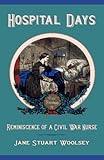
Jane Stuart Woolsey. Hospital Days: Reminiscence of a Civil War Nurse. Roseville, Minn.: Edinborough Press, 1996. 139 pp. $12.95 (paper), ISBN 978-1-889020-00-6.
Reviewed by Karen L. Cox (Murray State University)
Published on H-CivWar (February, 1998)
Lately, it is rare that a historical conference goes by where a session on history and memory is not part of the program. The study of memory and the Civil War, moreover, has emerged as an extremely popular field of inquiry. Reminiscences of the war offer some of the best evidence of how memory affects history, and Jane Stuart Woolsey's Hospital Days is no exception. Her memoir of her wartime nursing experience, originally printed in 1868, is useful to those wishing to better understand historical memory and the Civil War, as well as the role of women in the conflict.
Jane Stuart Woolsey was born in 1830, and in 1861 and 1862 she worked in New York City visiting local hospitals as a member of the Women's Auxiliary Committee. She received training in hospital management in Rhode Island and was working there when, in 1863, she and her sister were invited to become superintendents of nursing at a Union barrack hospital outside of Alexandria, Virginia. She remained there until August 1865, after which time she returned to New York and began writing a memoir of her wartime experience. Included in her account are descriptions of the work of nurses, the special diet of patients, the life of soldiers, and prisoners of war. She also provided samples of letters she and other nurses wrote for their soldier-patients.
Woolsey's "reminiscence" makes clear that the responsibilities of nurses during the Civil War had not changed much since Florence Nightingale served as a nursing superintendent during the Crimean War. Clean linens and carefully planned meals were considered important to the comfort and health of the patients. Just as food was believed to be a "curative agent," so personal attention was highly regarded as a healing measure. Writing letters to the loved ones of injured and dying soldiers and keeping their patients company were also considered important to the soldiers' well-being. What appears on the surface to be ordinary tasks, however, proved to be vital to all concerned during this extraordinary time in American history.
One of the more insightful chapters of Hospital Days is entitled "In the Wards." The hospital wards not only harbored the injured and dying, but served as a community forum for discussing the politics of war. Nurses were a party to such discussions, including those about "peace plans and the constitutional amendment to abolish slavery"--evidence that the war had provided an opportunity for women to be included in the political dialogue of the day. Still, the most conscious part of their daily experience was the impact that the enormous loss of life made on their own lives. As a friend who visited Woolsey at the hospital remarked, "the empty beds make a keener impression on [me] than if they were full of maimed and suffering men; they look so grim, so ready" (p. 87).
Writing and answering letters for the injured soldiers was also an important part of a nurse's daily routine, and Woolsey includes a variety of examples in the chapter entitled "Mail Days." The letters often reveal the tragedy of war, measured in terms of both physical and emotional loss. Many of the nurses were unprepared for the carnage of war, and sadly, many soldiers succumbed to death far removed from family members. Moreover, as rations were depleted, the nurses faced the reality of death on a more frequent basis. Writing about the lack of rations, one nurse commented, "the worst of it is, we cannot keep the men alive" (p. 118).
One of the lessons we learn from Woolsey's memoir is how conventional gender barriers broke down as a result of the war, particularly in the hospital. Whether doctors or soldiers, these men recognized the significance of women's roles in the conflict, as evidenced by their free discussion of politics with women and the appreciation they bestowed upon the nurses. Woolsey's memoir, as noted earlier, will also be useful to the understanding of memory and the Civil War. Although she ministered to ailing and dying soldiers, for example, it is interesting to note that Woolsey remembers the Union soldiers with whom she had contact as robust, dedicated men. Conversely, like many of her fellow citizens in the North, she regarded Confederates as "traitors."
Instructors should find Hospital Days a useful text for the high school or undergraduate classroom, but only if students have been provided with a proper background on the subject of the Civil War. The book's primary weakness is the absence of footnotes to explain events to which Woolsey makes reference. For example, on page 132, she comments about the "Tragedy" of April 1865, an allusion to the assassination of Abraham Lincoln. A footnote to such references would not only be helpful to students, but it would also highlight how such events permeated the thoughts of all Americans, including women working in remote army hospitals. Such references as well as the details of wartime nursing are what make Hospital Days significant.
Copyright (c) 1998 by H-Net, all rights reserved. This work may be copied for non-profit educational use if proper credit is given to the author and the list. For other permission, please contact H-Net@H-Net.MSU.EDU. [The book review editor for H-CivWar is Daniel E. Sutherland <dsutherl@comp.uark.edu>].
If there is additional discussion of this review, you may access it through the network, at: https://networks.h-net.org/h-civwar.
Citation:
Karen L. Cox. Review of Woolsey, Jane Stuart, Hospital Days: Reminiscence of a Civil War Nurse.
H-CivWar, H-Net Reviews.
February, 1998.
URL: http://www.h-net.org/reviews/showrev.php?id=1679
Copyright © 1998 by H-Net, all rights reserved. H-Net permits the redistribution and reprinting of this work for nonprofit, educational purposes, with full and accurate attribution to the author, web location, date of publication, originating list, and H-Net: Humanities & Social Sciences Online. For any other proposed use, contact the Reviews editorial staff at hbooks@mail.h-net.org.

