



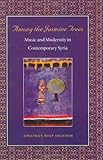
Jonathan Holt Shannon. Among the Jasmine Trees: Music and Modernity in Contemporary Syria. Middletown: Wesleyan University Press, 2006. 288 pp.p Illustrations. $40.00 (cloth), ISBN 978-0-8195-6798-7.
Reviewed by Christa Salamandra
Published on H-Levant (October, 2008)
Commissioned by Kevin W. Martin (Indiana University - Bloomington)
A Sentimental Modernity
Debates about musical genres have become implicated in concepts of--and contests over--modernity and identity in the Middle East and beyond. In Among the Jasmine Trees, Jonathan Holt Shannon explores the role an enduring musical tradition plays in the construction of the authentic modern self and society. Artists, audiences, and critics in Aleppo, a historic center of Arab musical culture, form the object of this ethnographic investigation. Shannon focuses specifically on the musical suite, the wasla, and its mainstay, the Andalusian muwashshah. The wasla involves taqsim, a genre of musical improvisation, which Shannon artfully adopts to structure his text: each chapter begins with a matla’, or opening evocation of a key theme, and concludes with a qafla, or closing reflection.
Shannon identifies an “Oriental spirit” (ruh sharqiyya) as a key constituent of locally conceived authenticity in contemporary Syria. This quality emerges in tarab, a term that refers to both a state of musically induced emotional rapture, and the high-cultural music genre that engenders it. Despite the preponderance of mass-marketed popular music, tarab retains large, even youthful, audiences throughout the Arab world, and particularly in Aleppo. Here heritage is not ossified but dynamic, a theme underscored by Shannon’s use of musical improvisation as a metaphor for the construction of modernity. Through tarab itself and the discourses surrounding it, Shannon argues, Syrians formulate a counter modernity emphasizing sentiment, in conscious counter-distinction to European Enlightenment rationality.
Throughout Among the Jasmine Trees Shannon emphasizes the intersubjectivity of tarab. Emotional transcendence is produced not through qualities inherent in the music itself, but rather emerges from the context of performance, from the connection, tawasul, between musicians and listeners, and among listeners themselves. Tarab is a dialogic process through which performers and audiences together reach states of emotional transcendence. This focus on social relations complements the musicology literature emphasizing the formal aspects of Arab music.
In his dual role as ethnographic researcher and musical practitioner, Shannon takes the reader to music lessons, cassette shops, nightclubs, concerts, and Sufi ceremonies. Music emerges as an embodied practice in which the senses of hearing, sight, smell, and touch are aroused to invoke states of heightened emotionality. Listening, rather than performing, is the key tarab-producing practice; rapture materializes, or not, in the context of communal listening. The auditory and kinesthetic merge in Shannon’s analysis, which treats tarab as a social rather than internal experience. Through vocalizations--shouts, sighs--and gestures--waving of arms, swaying of heads--listeners present to each other an authentic modern self, one capable of being swept away by musical enchantment. The auditory discipline through which the educated listener is cultivated forms an essential component of musical authenticity.
Tarab emerges as a category-blurring phenomenon. It is produced in contexts neither fully public nor private. Once held in wealthy homes, concerts now taking place in clubs and restaurants are still referred to as musical “evenings,” sahras, evoking a traditional intimacy. Although nominally secular, tarab draws on the Sufi practice of dhikr, or “remembering,” a ritual linking the human voice, music, and emotional ecstasy. The dhikr operates as a conservatory of musical tradition, serving as a training ground for musicians and singers considered masters of tarab.
In an era when Western scholars are consumed with Islamic revivalism and popular culture, classical secular music traditions remain strong and worthy of anthropological attention. Among the Jasmine Trees serves as a corrective to the overemphasis on authoritarianism that characterizes most academic literature on contemporary Syria, and reduces complex worlds of artistic production to issues of censorship and resistance. Its focus on aesthetics brings us closer to the concerns of Syrian cultural producers and critics themselves. Yet it also obscures the power structures that underlie artistic production. Shannon might have explored more fully the issues of hierarchy and authority that his preface promises (p. xxii), particularly given the ambiguous status of music in Arab and Muslim societies, where musicians and music-making are alternately revered and scorned. This omission may derive from the author’s close--and openly acknowledged--alignment with the tastes and dispositions of his interlocutors.
Deeply textual, meticulously researched, and sonorously written, Among the Jasmine Trees demonstrates the importance of aesthetic considerations in constructs of the modern and adds a Syrian dimension to a growing literature on alternate or multiple modernities. This important work will be of be of particular interest to students of expressive culture in the Middle East, but will attract readers from a wide range of disciplines. It would also serve as an engaging introduction to a significant aspect of social life in the contemporary Arab world.
If there is additional discussion of this review, you may access it through the network, at: https://networks.h-net.org/h-levant.
Citation:
Christa Salamandra. Review of Shannon, Jonathan Holt, Among the Jasmine Trees: Music and Modernity in Contemporary Syria.
H-Levant, H-Net Reviews.
October, 2008.
URL: http://www.h-net.org/reviews/showrev.php?id=15759
 | This work is licensed under a Creative Commons Attribution-Noncommercial-No Derivative Works 3.0 United States License. |

