



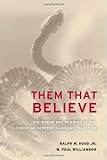
Ralph W. Hood, W. Paul Williamson. Them That Believe: The Power and Meaning of the Christian Serpent-Handling Tradition. Berkeley: University of California Press, 2008. 322 pp. $60.00 (cloth), ISBN 978-0-520-23147-4; $24.95 (paper), ISBN 978-0-520-25587-6.
Reviewed by Thomas Burton
Published on H-Pentecostalism (November, 2008)
Commissioned by Gene Mills (Florida State University)
Holiness-Pentecostal Serpent-Handlers
Ralph Hood and Paul Williamson in the second sentence of their preface insightfully state: “What appears to the casual observer as a dangerous and bizarre activity is a simple act of obedience that holds great significance and meaning for believers who subscribe to a literal interpretation of a passage in the Book of Mark” (p. xiii). From that point the authors skillfully and with scholarly care set forth a substantial basis for understanding both the tradition and practice of these Christians who include in their doctrine the handling of poisonous serpents.
As part of the context for the emergence of serpent-handling, the initial chapter presents a view that is apparently the impetus in part for the entire work, namely, that serpent handlers have not been treated fairly by scholars and the media. This view raises the question, is the treatment generally changing? In some cases, the treatment seems more indirectly pejorative. For example, the media often protest that they are presenting the practice objectively; yet even major network productions have couched their programs in series with negative connotative titles, such as “Strange Places” and “Taboo.” Another part of the context considered in chapter 1 is the Pentecostal movement itself. Ironically, it is this same pejorative attitude within the Pentecostal movement that has also marginalized serpent-handling. As Pentecostalism has moved socially upward, it has become normalized, and I might add secularized--a move which tends to exclude serpent-handling, especially its potentially doleful effects.
Chapter 2 charts the reader a clear passage through the convoluted tributaries of the history of Pentecostalism, the head waters ostensibly being the activities described in the Acts of the Apostles. The stream’s course as manifested is a complicated one. Rather than attempting to mark definitively the banks where the stream actually initiates in contemporary Protestant Christianity or to delineate thoroughly the landmarks, i.e., Methodism, Holiness, Pentecostal, Holy Spirit baptism, etc., Hood and Williamson explore all these channels in order to give focus to the place of serpent-handling within Pentecostalism. The discussion of the influence of the Wesleyan Holiness tradition is particularly important. There, all the seeds for the movement were sown: the heartfelt crises of the experience of salvation and the transformation of personal motives through perfect love. Both of these blessings became expressed in the emotional fervor of the revivals of the late eighteenth and early nineteenth centuries, including experiences essentially that were later described as a third blessing--the baptism of the Holy Spirit, manifested in the speaking in tongues, and in the other signs. The reader is charted through these revivals and to the emergence of the Church of God (Cleveland, Tennessee) with its early practice of handling serpents as an evangelistic sign.
Chapter 3 presents George Went Hensley as an individual who appeared at an auspicious time to manifest a role model for practicing a ritual that was waiting almost spontaneously to occur--but even his undeniably major influence was perhaps not as great as is sometimes presented. (The influence of Nancy Younger Kleinieck on Hensley, related in oral history, is particularly interesting.) Probably Hensley’s influence was more indirect than personal, as one can read in the many “Battlefield” reports in the Church of God’s paper, the Evangel. One wonders just how great Hensley’s influence would have been if he had actually been more of the “charismatic figure” (p. 44)--more on the literate level of A.J. Tomlinson, more personally appealing, and of course, less associated with private domestic trauma. To their credit the authors avoid sensational anecdotes about Hensley’s life and conclude astutely: “A faith tradition that persists by pointing to its legitimacy in a sacred text, however, cannot be dismissed based on exceptions taken to its major leaders” (p. 51). A minor detail: although there are discrepancies concerning Henley’s date of birth, he was probably thirty-four, not thirty-seven (p. 45) in 1915.[1]
The analytical approach of chapter 4 using the sociological church-sect theory proves useful in explaining varying aspects of the history of serpent-handling, particularly its relationship with the Church of God, Cleveland. In part this approach shows that the renegade sects of serpent-handlers survive because of their “high-cost behaviors” (p. 58), whereas the church grows because of its eliminating behaviors that conflict with mainstream culture. This theoretical approach also suggests that the laws enacted against serpent-handling might decrease the sects' growth, but increase their survival. The statistical data from the Evangel presented in this chapter are a valuable addition both in clarifying specifically the relationship between the Church of God and the serpent-handling sects, and in understanding generally the history of these sects. The last section of this chapter is on the theology of serpent-handling, which properly designates its central tenet: “obedience--not proof of faith” (p.76). The reader, however, may feel somewhat confused by a distinction, not as clearly set forth as it is later, between handlers’ accepting the key text in Mark as an imperative “for true believers” (p. 2) and accepting it as a practice that will follow believers--or as A. J. Tomlinson is quoted as saying: “‘if ... God’s power is present to manifest this sign’” (p. 54).
Chapter 5 focuses on the serpent as sign and symbol. As a sign, the serpent indicates imminent danger to both serpent-handlers and general observers alike. (Appendix 1 gives a valuable list of deaths by serpent bite, as does appendix 2 of the deaths by drinking poison.) As a means of providing a greater understanding of that danger, a catalog is presented of the serpents commonly used, which includes details of venom capacity, lethality, striking tendencies, etc., as well as details from relative research: for example, “those specializing in the study of venomous reptiles ... have ... found no satisfactory explanations for why handlers are not bitten more often” (p. 86). As a symbol, the serpent possesses a range of associations, from Freudian sexual imagery to positive, non-reductionist religious imagery. And for the serpent-handler in particular, the element of risk fuses sign sign and symbol, evoking (literally as well as figuratively) fear, death, life, and resurrection.
Chapter 6 addresses the complex subject of trance states and glossolalia. One principal dichotomy presented is one defining trance as an observed, empirical state, and possession as a personally experienced state--in either of which speaking in tongues may be effected or simply manifested. An experiment with an “anointed” fire-handler and several EEG experiments are also examined, with the authors concluding that the “confounding results only demonstrate the complexities of determining the meaning of altered states assessed by physiological measures” (p.105). Hood and Williamson’s associations of the beliefs of serpent-handlers with Rudolf Otto’s theology are particularly interesting. Serpent-handlers seek to be possessed by the transcendent and thus possess the transcendent in order to effect control over nature. Otto’s perspective relative to healing, however, does not appear to be “precisely what handlers believe,” since with serpent-handlers, the focus is not that the “capacity ... lies dormant in human nature” (p. 115), but that it lies in the anointment of the Holy Spirit.
In order to provide greater understanding of their practice from a personal perspective, chapter 7 analyzes eighteen sermons delivered by preachers at services where serpents were handled. (The hermeneutic technique of interpretation is explained in appendix 3.) From these sermons, five interrelated themes are presented, “all ... consequential to the central theme of God moving on the believer” (p. 118).
Chapters 8, 9, and 10, using the phenomenological method of chapter 7(explained in appendix 3), expand the analysis of personal perspectives of handlers in three different areas. Chapter 8 analyzes interviews with seventeen serpent-handlers regarding their experiences (105 encounters) in the practice. Five interrelated themes emerge, including the major one of “Fear”/“Victory,” “experienced by participants across all contexts of serpent handling” (p. 151). It is curious that in the responses relating to victory, there is no mention of its apparent biblical derivation: “O grave, where is thy victory?” (I Cor. 15:55). One section that readers will likely be eager to read lists various explanations by participants forfthe harm that sometimes occurs when serpents bite the handlers.
Chapter 9 analyzes the themes that emerge from interviews of eleven handlers who provided descriptions of their personal experiences with anointing. The protocols may seem somewhat tedious to the general reader, but the “global description” provided will be of interest to all: “The experience begins ... with feeling the moving of God on the person ... there is a profound sense of empowerment ... the person feels drawn away in varying degrees ... the person feels a flow that radiates through contact with others.... Indescribably good feelings ... are felt from the onset” (p. 166).
Chapter 10 analyzes the emergent themes from interviews relative to near-death experiences (NDEs) from serpent bites in religious settings, and places these experiences in the context of the larger research on NDEs. Again, for the reader specifically focused on the experience of the serpent-handler, the summary description is particularly informative: “the strike is experienced as ... likely to maim or kill ... overcoming fear by ‘victory’ is encountered ... intense ‘suffering’ occurs ... the stricken believer [contemplates] ... the reason for and the finality of his bite.... Fear ... may be relieved by visions of luminous places.... Ultimate victory is experienced in the eventual acceptance of both the serpent bite and its outcome as God’s will” (p. 182).
Chapter 11 examines the music of serpent-handling churches from three perspectives: (1) an overview of the music in terms of participants, instruments, and process; (2) the existing literature, including both studies of the link between music and religious experience (with a focus on Pentecostal music), and the few studies that give attention to serpent-handling music (surprisingly overlooked, given the general thoroughness, is Scot Schwartz’s analysis in Thomas Burton's edited volume,Serpent-Handling Believers [1993]); and (3) an analysis of the content of 1,114 songs (although not of the musical composition, which along with performance needs more exploration). The chapter concludes insightfully: “the content of the songs contribute to a tradition that likely needs its music as much as it needs its serpents” (p. 207).
Chapter 12, in a balanced review of the legislation relative to serpent-handling, suggests that the stereotyping of the churches and practitioners as bizarre is a major factor behind the legal restrictions against the practice. This prejudice also “may mask other legitimate motives for concern, such as love and reasoned opposition to the practice” (p. 218). To explore this subject, a psychological study, designed by the authors, reveals that “People who reject serpent handlers also stereotype them, have negative emotional reactions to them, and seek to avoid them” (p. 220). Another empirical study indicates that “allowing handlers to express their own views in the setting of their ritual” (p. 223) reduces stereotyping and changes negative attitudes.
The text continues strongly through the epilogue, examining the ebb and flow of churches and handlers, though wisely averting any sensational dark side, and focusing upon some of the seminal families as representative of the source of growth (which is internal) of this faith, “now firmly established ... as a faith tradition” (p. 237).
On the subject of Christian serpent-handling, this text is a useful reference that covers critically and in detail the bases that in many previous studies were only outlined.
Note
[1]. Thomas Burton and Ed Speer, “George Went Hensley: A Biographical Note,” Appalachian Journal 30 (2003): 346-348.
If there is additional discussion of this review, you may access it through the network, at: https://networks.h-net.org/h-pentecostalism.
Citation:
Thomas Burton. Review of Hood, Ralph W.; Williamson, W. Paul, Them That Believe: The Power and Meaning of the Christian Serpent-Handling Tradition.
H-Pentecostalism, H-Net Reviews.
November, 2008.
URL: http://www.h-net.org/reviews/showrev.php?id=15746
 | This work is licensed under a Creative Commons Attribution-Noncommercial-No Derivative Works 3.0 United States License. |

