



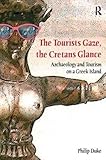
Philip Duke. The Tourists Gaze, the Cretans Glance: Archaeology and Tourism on a Greek Island. Heritage, Tourism, and Community Series. Walnut Creek: Left Coast Press, 2007. 154 pp. $65.00 (cloth), ISBN 978-1-59874-142-1; $29.95 (paper), ISBN 978-1-59874-143-8.
Reviewed by Quetzil Castaneda
Published on H-Travel (February, 2009)
Commissioned by Patrick R. Young (University of Massachusetts-Lowell)
Culture Critique of Archaeology in Contexts of Tourism
Having been engaged with the ethnographic study of tourism and of archaeology for more than two decades, I was very excited to have the opportunity to review this book. My excitement and interest only increased while reading the preface, introduction, and chapter 1. In these pages, the author, Philip Duke, sets his task as follows: “This book is about a past but it is firmly situated in the present. It provides a case study of the past/present nexus and its impact on a group of people, tourists, who briefly tour a specific colony of the past, the Minoan Bronze Age” (p. 14). Despite the vagueness of the phrase “past/present nexus,” this statement does focus on tourists as an object of study. The author’s objective, detailed in the remainder of the paragraph, is to show how “social inequality” is inherent in and expressed by the archaeological interpretation of Minoan civilization and the construction of Minoan sites for tourism.
As an ethnographer, I was misled by my own preconceptions that this would, therefore, be an ethnographic and historical study of the social contexts of archaeology with specific focus on some aspects of how tourism and archaeology intersect. By the time I was reading page 70 (out of 121 pages of text), I realized, however, that this was a different book than what I thought I was reading, and than what it, at times, proclaimed itself to be about. I will return to this issue following chapter summaries of the book.
In chapter 1, “Touring the Past,” Duke offers the reader a statement about the theoretical assumptions and focus of the book. The author begins with a series of questions on what and how tourists experience and understand archaeological sites. This leads to the most precise expression of what this book seeks to do, and does, in fact, accomplish: explore the substance and form of the archaeological knowledge that is presented to tourists about Minoan heritage sites. In this chapter, Duke clarifies his theoretical position on whether or not tourists and publics in general are passive recipients or active interpreters of the constructions of the past that archaeology offers tourism. His three assumptions are that the past is constructed by archaeology, that these constructions are forged out of and express a class elitism of archaeology/archaeologists, and that publics are not passive. He posits that it is archaeologists’ moral duty to allow a broader, and especially “lower” and non-middle-class, public to participate in the construction and interpretation of the past.
Chapter 2, “The Minoan Past,” is a synthetic synopsis of the current state of archaeological knowledge about Minoan Crete. For the nonspecialist, this is a very informative discussion, and it is also essential for Duke’s argument. His description is geared toward pointing out the class bias of this body of knowledge and in defining a few key archaeological debates.
The third chapter, “Tourists and the Constructed Past,” is a brief, eight-page, synthetic review of some theoretical issues in the anthropology of tourism. This chapter concisely summarizes the major positions of key anthropologists on the question of authenticity and commodification of the past (e.g., Dennison Nash, Edward Bruner, and Davydd Greenwood). The point of this chapter is to present the theoretical-conceptual grounds to argue first that the issue of identifying authenticity is not important; and second that the archaeological past as constructed for tourism is a real (or authentic, if you like) reality in the present regardless of archaeologists’ or others’ debates about the veracity and accuracy of the antiquity that is constructed for and presented to tourists.
The following chapter, “Modern Crete, Ancient Minoans, and the Tourist Experience,” complements the preceding chapter by offering a descriptive survey of tourism representation of Minoan civilization. After a brief, two-three page characterization of Cretans’ relationship to their past, Duke provides synthetic descriptions of archaeological sites like those at Knossos and Gournia, museum representations at Iraklion, and such touristic literature as site brochures as a way to “picture the Minoan past ... that is presented to the public” (p. 88). While the last part of the title of the chapter, “Tourist Experience,” promises to address “the specific encounter of tourists with a Minoan past,” neither tourists’ experiences nor tourists’ encounters have any presence in the content of this chapter (p. 67). There is neither description nor discussion of tourists’ experiences of and encounters with archaeological sites, museums, or tourism literature. The focus is entirely on what tourism represents of archaeological knowledge to tourists. Although the author does not hide the fact that this “picture” is based entirely on the subjective experience of one tourist’s (his) encounter with these materials, he also does not, in fact, explore his own experience and encounter. This weakness is particularly noteworthy given the author’s explicit plea that lower-class tourists should be able to participate in the construction of the meaning and interpretation of archaeological antiquities.
Chapter 5, “Constructing a Prehistory,” is an analysis of two different broadly construed periods or paradigmatic horizons of interpreting the Minoan past: the nineteenth to early twentieth centuries and the contemporary period starting in the era of Lewis Binford’s New Archaeology. Duke is specifically interested here in analyzing in broad strokes the political implications of the different historical modes and forms of knowledge that have been produced about the Minoans. The author considers the colonial/modern, processualist, postprocessualist, and Greek state archaeological constructions (i.e., knowledge production) of the Minoan past. This is, along with chapter 4, one of the two longest chapters forming the substantive body of the argument. However, this chapter only consists of a general discussion that does not make close, detailed analyses of any specific body of knowledge. It is broadly scoped commentary and synthesis filled with insights backed by an erudite knowledge of the field. It is less a rigorous analysis than a set of insights that would be useful as a launching point for sustained, in-depth studies using historical, ethnographic, and sociological methods. The central argument of this chapter is that there is a class-elitism in the production of knowledge of the Minoan past that extends across from the nineteenth into the twentieth century and even into the present.
Duke's final chapter, “The Nexus of the Past,” is less a chapter than a three-page epilogue with a thought-picture presented to synthesize and encapsulate the author’s arguments in this book. This image illustrates Duke’s concept of the “past/present nexus.” Unfortunately, this term had appeared only once previously (in the introduction) with an opaque meaning in the sentence quoted above that stated the objectives and purpose of this book. This second occurrence, at the very end, is where Duke defines and discusses the concept, albeit very briefly and in the illustration. This “chapter” does not attain the level of a conclusion and Duke's commentary would have been more effectively used in the introduction as a tool to conceptualize what he sought to accomplish in this study.
Halfway through this book, as mentioned above, I began to wonder why Duke was not doing what he seemed to have set out as his task. By the end of the book, I realized that this book is not a study “of tourism” in the sense of either a historical or an ethnographic investigation of tourism processes or tourism development; neither is it an ethnographic investigation of tourist experiences, consumption, or practices of the past. Further, despite the book’s title, it really does not provide an understanding of Cretan relationship to their past based on firsthand research. Duke effectively acknowledges as much when he asserts on more than one occasion that his book is based on his own subjective experience of visiting archaeological sites while living in Crete during a sabbatical. He indeed calls his book something of a “self-ethnography” rather an ethnographic study, with the only methodology described being one of “a very personal journey ... [based on] professional and personal observations ... published sources ... informal conversations ... [and] chatting over coffee” (pp. 18-19). While the ethnography is weak, Duke's profound insights, erudite understandings, and expansive scope of knowledge has allowed him to produce a “study” that is nonetheless well worth reading. It is written by an archaeologist primarily for archaeologists, telling them mainly that they need to be concerned with the social contexts of archaeology. Further, it is also a warning for archaeologists: to do good ethnography, one must have some training and a rigorous research design, even if or especially because the subject matter is so familiar. However, this study, to reiterate, is not ethnography. Instead, it should be viewed as a strong example of culture critique made from an internal position (i.e., as an archaeologist) to what it targets, archaeology.
The Tourists Gaze, the Cretans Glance should also be read by ethnographers, cultural studies scholars, and students of tourism. The weaknesses and the successes of this book offer many lessons from which we can learn and improve our work. This study needs to be read, and read closely, in multiple contexts of disciplinary interests to extract both intended and unintended significance. It is another important contribution for the continuing development of the ethnographic study of archaeology.
If there is additional discussion of this review, you may access it through the network, at: https://networks.h-net.org/h-travel.
Citation:
Quetzil Castaneda. Review of Duke, Philip, The Tourists Gaze, the Cretans Glance: Archaeology and Tourism on a Greek Island.
H-Travel, H-Net Reviews.
February, 2009.
URL: http://www.h-net.org/reviews/showrev.php?id=15725
 | This work is licensed under a Creative Commons Attribution-Noncommercial-No Derivative Works 3.0 United States License. |

