



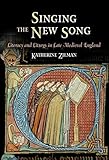
Katherine Zieman. Singing the New Song: Literacy and Liturgy in Late Medieval England. Philadelphia: University of Pennsylvania Press, 2008. xvii + 294 pp. $59.95 (cloth), ISBN 978-0-8122-4051-1.
Reviewed by Andrew Galloway
Published on H-Albion (October, 2008)
Commissioned by Margaret McGlynn (University of Western Ontario)
Medieval Literacy Studies in a New Key
Singing the New Song by Katherine Zieman is an important and original contribution to a range of fields that center both on literacy studies and on late medieval English vernacular literary criticism. Its argument is difficult to sum up in a single sentence without sounding far more abstract than its lucid, theoretically acute, and historically rich discussions themselves do, but that is because the book’s implications extend so far. Its six chapters pivot on the modes of “literacy” in a culture where liturgy--song, chant, and ritual setting--defined clerical identity, and where expanding numbers of non-beneficed clerics and nonclerical intellectuals used and engaged textual authority. William Langland and Geoffrey Chaucer found themselves carving out new poetic turf, since they were learned but not (apparently, in the case of Langland) clerically beneficed, and were able to use liturgy’s peculiar gaps between comprehension and mere formal evocation of authority and piety.
The study is also hard to sum up swiftly because the author is committed to reassessing from the ground up the history and the theoretical implications of the materials she treats, and she does so in an understated and careful way. Her own voice is a quiet but penetrating one. So, she turns from the politics and “cultural capital” (after Pierre Bourdieu) of who is using knowledge or song keyed as “clerical,” to theory of Althusserian “interpellation” in the definitions of identity fostered and reassigned by liturgy and other clerical texts, to specific criticism of Langland and Chaucer (and John Gower in a minor way), as those poets’ uses of liturgical texts exploit a general unsettling and remapping of the textual territory traditionally marked as clerical. This sounds highly theoretical, and it is, but the book manages to move from a level of historical research on clerical schooling that would have pleased A. F. Leach, to a fascinating and extremely up-to-date elucidation of the late medieval “politics of understanding,” which focuses on the uncontrollable power of the Mass and ofliturgy in a period when lay contractual control of prayers and Masses was proliferating. It even offers economic theory in the broadest sense: in the final chapters, Zieman finds a way to discuss liturgical song and its transformation into a kind of commodity in a complex gift-exchange system (the late medieval chantry system) in terms that illuminate the wry presentation of self-interested liturgy in Langland and the ideal of “intentionless song” in Chaucer.
Big as the conceptual steps involved are--and Bourdieu’s notions of “symbolic capital” are central to the whole framework, though their centrality is not flagged--Zieman takes pains to be precise and specific, and, as I have already suggested, to think things through herself rather than avert (as so often is the case in academic literary studies) to theoretical notions left wrapped in the words of their most famous modern expositors. As a result, many parts of this book, especially on the institutional contexts and uses of clerical literacy, can be read profitably by readers without any background in the ideas of Bourdieu or Louis Althusser, on the one hand, or any background in the history of the liturgy, on the other. The application to literature of the context of the medieval modes of liturgy and the decline of those modes that Zieman traces are wonderfully pellucid, though intricate. Mainly because of that intricacy, the study is addressed to a community of academic specialists and graduate students in late medieval literary study, who will be readier to follow a sometimes rapid sequence of claims that build complexly on ideas of “symbolic capital” in order to trace the workings of the idea of “literacy” as that shifts through a highly complex range of modes and political, institutional, and literary implications.
That kind of complexity is, in fact, something we have needed. Like most current studies of late medieval English literary history, this is a study of the late medieval transition of knowledge marked as “clerical” into knowledge marked in less fixed terms; unlike most such studies, though, it also displays the hardening of clerical claims to “own” particular kinds of liturgical expression. It documents what might be called (with apologies to Anne Hudson) the “premature counter-Reformation,” as the late medieval clergy, already threatened before the Reformation proper by their own increasingly mobile uses of Masses and the liturgy as much as by lay inroads into sacred texts and textuality itself, circled their wagons around particular realms of bookish “clergy.” It is thus dialectical rather than teleological; it marks contradictions, not just “progress” toward modern notions of secular life, and modern notions of literacy.
Its critique of the last notion is trenchant, and perhaps the study’s most profound contribution. Studies of medieval literacy have opened new understandings of “mode” before--the work of Brian Stock on how aurality remains, yet is shifted, in medieval textual understanding was an early and major guide; a rich range of more recent contributions, including some by Zieman anticipating a number of the points made in this study, appear in the useful 2003 collection of essays edited by Sarah Rees Jones, Learning and Literacy in Medieval England and Abroad. But Zieman presents the most important new definition of a mode of medieval literacy to appear in decades, and she does so as a means to arrive at a kind of “voice” of late medieval literature that is alien and fascinating. Using as background a large and rich range of knowledge about late medieval liturgy and its changing institutional contexts, Zieman insists on challenging very acutely the modern idea of voice (including textually defined voice) as “personal expression,” or at least as something the speaker understands and pays attention to as he or she utters or writes it. Even speech-act theory in the modern world--even deconstruction--assumes that the agent is committed to the meaning of the utterance in some fairly precise (if not fully controllable) way. Using medieval liturgy allows Zieman to focus on a more collectively and traditionally authorized understanding of voicing, which can tolerate without irony quite a significant “gap” between the form used and the “attention” or understanding of the user.
In the last chapters, Zieman applies this idea of a “gap” in personal understanding, and the accompanying claim to the social collectivity of the song itself, to literary works--Langland’s Piers Plowman and Chaucer’s Prioress’s Tale. This set of finely careful readings of how the “choral ideal” falls apart in these works also allows Zieman to show how the mode of communal “voicing” and thus identity was becoming impossible to sustain except as a nostalgic ideal. In these chapters, the book offers subtle aesthetic claims. Langland emerges as the more cynical, one might say dissonant, voice; he shows efforts to proclaim communal, Christian identity collapsing under the force of self-interest, because of personal efforts to insert particular kinds of individual understandings and vicarious authority into religious texts (which are all understood to be a kind of “song” in this study’s interesting perspective). Chaucer, who is more directly ironic about personal appropriations of and agency over scripture, is viewed as more haunted by the trace of the ideal. His evocations of Latin liturgy (and, it seems, any religious Latinity) not only show the failure of the ideal in the lived world--and of Chaucer’s own constant self-conscious manipulation of tradition and authority--but also show a poignant residue of desire for “sanctification” of language and poetry.
Zieman clearly mentions, but does not dwell much on, the violence against the Jews that such longing for sanctification and the “choral ideal” seems to involve for Chaucer especially (Langland too, though that goes unnoticed). The book began by discussing the anti-Judaicism in the very premise of a “new song” (by which the New Testament replaced the “old song” of the Hebrew Bible), but does not emphasize the violence of that basic issue. The study moves from ideology into aesthetics and abstract form, and this leaves the poetry in a thinner atmosphere than the contexts where the book began. This progression sympathetically evokes, though, the career of the elusive ideal of a communal Christian identity that the study has pursued throughout.
The book thus opens up literacy studiesin two new directions. One focuses on how a range of ideas of “literacy” function in the late medieval economy of symbolic capital; some of Zieman’s most remarkable claims on that topic appear in her chapter on “Extragrammatical Literacies.” The other new direction is her strong demonstration of the medieval tolerance for a “gap” between understanding and voicing, and the use of that gap to investigate both the communal, nonpersonal identity of Christian culture and its decay into ironic subversions and nostalgia in some of the period’s most satiric poets. This is a finely wrought and very suggestive book, which redefines the nature and uses of medieval literacy and literary “voicing” together, in a field whose complexity Zieman both patiently unfolds and uses to challenge deep-seated assumptions about “text” and “song,” and literacy itself.
If there is additional discussion of this review, you may access it through the network, at: https://networks.h-net.org/h-albion.
Citation:
Andrew Galloway. Review of Zieman, Katherine, Singing the New Song: Literacy and Liturgy in Late Medieval England.
H-Albion, H-Net Reviews.
October, 2008.
URL: http://www.h-net.org/reviews/showrev.php?id=15699
 | This work is licensed under a Creative Commons Attribution-Noncommercial-No Derivative Works 3.0 United States License. |

