



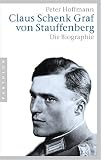
Peter Hoffmanm. Claus Schenk Graf von Stauffenberg: Die Biographie. Revised and expanded edition of _Claus Schenk Graf von Stauffenberg und seine Brüder_. Munich: Pantheon, 2007. vii + 708 pp. EUR 14.95 (paper), ISBN 978-3-570-55046-5.
Reviewed by Patricia Kollander (Department of History, Florida Atlantic University)
Published on H-German (April, 2009)
Commissioned by Susan R. Boettcher
Heroism Reconfirmed
Peter Hoffmann is the author of several acclaimed books on the subject of resistance against Adolf Hitler, and is without doubt the foremost expert on the subject. His particular area of expertise is the abortive assassination attempt of Hitler in July 1944, spearheaded by Claus von Stauffenberg and other esteemed members of the German army. This volume is the revised, expanded edition of Claus Schenk Graf von Stauffenberg und seine Brüder (1992). Hoffmann begins by placing his revised and updated work within the context of recent historiographical developments. He is uncomfortable with historians who have moved away from the tradition of narrative history, especially those who, he believes, have the tendency lump every member of the Wehrmacht into the ranks of the perpetrators of the crimes of the Nazi era. His mission, therefore, is not only to update his biography by including materials that recently came to light from the archives of the former Soviet Union, but to also validate the tradition of narrative history as a reliable means of reconstructing the past. As he puts it, the job of the historian and the reader is to reconstruct and represent the past with as much objectivity as possible. Past thoughts and actions need to be examined without prejudice and understood in their proper historical context.
The net result of Hoffmann's efforts is a clearly written, superbly researched biography. Hoffmann uses lengthy passages from letters written by and to Stauffenberg from childhood to adulthood to provide long-range insight into the motives that made him at first condone but ultimately oppose Hitler. Some might argue that Hoffmann might have edited his primary sources for the sake of producing a more concise portrait, but on the other hand, length may be necessary in order that the reader might be able to tease out the motives for Stauffenberg's actions. While some might be apt to overlook Stauffenberg's boyhood writings as insignificant, for Hoffmann, they are pregnant with meaning. One of his favorite poems as a young boy was Heinrich Heine's Belsazar (1827), the story of the king of Babylon who slandered God and robbed his temple. Interestingly, Hoffmann points out that the passage of the poem that young Claus recited most passionately was the one referring to the murder of the corrupt Belsazar by his own henchmen. In retrospect, the incident seems almost prophetic. Then there is Stauffenberg's essay, written at the age of fifteen, on the subject of what he wished to be when he grew up, in which he wrote that he wished, in essence, to dedicate his life to the welfare of his country. Hoffmann also devotes a lot of space to Stauffenberg's association with the poet Stefan George (1868-1933), because many of the values that George espoused in his poetry, such as self-sacrifice, heroism, and power, were emulated by Stauffenberg later on. The young Stauffenberg was a well-liked young man who was devoted to his country. He also appeared to lack the antisemitism that would drive Germany to its sinister fate during World War II; he included many Jews in his circle of acquaintances, and none them ever remembered hearing a antisemitic utterance from him. Stauffenberg and his friends did not join the Nazi Party, and tried to distance themselves from the Nazis during the 1930s.
But Hoffmann also makes it clear that Stauffenberg was no saint. Although he did not join the party, he agreed with many elements of its program, including the destruction of the Versailles treaty, and ideas of racial purity. He also wished to see Germany secure additional territory as a consequence of the war and was a noted member of the Wehrmacht as well as a decorated war hero. But Stauffenberg did go against Hitler, and the timing of this decision is important. A majority of those who participated in the July 1944 plot to kill Hitler joined in only after it became clear that Germany would lose the war in the wake of the Stalingrad debacle in 1943, and did so to secure better peace terms from the Allies, not necessarily to put a stop to the murder of Jews in concentration camps. Hoffmann, however, clearly shows that Stauffenberg turned against Hitler in 1942, when he became aware of the crimes committed by the regime, including the mass murder of Jews, Poles, Russians, and prisoners of war, and the general mistreatment of the Soviet people. Hoffmann refers to 1942 as the year of Stauffenberg's "radicale Wende"--as he henceforth made it increasingly known that he regarded Hitler as a "lunatic and criminal" who needed to be removed from power (p. 263). But translating these sentiments to concrete action was not easy; those who shared his feelings were not in his circle of friends, and did not possess the kind of power necessary to pull off a coup d'état.
So, he continued to serve as commander of the 6th Panzer Division in Africa, and was severely injured when he and his entourage were strafed by British planes in early 1943. As he recovered from his devastating injuries (he lost his right arm, left eye, and two fingers on his left hand), the wave of opposition to Hitler increased in the wake of the German defeat in Stalingrad and the brutal suppression of the Weiße Rose group. Under these conditions, the idea of overthrowing Hitler became more acceptable, and the conspiracy began to take concrete shape. The plot was incredibly intricate and risky; those who were in on it knew that they were operating against incredible odds, and that failure, rather than success, would be its most likely outcome. But Stauffenberg remained convinced of its ultimate necessity; the disposal of Hitler would be the first step in the construction of the new Germany.
Hoffman's exhaustive examination of primary sources shows that Stauffenberg's willingness to do right by his country remained consistent throughout his life. And, although some might argue that he came to the resistance movement too late, Hoffmann's work demonstrates that Stauffenberg came into it earlier than the others, and for all of the right reasons, and that the quality of the resistance he rendered in the name of a better Germany should be seen as beyond reproach.
Hoffman does come close to overstating the importance of the timing of Stauffenberg's decision to get rid of Hitler, and he includes some pieces of information from primary sources that seem rather extraneous to the story line (breakfast menus, for example) and might better have been omitted. In the end, however, these are very minor points that do not really detract from the overall power of the narrative. Hoffmann has once again shown that he is the very best authority on the German resistance in general and the July 1944 plot in particular.
If there is additional discussion of this review, you may access it through the network, at: https://networks.h-net.org/h-german.
Citation:
Patricia Kollander. Review of Hoffmanm, Peter, Claus Schenk Graf von Stauffenberg: Die Biographie.
H-German, H-Net Reviews.
April, 2009.
URL: http://www.h-net.org/reviews/showrev.php?id=15665
 | This work is licensed under a Creative Commons Attribution-Noncommercial-No Derivative Works 3.0 United States License. |

