



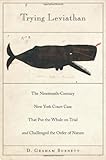
D. Graham Burnett. Trying Leviathan: The Nineteenth-Century New York Court Case That Put the Whale on Trial and Challenged the Order of Nature. Princeton: Princeton University Press, 2007. xiv + 266 pp.p Plates. $29.95 (cloth), ISBN 978-0-691-12950-1.
Reviewed by Diarmid Finnegan
Published on H-HistGeog (September, 2008)
Commissioned by Robert J. Mayhew (University of Bristol)
Of Whales and Men
It is probably true to say that the history of taxonomy has not been widely regarded as a subject full of interest and intrigue. Historians of science have of late challenged rather effectively this prejudice, discovering among the annals of taxonomic endeavor abundant material for narrating a past stranger than the one normally recognized. Among the services rendered by historians willing to tackle a subject matter often stigmatized as tedious if necessary has been a better understanding of the intensely agonistic character of debates about nature and naming before Charles Darwin. The suggestion, still circulated, that Darwin shattered a long and strongly held consensus about the order of nature and, by extension, society is now much harder to sustain. At the very least, in the decades leading up to Darwin’s Origin of Species, passionate commitment to the idea of a discernable order in nature is now better understood against a backdrop of heated debate about how to discover, name, and deploy nature’s perceived regularities.
In Trying Leviathan, D. Graham Burnett provides an account that enlivens further this already energetic historiography. The empirical meat of the book involves a detailed and well-organized reconstruction of the trial of James Maurice (inspector of "fish oils") versus Samuel Judd (chandler), which was brought before the New York Court of Common Pleas in October 1818. The trial was occasioned by Judd’s refusal to pay a fine of seventy-five dollars for purchasing three casks of spermaceti not "gauged, inspected and branded" by Maurice (p. 1). It soon became clear that the dispute was not about whether this transaction had occurred (Judd never denied buying the oil). Instead, the trial revolved around whether spermaceti (and other whale oil) was properly designated "fish oil." The trial became a public sensation reported in newspapers across the (still expanding) United States and involved hours of testimony from witnesses with a stake in classifying whales.
By following taxonomic debate into an early nineteenth-century New York courtroom, Burnett shifts attention from ostensibly more scientific settings to a context in which controversies over classificatory schemes of all sorts was standard fare. The politics and practices of splitting and lumping living nature that have been brought into vivid view elsewhere are here cross-examined by those with a well cultivated disrespect for the taxonomic assertions of self-professed naturalists. The political authority of New York’s ambitious men of science was only one of the interests at stake in the trial and it emerged from the mix rather worse for wear. New Yorkers well versed in Swiftian satire were not slow to disabuse naturalists of any authority to speak on matters beyond their (hyper-) specialist purview.
In parsing his account of the trial, Burnett takes his cue from the lead prosecutor, the sassy Irish lawyer William Sampson, who divided the interested parties into fishermen, artisans, men of science, and a "larger class" of ordinary New Yorkers (p. 1). This allows Burnett to expand into worlds beyond the courtroom, thus providing a number of scholarly excursuses valuable in their own right. For example, Burnett surveys the highly profitable tanning industry--represented in the trial by the redoubtable Gideon Lee--to better understand the powerful influence of New York’s rising tanner-financiers. Also included is a lengthy account of the "practical cetology" of whale men, which adds to the growing literature on natural historical knowledge known and used beyond the confines of self-designated naturalists. In the face of such detailed investigation, Sampson’s rudimentary taxonomy breaks down, and we discover instead a more complicated and competing set of interests behind disputes about the answer to the trial’s pivotal question (is a whale a fish?). Among the artisans, oil merchants and chandlers were pitted against tanners. Whale men, for all their underappreciated applied knowledge of whales, could not reach a settled conclusion. Men of science, represented by the physician-naturalist Samuel Latham Mitchill, were ridiculed for presenting contradictory views of taxonomy. Depending on audience, taxonomy was painted by Mitchill as an authoritative account of organic nature or as a vital and dynamic enterprise constantly revising received knowledge of the living world. It was a good grasp of the latter view that provided Sampson with ample material to unhinge Mitchill’s confident assertions about the mammalian character of whales.
Burnett’s scrutiny of the trial allows him to reflect in novel ways on a number of wider issues relevant to the history of taxonomy and of science more generally. As Burnett demonstrates, tensions between the demotic and the esoteric character of scientific inquiry took on a particular form in the New York courtroom. Perhaps more notable than the decision of the jurors to favor the plaintiff was the fact that Mitchill’s taxonomic arguments were also side-lined, even ridiculed, by the defense. After the testimonies of oil merchants, Judd no longer required the help of a seemingly inscrutable scientific nomenclature. At the trial’s end, scientific authority ended up looking decidedly despotic despite Mitchill’s attempt to present science as a quintessentially democratic enterprise. In this way, Burnett illustrates in lavish detail the fragile and fraught character of deploying scientific findings in courts of law.
The New York trial also enables Burnett to comment on the use made of biblical exegesis, a matter of some importance right through the course of the trial. He directs attention, for example, to the persistence in popular consciousness--reflected in trial testimonies--of the "Genesical triangle" of flying, creeping, and swimming animals, something obviously challenged by Mitchill’s Cuvierian science. But, as with other trials in which science and Christian scripture became entangled (Galileo obviously springs to mind), the issue was not whether the biblical text was to be rejected tout court but rather which understanding of its character and scope was to be deemed authoritative. Mitchill offered his own interpretation of Genesis arguing that the text suggested whales were brought forth in a separate creative episode. Needless to say, this exegesis was regarded as a betrayal of the text’s plain sense by the plaintiff’s lawyers who continued to uphold the simple tripartite scheme of beasts, birds, and fishes. An interesting twist to this exegetical tale was the use made by the plaintiff’s side of the argument that living nature in its staggering diversity dissolved the classificatory schemes of Carl Linnaeus, Etienne Geoffroy, and Georges Cuvier and supported instead the commonsensical taxonomy of Genesis 1.
In closing, it is worth noting that Burnett’s account also points to the profoundly geographical character of the trial and its consequences. The two maps showing the proximity of the New York Institution (a conglomeration of the city’s learned and scientific bodies) and the city hall is not incidental to Burnett’s narrative. Instead, "locating Maurice v. Judd in the local geography of New York City permits us to see the ways that the trial was both embedded in, and helped shape, wider debates about science and society in Manhattan" (p. 208). The elitist vision of Mitchill and other "gentlemen of taste and learning" was one in which scientific and civic authority were proximate and interdependent (p. 21). This vision was damaged by the trial’s verdict in which New York’s citizens "distanced the Mayor’s Court from the New-York Institution, and fended off what had come to be seen as the encroachment of the philosophers camped at the gates of the City Hall" (p. 206). As well as altering the political geography of New York, the trial also hinged on what Burnett calls a "human biogeography of the early republic" (p. 167). In the end, it was not physician-naturalists, such as Mitchill, who got to decide whether or not a whale was a fish but rather mercantile types operating within the "taxonomy of the market" (p. 190). The success of this powerful group allows Burnett to challenge the proposition that natural history provided a language and set of practices useful for producing national unity of purpose. In the trial and, by extension, in wider efforts of nation building, natural historical knowledge could function as a divisive rather than unifying force. This conclusion, like much else found among Burnett’s stimulating commentary, is a welcome antidote to the airy rhetoric, common in the nineteenth century, that lumped natural history with equally amorphous social and political interests.
If there is additional discussion of this review, you may access it through the network, at: https://networks.h-net.org/h-histgeog.
Citation:
Diarmid Finnegan. Review of Burnett, D. Graham, Trying Leviathan: The Nineteenth-Century New York Court Case That Put the Whale on Trial and Challenged the Order of Nature.
H-HistGeog, H-Net Reviews.
September, 2008.
URL: http://www.h-net.org/reviews/showrev.php?id=15616
 | This work is licensed under a Creative Commons Attribution-Noncommercial-No Derivative Works 3.0 United States License. |

