



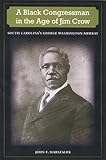
John F. Marszalek. A Black Congressman in the Age of Jim Crow: South Carolina's George Washington Murray. Gainesville: University Press of Florida, 2008. xix + 211 pp. $29.95 (paper), ISBN 978-0-8130-3340-2.
Reviewed by Bart Dredge
Published on H-SC (September, 2008)
Commissioned by Phillip Stone (Wofford College)
The Republican "Black Eagle" from South Carolina
In 1992, South Carolina Rep. Jim Clyburn celebrated his election to Congress by noting that he was continuing the legacy of his great-great-uncle, George Washington Murray. While it is unclear whether Murray was a documented ancestor, Clyburn was certainly pointing to a political legacy handed down from the state’s only black, and only Republican, congressman during the late 1890s when the Democratic Party dominated state politics and routinely excluded blacks from political office. John F. Marszalek has written an excellent political biography of Murray that describes the fascinating arc of his life while also illuminating the complex nature of post-Reconstruction politics in the South.
Murray was born a slave on September 22, 1853, in Sumter County, South Carolina, and, while still a slave, he learned to read and write. Following the Civil War, Murray began to farm a nearly fifty-acre plot while still in his teens, and later served as a delegate to the state Republican Party convention. At one meeting of close to two thousand black listeners, his speaking skills earned him the reputation of the state's “Republican black eagle,” and he often spoke passionately of race pride at a time when such thoughts were not only uncommon but also dangerous. Consistent with his ambitions, Murray attended the University of South Carolina, which had been integrated after the Civil War, but was unable to finish after he and other black students were expelled during the so-called redemption in 1876-77.
Returning to political power near the end of Reconstruction, white Democrats were in the process of disenfranchising black voters and legislating the permanent segregation of the races. In 1882, the party gerrymandered congressional districts throughout South Carolina to ensure massive victories in six areas, while at the same time sacrificing the Seventh Congressional District because of its heavy concentration of African American residents. It was here that Murray began his political career, having been chosen to serve as a delegate to the Republican state convention in 1880, and it was from here that Murray ran successfully for Congress in 1892. While a victory for Murray and others in the area, the Democratic Party broke up the Seventh Congressional District, and nearly eighty years would pass before another Republican would win an election there.
While in Congress, Murray focused much of his energy on promoting economic self-sufficiency among African Americans in South Carolina, and his moderate stand on education for blacks led to a personal invitation to speak at the Tuskegee Institute. Still, while Murray’s political philosophy could often appear restrained, he also understood the legacy of slavery to be an uncompromising racism on the part of whites. He believed that African Americans had to overcome the mental and spiritual effects of slavery, and, as part of that effort, he encouraged them to buy land and become landowners--as well as legally qualified voters. He also demonstrated his political and personal courage by filing lawsuits and petitions, and organizing a “protection society” to stop the on-going disenfranchisement of black voters in the state.
Early in the twentieth century, Murray was defeated by a combination of corrupt post-Reconstruction politics and white supremacy. In 1904, he was charged with forging a duplicate lease on land he sold to black residents of his district--an example of what Marszalek calls “legal whitecapping,” the elimination of a troublesome black from the political arena (p. 143). Despite having gained nothing from the allegedly forged document, Murray was nevertheless convicted of the crime and sentenced to three years of hard labor on a chain gang. He appealed the conviction and was subsequently charged with perjury, an additional charge that led him to turn over his property to his attorney and flee to Chicago. Never extradited because of a fear among South Carolina whites that he would appear to be a martyr to other African Americans, Murray spent the rest of his life speaking and writing on race and political issues. He published his views and visited thirty states in ten years, advocating greater education and economic independence as a means to develop black spiritual freedom and autonomy. Later, suffering from cancer, Murray died penniless and in relative obscurity on April 21, 1926.
Marszalek describes a dedicated, ambitious, and hardworking two-term U.S. congressman whose approach to political activism in favor of social and economic integration is reminiscent of W. E. B. DuBois. This biography opens a fascinating window into black political life in the context of the Jim Crow South, and will be of interest to specialists in the political history of the region, and South Carolina especially, while students of African American history will be rewarded as well. As Marszalek notes, Murray had the wrong skin color and belonged to the wrong political party to enjoy lasting political success in South Carolina, and because of the complex heritage of racism in that state, he remained the South’s last black congressman for decades.
If there is additional discussion of this review, you may access it through the network, at: https://networks.h-net.org/h-sc.
Citation:
Bart Dredge. Review of Marszalek, John F., A Black Congressman in the Age of Jim Crow: South Carolina's George Washington Murray.
H-SC, H-Net Reviews.
September, 2008.
URL: http://www.h-net.org/reviews/showrev.php?id=15610
 | This work is licensed under a Creative Commons Attribution-Noncommercial-No Derivative Works 3.0 United States License. |

