



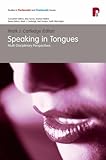
Mark J. Cartledge. Speaking in Tongues: Multi-Disciplinary Perspectives. Paternoster Press, 2006. xxiv + 238 pp. $24.99 (paper), ISBN 978-1-84227-377-7.
Reviewed by Shane Clifton
Published on H-Pentecostalism (September, 2008)
Commissioned by Gene Mills (Florida State University)
Reflections on the Spiritual Significance of Tongues Speech
_Speaking in Tongues_ is an anthology addressing the history, nature and function of glossolalia from a multi-disciplinary perspective. While it is often the case that anthologies are somewhat of a mixed bag, this particular work is a pleasure from beginning to end. In the first place, it benefits from a consistent and obvious theme, which provides the book with a sense of unity and coherence that is sustained together with the rich diversity that comes from a multi-author and multi-disciplinary text. In the second place, Mark Cartledge has gathered together the highest caliber of scholars, with every contributor being a well-known expert in their field: Max Turner (New Testament), Frank Macchia (Theology), Neil Hudson (History), James Smith (Philosophy), David Hilborn (Linguistics), Margaret Poloma (Sociology), and William Kay (Psychology). In all cases, each scholar brings to the topic of reflection disciplinary knowledge and rigor, along with a certain sympathy to the object of study (glossolalia). This is not to say that all contributors are Pentecostal, or that any are taking a defensive posture. Rather, it is to note that all of the authors treat the topic with respect so that, even when challenging traditional Pentecostal and Charismatic (P/C) horizons, they do so for the purpose of enhancing understanding and encouraging authentic spirituality.
Turner’s essay, which opens the book and is worth the purchase price on its own, provides a thorough analysis of the data of both Luke and Paul, ultimately describing tongues as “a distinctive sign of God’s eschatological presence” (p. 32) that stands as gift for private prayer and, when interpreted in public, a “sign of cruciform weakness” (p. 33). Turner’s analysis, along with all the articles in the book, invites P/C communities to get beyond the sometimes narrow, outdated, and, as Turner asserts, unconvincing discussions of initial evidence that have too often constrained reflection on this topic (pp. 9-10). Indeed, one can imagine the contribution that could be made to the church as a whole if P/Cs took hold of Macchia’s assertion that tongues, as the fulfillment (not reversal) of Babel, was intended as an event to bless the nations, and as a sign of Spirit empowered unity in diversity that should function ecumenically.
It is impossible, in reviewing an anthology, to do justice to the insight of all the contributors, or to summarize their diverse insights. What we can do is note that readers will be enriched by the multi-disciplinary perspectives, since it is almost certain that, at some point in the book, they will be reading about a familiar topic (tongues) from an unfamiliar perspective. Of course, if the text is taken up by non-P/C readers (which I hope it is), then it will be full of surprise from cover to cover. To illustrate the point, James Smith provides an analysis of tongues using the insight of philosophical hermeneutics and speech act theory. Notwithstanding the fact that the propositional content of tongues cannot be understood, Smith argues that glossolalia functions to communicate meaning and is, for this reason, a form of language with interpretative and symbolic significance. That is to say, from the perspective of the person praying (illocution), tongues speech communicates, not propositional content, but a depth of desire and a humility before God. Likewise, from the perspective of the person who is prayed for (perlocution), hearers of tongues are encouraged to be open to the Spirit and believe in the power of God. Smith goes on to argue that tongues, more broadly, functions as a language of resistance, particularly against the oppressive structures of capitalism. While his case against capitalism and his presumption that tongues speech is the language of the poor is overstated (indeed, economic theory needs more nuanced critique and, similarly, Pentecostalism is not just the religion of the lower classes), it is surely the case that tongues functions as a language of resistance against the limits of human reason and oppressive ideologies of every variety.
From biblical studies, to theology, history, philosophy, linguistics, sociology, and psychology, _Speaking in Tongues_ is full of the sorts of diverse insight described above. My only critique, and it is a minor one, is that the text, while multi-disciplinary, is not really inter-disciplinary. It is my opinion that Christians, unlike the divided secular academy, have the capacity to engage in groundbreaking interdisciplinary work, precisely because they share a common experience of grace and a unifying vision of the triune God that facilitates unity in diversity. This book takes the reader someway toward that goal, but the authors themselves do not engage in substantial interdisciplinary conversation, with the arguments of each contributor remaining essentially self-contained. Having said this, the final essay, written by the editor, does advance an inter-disciplinary approach. Taking the case study of the New Wine family camp meetings in England, Cartledge proceeds to show how the argument of each of the contributors helps to frame an understanding of what is going on in that community’s practice of tongues speech. Apart from the value of his essay as a model for further inter-disciplinary work, his conclusion reminds us of the need for Pentecostals themselves to match their practice with a more explicit theology, one in which the movement’s leaders seek “to work out together what their theology of glossolalia actually is” (p. 232). Such reflection would not only clarify and guide Pentecostal practice, as well as contribute to ecumenical discussion of Christian spirituality in the broader church, but it would also serve to remind P/C communities of the ideological challenge implicit in tongues speech.
Finally, while it might seem inconsequential to mention the cover of a book, I simply have to note my surprise, upon finding this manuscript on my desk, to see it adorned with the face of a young women with lusciously painted lips. I was, of course, encouraged to read the text, and was certainly not disappointed, even if my enjoyment took a different turn to that suggested by the cover! _Speaking in Tongues_ is the first book in a new series of Studies in Pentecostal and Charismatic Issues to be published by Paternoster, and if the quality of this text is an indication of what is to come then we have a lot to look forward to.
If there is additional discussion of this review, you may access it through the network, at: https://networks.h-net.org/h-pentecostalism.
Citation:
Shane Clifton. Review of Cartledge, Mark J., Speaking in Tongues: Multi-Disciplinary Perspectives.
H-Pentecostalism, H-Net Reviews.
September, 2008.
URL: http://www.h-net.org/reviews/showrev.php?id=15589
 | This work is licensed under a Creative Commons Attribution-Noncommercial-No Derivative Works 3.0 United States License. |

