



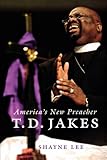
Shayne Lee. T. D. Jakes: America's New Preacher. New York: New York University Press, 2007. 214 pp. $19.00 (paper), ISBN 978-0-8147-5224-1.
Reviewed by Kathleen Hladky
Published on H-Pentecostalism (September, 2008)
Commissioned by Gene Mills (Florida State University)
A New Black Church?
The spread of prosperity-centered charismatic Christianity is only beginning to receive scholarly attention, and Shayne Lee’s book T. D. Jakes helps to open up this interesting field of inquiry. Centering his text on the life, personality, and ministry of megachurch pastor T. D. Jakes, Lee combines data collected from Jakes’s writings, as well interviews with his colleagues and friends to construct the first scholarly biography of this preacher sometimes touted as the next Billy Graham.
Lee’s accounting of Jakes’s life offers readers interesting and mundane details expected in a biography. We learn about Jakes’s childhood temperament, his inclination for hiking, his marriage, and several of his early relationships. However, Lee is also careful to draw connections between Jakes's early life experiences--for example, his enrollment in a college psychology class--and later developments in his religious message. After aligning with Trinity Broadcasting Network, Jakes quickly developed a ministry directed at women that emphasizes self-esteem, the proper deployment of gender, weight loss, and therapeutic relationships with the divine. Lee does an admirable job of illustrating the tense relationship Jakes has with feminism and women’s empowerment in the chapter “Women Art Thou Really Loosed?”
Through the narrative of Jakes’s life, scholars will take away an appreciation for the complicated nature of contemporary Pentecostal and charismatic Christian identity. Though Lee characterizes Jakes as a Neo-Pentecostal, he could also easily be described as a practitioner of Word of Faith, or, if we take him at his own word, a plain and simple Christian. Indeed, some of Jakes’s critics would deny that he should be considered Christian at all. These kinds of divisions within Pentecostal and charismatic Christianities not only draw into question how we are to evaluate the formation of new denominations (and whether that is still a useful category), but also challenges scholars to think about how we are to deal with insider contestation over who can be contained within the boundaries of these identities.
Using the biographical format, Lee uses his narrative of Jakes's life and ministry as a microcosm for larger developments in American, and especially African American, religions. Calling Jakes a “signpost for postdenominational Protestant America,” Lee argues that Jakes has many followers and critics because he personifies American ideals and possesses postmodern features that resonate with a diversity of psychosocial needs and cultural tastes (p. 6). Lee identifies such American ideals as capitalism, individualism, empowerment, media, and the combination of the secular and religious in Jakes’s ministry, and he argues that Neo-Pentecostal ideas of prosperity, individual empowerment through God, and the movement’s media savvy accommodate changing religious demands. Indeed, Lee cleverly parallels the trajectory of Jakes's life from poverty to wealth with the gradual shift from asceticism to prosperity in Pentecostal Christianity. More than a biography, the life and ministry of Jakes offers scholars insight into the way that religion is practiced in America.
Readers may find the treatment of the term "postmodernism" in this text odd as Lee never offers a succinct account of his own understanding of the concept. At various times in the text, Lee defines postmodernism as commercialized spirituality, self-empowering, pluralistic, high-tech, multidimensional, “pop culture with therapeutic spirituality,” and “preaching with pizzazz" (p. xviii). His use of the term, therefore, seems to have little relationship with academic concepts of postmodernism, and Lee spends no time explaining how his use of the term relates to the abundant literature that has carefully explored postmodernism. Indeed, Jakes’s religious orientation seems decidedly anti-postmodern in its essentialist treatment of gender and rejection of moral relativity. Lee’s lack of clarity in his use of postmodernism would not be nearly as problematic if it were less central to his arguments. However, his repeated insistence on postmodernism as a critical element of Jakes’s success and appeal necessitates that Lee be far more precise.
Throughout his conclusions, Lee revisits the long standing category of “the black church” as an important unifying institution in African American communities. Lee takes on a discussion of Jakes’s ministry as a manifestation of a “new black church” in which the integration of media, the collapsing of the sacred and secular, and the emphasis on American individualism have shifted the religious emphases that typically defined the traditional black church. To this end, Lee describes a sort of institutional stand off between the traditional black church, represented by such denominations as the National Baptist Convention and the African Methodist Episcopal Church, and the “new black church” represented by Neo-Pentecostals like Jakes. Putting aside problems with the category of the black church recently illuminated in Curtis Evans’s publication, The Burden of Black Religion (2008), Lee’s assertion that ministries like the Potter’s House are manifestations of the black church are problematic for two reasons. First, the idea that contemporary prosperity churches represent a break from a traditional model of the black church ignores the historical diversity of black churches and the legacy of prosperity teachings (like those of Father Divine) by envisioning a new religious order. Second, Lee's assertion that ministries like the Potter's House are part of a “new black church” is complicated by the fact that many Neo-Pentecostal (and Word of Faith) churches are highly interracial and emphasize the importance of integrated communities of worship. To confine these religious movements to the category of the black church, or the new black church, misrepresents the data and the identity of these believers.
By crafting a work that pays attention to an African American megachurch, the Potter's House, Lee implicitly critiques the substantial scholarship on the white megachurch phenomenon that has ignored megachurches dominated by people of color. This absence is even more problematic because black megachurches, like Olivet Baptist Church in Chicago and First African in Richmond, Virginia, existed before the rise of the white megachurch phenomenon. Evenhanded and critical, Lee takes Jakes seriously as both a preacher and businessman.
If there is additional discussion of this review, you may access it through the network, at: https://networks.h-net.org/h-pentecostalism.
Citation:
Kathleen Hladky. Review of Lee, Shayne, T. D. Jakes: America's New Preacher.
H-Pentecostalism, H-Net Reviews.
September, 2008.
URL: http://www.h-net.org/reviews/showrev.php?id=15588
 | This work is licensed under a Creative Commons Attribution-Noncommercial-No Derivative Works 3.0 United States License. |

