



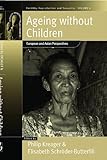
Philip Kreager, Elisabeth Schroeder-Butterfill, eds. Ageing without Children: European and Asian Perspectives on Elderly Access to Support Networks. New York: Berghahn Books, 2004. 256 pp. $60.00 (cloth), ISBN 978-1-57181-614-6.
Reviewed by Hoi-eun Kim (Department of History, Texas A & M University)
Published on H-German (February, 2009)
Commissioned by Susan R. Boettcher
De-marginalizing the Childless Elderly
In recent years, a sinister joke reflecting the potentially catastrophic social ramifications of super-low fertility rates has been widely propagated in Korea. It goes like this: what is the second most miserable thing one can be in Korea? An old chap without money. What is the most miserable thing, then? A sick old chap without money or children. In a society where elderly care has traditionally been relegated to succeeding generations without any adequate social safety net, the rapid crumbling of the ideology of filial piety combined with a plummeting fertility rate is certainly frightening enough to generate a not-so-funny joke. But is this phenomenon--ageing without children--a unique situation in contemporary South Korea? Not at all, claim the nine anthropologists, sociologists, and historians who contributed to this edited volume. The childless elderly as a social phenomenon have appeared synchronously in Europe and in the United States, and more significantly, both in the East and the West. "Current levels of childlessness," argues Philip Kreager, one of the co-editors of the volume, "are not a new, post-transitional phenomenon but the continuation of long-term customs of postponed reproduction" (p. 23).
One of the central purposes of the book is to save elderly people without children from the dungeon of scholarly and public indifference by demonstrating the universality of the phenomenon in the past and present. The authors achieve this goal by radically expanding the parameters of the childless elderly population beyond the conventional definition of them as "an infertile minority" that remains childless due to non-marriage, delayed marriage, contraception, or pathological reasons. By introducing the concept of "de-facto childlessness," the authors propose that the childless elderly also include--quite rightly--people who had children but lost them at some point in their lives due to their marital status (divorced or remarried) or the circumstances of their children (absent, feckless, incapable, dead, or not of the "right" gender). Applying this broadened definition, it is argued, one cannot but recognize that elderly people without children are "a recurring and normal element of social organization" (p. 6) and a significant demographic. In eighteenth-century England, for instance, "one in five to perhaps more than one in three women" was "without children at age forty" (p. 14) and this result is achieved even without factoring in de-facto childlessness. According to Kreager, "many societies have experienced levels of childlessness of 10 to 20 percent or more over long periods" (p. 27).
The omnipresence of the childless elderly as a numerically significant social group in pre-industrial Europe, sub-Saharan Africa, and contemporary Indonesia does not necessarily mean that the circumstances and processes surrounding the formation of the childless elderly population, or by extension, the potential solutions to the elderly care issue, are the same. Rather, "there are several routes to childlessness in a given society and several alternative courses of action in response to it at different points in social space and time" (p. 36). The eight chapters following the theorizing introductory chapter by Kreager--"Where are the Children?"--are indeed attempts to prove this second central point of the book by contextualizing the formation and transformation of the childless elderly in different spatial and temporal circumstances.
The first four chapters try to untangle the complicated links between the childless elderly and the variegated social, cultural, and economic circumstances of Southeast Asia. In an anthropological observation study in West Sumatra--"Problems of Elderly without Children: A Case-study of the Matrilineal Minangkabau, West Sumatra"--Edi Indrizal provides an intriguing observation by incorporating a gender perspective. In a matrilineal society, argues Indrizal, "childless elderly men tend to be in a worse position than their female counterparts when it comes to security in old age" (p. 52) because kinship links--the backbone of elderly care--are always organized via the roles of wife, mother, and daughter. In an article tracing the discrepancy between the norm of filial piety (a son should provide support to his parents) and actual practice (sons do not provide it) in South India--"'They Don't Need it, and I Can't Give It': Filial Support in South India"--Penny Vera-Sanso, in turn, examines a particular regional context in which empowered sons, rather than parents, determine the timing, scale, and scope of filial support and how this practice, more often than not, puts parents in the precarious status of de-facto childlessness.
While Vera-Sanso describes a situation in which parents with their own children cannot secure adequate support in their old age, Elisabeth Schroeder-Butterfill researches the practice of adoption, patronage, and charity in East Java through which even those without their own children can enjoy relative comfort in their old age. Based on her observations, Schroeder-Butterfill concludes that "there is no simple connection between a lack of children and the availability of support in old age" (p. 137) in an article entitled "Adoption, Patronage and Charity: Arrangements for the Elderly without Children in East Java." Finally, Ruly Marianti elaborates on the experiences of 111 people in triple jeopardy--aged, childless, and widowed--in urban East Java in the article titled "In the Absence of Family Support: Cases of Childless Widows in Urban Neighborhoods of East Java." Although they found themselves in similar social conditions, argues Marianti, the individual experiences of these widows were--not surprisingly--diverse and dependent upon a variety of personal circumstances including health, economic location, and the availability of community support.
The heterogeneous picture of the childless elderly in Southeast Asia is further complicated by studies of European cases in the second half of the book. With the shift in geography comes a shift in scholarly interest--compared to the anthropological observation studies of the Southeast Asia section, the four articles on Europe make more explicit policy suggestions. The articles by Maria Evandrou and Jane Falkingham ("Demographic Change in Europe: Implications for Future Family Support for Older People") and by Alison Shaw ("British Pakistani Elderly without Children: An Invisible Minority") are clear examples of this shift. After delineating major demographic movements and changing trends in concomitant social and conjugal practices (for example, the increasingly limited numbers of European women--perhaps half or fewer--who will marry), Evandrou and Falkingham urge European policymakers to make appropriate adjustments reflecting the ongoing low fertility rates. While Evandrou and Falkingham draw a big scale picture for the Europe-wide phenomenon, Shaw depicts how transplanted ethnic minorities grapple with the childless elderly situation. The conclusion of his research is rather striking: in contrast to the romanticized image of Pakistanis helping each other. The reality of family dynamics is far more complicated and fraught with the constraints of modern, working class life. Shaw goes on to warn against making benign presumptions about the idyllic family and community life of Pakistani immigrants in Great Britain.
In "Home-Place, Movement and Autonomy: Rural Aged in East Anglia and Normandy," Judith Okely transfers our attention from the world of urban, working-class immigrants to that of the rural elderly in England and France. Despite their distinctiveness from the Pakistani elderly without children, according to Okely, the childless elderly in East Anglia and Normandy are under the same spell of globalization. In societies where the ethos of solidarity and mutual help is rapidly being drowned by a wave of commercialization and privatization, the childless elderly are suffering from a lack of adequate transportation methods, which in turn undermines their autonomy of movement. In this case, public planners who are expected to implement adequate policy provisions for the elderly have simply dropped the ball. Moving south, Violetta Hionidou, in "The Position of the Elderly in Greece prior to the Second World War: Evidence from Three Island Populations," outlines the development of an informal system in which biological or adopted relatives are promised an inheritance, usually of property, in exchange for old-age care. Although she designates this informal (non-contractual) arrangement as an example of a uniquely southern European pattern of old-age provision, I feel there are more similarities to other European countries than differences.
What do these detailed anthropological and sociological studies all mean for German historians, who might detail similar effects in German society? Certainly one might be tempted to study Turkish immigrants and their approach to the issue of the childless elderly in Berlin or Düsseldorf. One might also consider researching the impact of the distinctive pattern of household formation and inheritance customs on the childless elderly in early nineteenth-century Bavaria. More than anything else, however, what becomes clear from reading these articles--and this is the third important point of the book--is that the phenomenon of the childless elderly can function as a microscopic window into the much larger social transformation of any given society. "Childlessness," as Kreager reminds of us, "is an outcome of many events and processes over a person’s life course. Once we have an idea of the composition of the childless population in a given society, we can begin to study older people without children in relation to prevailing social and economic forces" (p. 29). Although doubt may linger as to whether we really need to go via the route of the childless elderly to better understand prevailing social, economic, and cultural forces and structures, one can hardly deny the fact that this once marginalized group in historical, anthropological, and sociological studies might hold a key to many questions at hand.
Its merit notwithstanding, the book suffers from minor shortcomings. The first is one that often plagues edited volumes. Despite the overarching theme laid out quite effectively in the introductory essay, the book as a whole lacks a sense of organic congruence among chapters, other than the common denominator of the childless elderly. Even the concept of "elderly" sometimes suffers from disparate emphases and definitions. For instance, one author defines the elderly as "people, irrespective of chronological age, who are--or who are considered by themselves or by others to be--ageing or aged" (p. 81), suggesting that the category is purely subjective. Finally, the inclusion of additional geographical locations--particularly in the Asian section--would have provided a more complete survey of European and Asian perspectives. Though they are important, Indonesia and India certainly do not represent the entire Asian case.
In sum, by emphasizing the historical and synchronous universality of the childless elderly in the East and the West and by highlighting the social context of their formation and relations, Ageing without Children: European and Asian Perspectives fills a glaring lacuna in demographic studies with potential applicability to German history.
If there is additional discussion of this review, you may access it through the network, at: https://networks.h-net.org/h-german.
Citation:
Hoi-eun Kim. Review of Kreager, Philip; Schroeder-Butterfill, Elisabeth; eds., Ageing without Children: European and Asian Perspectives on Elderly Access to Support Networks.
H-German, H-Net Reviews.
February, 2009.
URL: http://www.h-net.org/reviews/showrev.php?id=15499
 | This work is licensed under a Creative Commons Attribution-Noncommercial-No Derivative Works 3.0 United States License. |

