



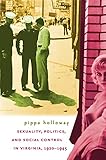
Pippa Holloway. Sexuality, Politics, and Social Control in Virginia, 1920-1945. Chapel Hill: University of North Carolina Press, 2006. xi + 258 pp. $59.95 (cloth), ISBN 978-0-8078-3051-2; $19.95 (paper), ISBN 978-0-8078-5764-9.
Reviewed by Martin Hardeman (Eastern Illinois University)
Published on H-Law (September, 2008)
Commissioned by Michael J. Pfeifer (John Jay College of Criminal Justice, City University of New York)
Policing Sex and Race in the Modern South
Pippa Holloway is an associate professor of history at Middle Tennessee State University and her book, Sexuality, Politics, and Social Control in Virginia, 1920-1945, is both well researched and illuminating. Using a Foucaultian model and class, race, and gender as her primary categories of analysis, she explores the relationship between a small ruling elite of white men and the questions of sex, morality, and their ramifications.
From the beginning of her study, Holloway describes these men as self-defined “business progressives.” Wary of centralization or interference from either the national or the state government, their professed goals were social stability, low taxes, good roads, and the projection of Virginia as a prosperous and business-friendly state. To fulfill these goals, however, they believed that social control and most especially sexual and racial regulation were necessary.
Holloway has divided her book into an introduction, seven chapters, and an epilogue. While the introduction and epilogue provide the reader with a broad overview, each of the first five chapters explores a specific aspect of her themes and the last two are case studies of Richmond and Norfolk, respectively, during the Second World War.
Chapter 1, for example, examines Virginia’s new state-wide censorship act (1922), new Racial Integrity Act (1924) and new sterilization act (1924). Holloway contends that there was virtually no debate or dissent over the sterilization of residents in Virginia’s four mental institutions. Virginia’s elite had no qualms about limiting either the lives or the liberties of those they considered marginal and as the author writes, “sexual regulation, economic growth, and progressive visions of the state all went hand in hand” (p. 50). Yet, both movie censorship and stricter racial integrity laws had their critics.
State-wide movie censorship would enhance the power of Virginia’s government, might encourage official censorship in other areas, and would affect the population as a whole--not merely the working class, poor whites, and African Americans. Although the measure passed, it did so without the wholehearted support of the elite. Some elements of the proposed racial integrity statute were even more problematic. It continued the traditional bans on interracial sex and marriage. It sharpened the definition of race, however. African Americans were defined as those with a single drop of African blood and the statute also sought to define those with a single drop of Native American blood as “colored.” While the former was broadly acceptable, the latter was not. Even with a specific exception for the descendents of John Rolfe and Pocohontas, many of the state's most prominent families would be adversely affected. This would include, according to an article in the Richmond News Leader: "two United States senators, a United States ambassador to France, two secretaries of war, two presidents of the United States, five generals, three of the most distinguished of living Southern novelists, three governors of Virginia, a speaker of the house of representatives, two bishops, three congressmen, one rear-admiral, two judges of the Virginia Supreme Court, and many of the foremost officers of the Confederate army" (p. 39). The statue passed, but those with less than one-sixteenth of Native American ancestry remained “white.”
The next four chapters deal with the implementation of these new laws, the debate over state policy toward venereal disease, the subversive possibilities of official regulation on social stability, and the ambiguous challenge of birth control. While the specific subjects change, the underlying theme stays the same: the struggle of Virginia’s elite to retain its preeminence. Increasingly in the 1920s and ‘30s, the elite faced assaults on the established social hierarchy from dissidents within its own ranks, from women, from lower middle-class and working-class whites, from African Americans and, ultimately, from the federal government.
It was the war, of course, that truly brought the national government into collision with Virginia’s elite and its established order. It was the war that disrupted communities, undermined parental authority, and produced the “Victory girls,” patriotic amateurs who were seen as a significant vector of sexually transmitted diseases. Fear that such diseases would cripple the American military inspired federal laws calling for the abolition of prostitution and mandatory treatment for venereal disease. The final chapters comparing Richmond and Norfolk’s successes and failures in handling the crisis focuses on the “conflicting agendas of local and state governments, federal health officials, and the military” (p. 19).
Sexuality, Politics, and Social Control in Virginia casts a light on a privileged elite’s attempt to preserve that privilege by using the rhetoric of modernization, prosperity, morality, and science while expanding official control over the sexual and reproductive behavior of those on the margins. Professor Holloway, however, points out that this could not be done without the assistance of a growing middle class. Social workers, policemen, school teachers, ministers, and physicians were needed to identify mental defectives and denounce the suspect racial backgrounds of individuals. Yet, the participation of such people with their own agendas as well as intervention by the bureaucrats of the federal government before and during the Second World War made the control of sexuality a double-edged sword.
This is a good and workman-like book. It will provide a solid foundation for future studies of sex, class, race, and politics in Virginia and the rest of the modern South. But there are a few caveats. Homosexuality and the change in Virginia’s age of consent are mentioned only in passing. Both would seem to be intimately involved in any discussion of the official regulation of sexuality; and to dismiss concern over homosexuality as a “product of the new postwar era” (p. 195) is unsatisfying. Also, Harry Byrd and his political machine play important parts in this study. Again in passing, Holloway mentions the dependence of both the man and the machine on rural support, yet offers little analysis of conflict between urban Virginia and the countryside.
If there is additional discussion of this review, you may access it through the network, at: https://networks.h-net.org/h-law.
Citation:
Martin Hardeman. Review of Holloway, Pippa, Sexuality, Politics, and Social Control in Virginia, 1920-1945.
H-Law, H-Net Reviews.
September, 2008.
URL: http://www.h-net.org/reviews/showrev.php?id=15494
 | This work is licensed under a Creative Commons Attribution-Noncommercial-No Derivative Works 3.0 United States License. |

