



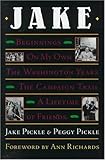
Jake Pickle And Peggy Pickle. Jake. Austin: University of Texas Press, 1997. xxii + 238 pp. $22.95 (cloth), ISBN 978-0-292-76572-6.
Reviewed by George N. Green (University of Texas at Arlington)
Published on H-Pol (December, 1997)
Jake Reviewed
In this book Jake Pickle and his daughter Peggy, a public relations writer, recount the highlights of Jake's life, including his three decades in Congress from the district centered on Austin, Texas. Born in 1913, Jake grew up in several West Texas towns, especially Big Spring. He showed an entrepreneurial streak early on--at the age of six he offered to swap his baby sister to a neighbor in exchange for a pig. Attending the University of Texas during the hard years of the Great Depression, Jake and others stole turnips from Engineering Dean T. U. Turner's patch on one side of the Engineering Building. An amused Dean Turner secretly watched the boys "stumble" into the patch and quickly pull up a few turnips. The country boys ate them raw.
Pickle met John Connally in the law fraternity and in 1940 Connally, aide to Congressman Lyndon Johnson, offered Pickle a job as director of the National Youth Administration district that had the same boundaries as Johnson's tenth congressional district around Austin. During his first real meeting with Johnson, Lyndon was defecating. In 1942 future governor Connally, future Congressman Joe Kilgore, and over a dozen other pals gave Jake a bachelor's party in which they stripped him naked, doused him with mercurochrome and bound him head to toe with surgical tape. He got the tape off, but notes that his wedding was a "sticky situation" (p. 46). Pickle is a raconteur, and much of the book is given over to these Texas tales.
Life became more serious when Jake saw combat as a gunnery officer on the USS Miami during World War II. He resolved that if he made it back he would try to do something important and good. He and Connally and other veterans hooked up with Johnson after the war and entered the radio station business. Jake sold ads for KVET, but left in 1949 to establish the Syers Pickle and Wynn public relations agency. He and his agency plunged into Democratic politics on behalf of Governor Allan Shivers, noted for his clashes with the liberal faction of the party. Republicans in the 1950s were inconsequential in Texas, but the internecine war among the Democrats was, as Pickle admits, "raw and brutal" (p. 75).
Jake recollects that in 1954 Port Arthur, Texas, underwent a "crippling labor strike" (p. 71), but in fact Port Arthur was not crippled or shut down. A Shivers campaign film made by Jake's firm depicted the town as deserted, but Jake confesses (long after the fact) that it was filmed at six a.m. Shivers' liberal opponent, Ralph Yarborough, was effectively identified with labor and outside (Communist) agitators. Texas liberals complained for years that Yarborough would have been elected governor of Texas had it not been for Pickle, but Jake claims that he had nothing to do with the film. Indeed, Jake asserts that film left such a bad taste in his mouth that when he ran for public office himself he never ran "another" (p. 72) negative, misleading campaign ad.
In 1963 the tenth congressional district seat became vacant. Jake merely states that he knew the district, felt he could count on Vice-President Lyndon Johnson's support, campaigned hard, and won. He omits the fact that Johnson selected him to run or he never would have filed, and does not deign to mention that he had an underfinanced, unknown progressive opponent who came within an eyelash of beating him. Jake would probably concede these points in private. Jake evidently wants to be remembered as quite a progressive. He is most proud of his vote for the 1964 Civil Rights Act, but also fondly recalls votes for the first health warning on cigarette packs in 1965 and his investigation of tax abuses among supposedly non-political, non-profit televangelists. As Chairman of the Oversight Committee in the 1980s Jake investigated corporate abuses of pension plans. Pickle notes that the Pension Protection Act of 1987, however, was filled with loopholes, some of which were closed--over corporate objections--by the Pension Reform Act of 1994. In reality, though, Jake's voting record was only progressive in his first few years in Congress, until his seat was safe and Johnson had retired. His Conservative Coalition scores were less than 50 percent, 1965-1968, and 70 percent for the rest of his career. The Austin district could have supported a much more progressive congressman, and in fact did so before Jake's thirty-one years, and has done so since his retirement. Several well known Austin liberals grew too old to run for Congress, and some died, waiting for him to retire.
Some issues are not easily characterized ideologically. Jake believed that one great economic problem that the Ronald Reagan administration in particular ignored, was the descent into insolvency of the social security program. Congress reduced automatic cost-of-living increases in 1977, and Jake's social security subcommittee managed to raise social security tax rates, raise the retirement age, and tax social security benefits in 1983. Jakes warns, though that social security's annual deficits still pose future difficulties, and he is quite right. Jake's leadership on social security was generally thoughtful and moderate.
Recollections of his Washington years are also filled with anecdotes. At a very formal dinner honoring one of Jake's old pals, ribald Texas political operative Ed Clark--then serving as Johnson's ambassador to Australia--Supreme Court Justice Tom Clark proposed a "toast to the ladies--bless their hearts." Ed burst out, "And all their other vital organs" (p. 114). The gales of laughter really broke the ice. Fellow Texan Dan Rather testifies that Jake turns the book into a front porch on a lazy summer evening and puts the reader right beside him. That's about right. I once heard Jake spin a few yarns myself, and they are, of course, even better in person than they are on the printed page.
Ol' Jake probably won't take offense at anything I've written. Maybe he'll even send me some rattlesnake chili or one of those green pickle-shaped whistles.
Copyright (c) 1997 by H-Net, all rights reserved. This work may be copied for non-profit educational use if proper credit is given to the author and the list. For other permission, please contact H-Net@h-net.msu.edu.
If there is additional discussion of this review, you may access it through the network, at: https://networks.h-net.org/h-pol.
Citation:
George N. Green. Review of Pickle, Jake Pickle And Peggy, Jake.
H-Pol, H-Net Reviews.
December, 1997.
URL: http://www.h-net.org/reviews/showrev.php?id=1529
Copyright © 1997 by H-Net, all rights reserved. H-Net permits the redistribution and reprinting of this work for nonprofit, educational purposes, with full and accurate attribution to the author, web location, date of publication, originating list, and H-Net: Humanities & Social Sciences Online. For any other proposed use, contact the Reviews editorial staff at hbooks@mail.h-net.org.

