



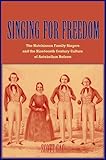
Scott Gac. Singing for Freedom: The Hutchinson Family Singers and the Nineteenth-Century Culture of Reform. New Haven: Yale University Press, 2007. xiv + 312 pp. $45.00 (cloth), ISBN 978-0-300-11198-9.
Reviewed by Bonnie Laughlin-Schultz (Department of History, Indiana University)
Published on H-SHEAR (July, 2008)
The Hutchinson Family Singers, Antebellum Antislavery, and Abolitionist Memory
In this thoroughly researched and engaging work, Scott Gac vividly portrays not only the Hutchinson Family Singers but, as his subtitle suggests, the broader nineteenth century culture of reform. Offering what might best be described as "cultural biography," Gac describes the rise (and fall) of the Hutchinson Family Singers against a backdrop of the broad transformations occurring in the first half of the nineteenth century in the northeast and broader United States. The story of Judson (1817-59), John (1821-1908), Asa (1823-84), and Abby (1829-92) Hutchinson, Gac argues, "details a vibrant cultural space created by waves of reform pulsating through the United States in the first half of the nineteenth century" (p. 4). With their creation of a new kind of music directed first at temperance and then at antislavery reform efforts, the Hutchinsons rose to popularity as a family quartet in the 1840s and performed over 12,000 shows. By 1843, their popularity was such that Asa observed that "the people of New York are crazy after 'The Hutchinsons'" (p. 65). By the 1850s, however, the Hutchinson Family Singers could no longer make such claims: the group had partially disbanded and, Gac argues, had lost much of its cultural relevance. Despite their short time in the limelight, Singing for Freedom makes a compelling argument that the story of the Hutchinson family sheds much light on antislavery history--as well as rural New England history, family history, music history, and the broader nineteenth century.
Gac carefully situates the Hutchinson singers' entrance into music against the backdrop of the broad changes sweeping across New England (and the country) in the early nineteenth century, especially those of the Second Great Awakening, the rise of reform culture writ large, technological innovations, and the market revolution. The Hutchinson Family Singers came from the small community of Milford, New Hampshire, and Gac demonstrates the broad effects of the market revolution by focusing on the changes it brought to large farm families such as theirs. (Polly Hutchinson, their mother, had sixteen children over a twenty-nine year span.) It seems no coincidence that Judson, John, Asa, and Abby were four of the youngest members of this large Baptist family: while most of the older Hutchinson siblings went into farming, at least for a time, of the younger Hutchinson siblings, only one of eight spent his/her life as a farmer. Confronted by industrialization and the accompanying changes made to farming across New England, their parents, Jesse and Polly Hutchinson, could no longer "guarantee a farming life" for each of their sixteen children (pp. 86, 77). Gac notes, too, that the younger Hutchinsons were educated differently than their parents and even older siblings; for example, Abby, one of the youngest Hutchinsons, attended the Milford Female Seminary as a young girl, an opportunity that never would have been afforded to her mother Polly. Following the lead of Joshua Hutchinson, who broke from farming to take on work as a choirmaster and then instructor of a singing school, the youngest five Hutchinsons, with the exception of Rhoda (too shy for the stage, Gac asserts), turned to public performance of music.
Though John, Judson, and Asa Hutchinson were drawn towards music, Gac notes that, initially, the odds that they would succeed as public performers were slim to none, partly due to their provincial origins and lack of connections but even more due to an American predisposition for European performers. The brothers moved from Milford to Lynn, Massachusetts, in 1841, where they worked for their older brothers in their grocery and hardware stores and tried to make headway with their music. A pivotal moment came in December of 1841, when the famous Swiss family singers, the Rainers, visited Lynn; their visit, Gac notes, "awakened" the Hutchinsons to the idea of a family singing group (p. 137). By the following month, John, Judson, and Asa transformed themselves from a vocal trio into the Hutchinson Family Singers. Now a quartet, they were joined by their young sister Abby, aged eleven.
It took the Hutchinsons some time to carve out a niche that was more than just imitative of the model offered by the Rainers. (For a while they even appeared in Swiss-like gear!) But over time, their innovative approach to reform music and careful attention to publicity catapulted them to national fame. Gac contends that the musical form that the Hutchinsons adopted--one original and new--also played a critical role in their rise to fame. They wrote their own lyrics to "well-liked melodies of blackface minstrelsy and of church hymns," adding new, catchy refrains to create what Gac describes as a new form of "sacred" music (p. 5). By the end of 1842, they were touted as entertainers at temperance meetings, and their song "King Alcohol" had grown quite popular. With another song, "Old Granite State," they moved beyond being Rainer family knock-offs and paid homage to their New England origins. Especially with their adoption of this tune, Gac reveals them to be astute self-marketers as well as performers, participating in a "full-fledged commercialization of antislavery" (p. 5).
Though they had attended antislavery meetings in Milford as early as 1840 and were fervent in their commitment to temperance reform, it was not until 1843, at the urgings of abolitionist leaders such as William Lloyd Garrison, that the Hutchinson Family Singers came out as antislavery singers. With this transition, Gac contends, they "came into their own as musical activists" (p. 173). In 1844, they released "Get Off the Track," a song in which they changed the lyrics of a popular minstrel tune "Old Dan Tucker" into "a medium for emancipation" (p. 177). Its opening lines announced their antislavery mission: "Ho! the Car Emancipation / Rides majestic thro' our nation / Bearing on its train the story, / LIBERTY! a nation's glory" (p. 249). Though there was some backlash against the song (especially for its distaste for the popular compromiser Henry Clay), the song was also widely popular in the North.
By the end of the 1840s, however, the Hutchinsons were no longer central figures in the antislavery struggle, and Gac carefully portrays them as figures of 1840s rather than 1850s antislavery. Though he contends that they had once functioned to unite antislavery factions, by the end of the 1840s this was impossible. Amidst the backdrop of the Mexican War controversy, the Hutchinson Family Singers appeared at a tribute to Henry Clay; for this, they were seen as selling out for popularity and were (temporarily, it seems) banned from the American Anti-Slavery Society, once a prominent backer. In addition to growing sectionalism and the fact that--with the rise of the free soil movement and its broadening of the antislavery constituency--their pleas for racial tolerance and encouragement of racially integrated audiences were no longer popular, there were also personal reasons behind their decline in popularity. One reason was the loss of, perhaps, the most recognizable and marketable of the Hutchinsons, Abby. Abby married Ludlow Patton in 1849, and the day after, newspaper headlines announced "Abby Hutchinson no more." Indeed, Patton informed Frederick Douglass that he preferred Abby as "my private companion and not as an amusement for the crowds," and she subsequently retired from the stage (p. 225). Throughout his work, Gac notes that Judson, John, and Asa had distinct (and at times clashing) personalities, and after Abby's retirement, the trio moved further and further away from being a family group known for its harmony--literal and figurative--and devolved into "a band of bickering brothers" (p. 228). In his discussion of their internal dynamics, Gac adds to a small body of literature that examines abolitionist family internal dynamics.[1]
One of the best elements of Gac's work is that he does not end his story in the 1850s or with the Civil War; instead, early in the work and then again at its conclusion, Gac leaps forward to the 1890s and looks at how the remaining Hutchinsons, especially John, participated in an "antislavery vanguard" working to commemorate the abolitionist movement and, to some degree, uphold its aims in an American increasingly hostile to the one-time Hutchinson ideal of racial tolerance and, even, equality (p. 22). Gac describes an abolitionist reunion in 1893 at Danvers, Massachusetts, where John appeared and sang many old Hutchinson favorites while abolitionists such as Lucy Stone and others "remembered, recollected, and reshaped the past" (p. 37). Though Frederick Douglass did send a letter that referred to the reunion as featuring "the recollections of deeds well done, of lives well spent, of wrongs successfully combated and of a race redeemed from slavery," he did not attend.[2] Gac speculates that this was because he "understood that his old friends, by and large, were not the reformers they once had been" (p. 240).
John Hutchinson was no bystander to this reshaping of the abolitionist past. He gave a speech at the Danvers meeting and performed numerous Hutchinson family songs, apparently by popular demand. Additionally, three years later, in 1896, he penned The Story of the Hutchinson Family Singers, which Gac notes blended fact with fiction in John's attempt to claim a meaningful and prominent role in the abolitionist movement. While Douglass penned the introduction to Hutchinson's memoir, Gac notes that the two allies had different needs in the present: while John found some "solace in being a relic from days past, … Douglass battled against being an 'antique abolitionist'" (p. 246).
The value of such consideration of abolitionism in the decades after the Civil War cannot be overstated. Gac's consideration and careful discussion of abolitionist commemorations of their movement--as well as their blind spots and idealizing of the past--stands as an important contribution to antislavery historiography. As recently demonstrated in Julie Roy Jeffrey's treatment of abolitionist memoirs--one of the first works to do so in recent years--there remains much to know about what abolitionists thought after the war's end, how they commemorated their own movement, and what they made of the world that the demise of federal Reconstruction had brought. Both Gac and Jeffrey demonstrate that the sources for such consideration are rich and will yield much to scholars.[3]
In the end, though the Hutchinson Family Singers rose to great heights, their story--and that of the 1890s--appears as a sad one, even a tragedy. Against a backdrop of backlash against any egalitarian aims and the advent of Jim Crow, the Hutchinson Family Singers experienced their own personal tragedies. Each member of the family quartet, Gac notes, "seemingly paid a price for their early and fantastic rise to fame" (p. 236). After the 1840s, the Hutchinson brothers pined for their previous fame. Judson, long prone to melancholy, committed suicide in 1859, while Asa died relatively poor in the 1880s. John, too, may have died at his own hand in 1908. And their sister was not spared: Abby, Gac adds, "died after more than forty years under Ludlow's wealth and authority" (p. 236).
So much goes on in Gac's treatment of the Hutchinsons that in a few instances, the reader may be left wanting more. Historians of music and nineteenth-century culture, for instance, might want more discussion of the ways in which the Hutchinsons turned minstrel tunes to their advantage and what the implications of this for minstrelsy were. Additionally, two other examples involve Abby Hutchinson. Gac portrays her as central to the Hutchinsons's initial success, noting that her portrayal as utterly candid was savvy and appealing to Americans. I wanted to know more about how the Hutchinsons, including Abby, actively constructed their image. I was also intrigued by Abby Hutchinson's retirement. Gac almost teasingly notes that "by the start of the Civil War, Abby wasn't really allowed to appear on stage (though her actions reveal a yearning to do so)," but he does not offer much more information or consideration beyond this, and I wanted to hear more about her chafing against the confines of her marriage and to see how this might have correlated with struggles other antislavery activist women had after marriage (p. 238). Finally, I wanted to know more about the Hutchinsons's commitment to racial equality and tolerance, particularly vis-à-vis the recent scholarship that has commented on and celebrated abolitionist John Brown's commitment to egalitarianism.[4] The Hutchinsons, Gac notes, welcomed and even clamored for interracial audiences for their performances. What created their extraordinary mindset? Was it rooted in their family, their religious upbringing, or in something else entirely? However, the fact that all of my questions were not answered by Gac's treatment is no critique: instead, it stands as testimony to the vibrancy of his account. This is a book that will be of much use to historians of antislavery, the family, the broader nineteenth century, and to anyone looking for an intriguing family biography.
Notes
[1]. In addition to biographical treatments of various abolitionists, recent works on abolitionist family dynamics include Harriet Hyman Alonso, Growing Up Abolitionist: The Story of the Garrison Children (Amherst: University of Massachusetts Press, 2002); Chris Dixon, Perfecting the Family: Antislavery Marriages in Nineteenth-Century America (Amherst: University of Massachusetts Press, 1997); Mark Perry, Lift Up Thy Voice: The Grimke Family's Journey from Slaveholders to Civil Rights Leaders (New York: Viking, 2003); and Ronald Salomon, "Being Good: An Abolitionist Family Attempts to Live Up to its Own Standards," Vermont History 69 (2001): 32-47. In her biography of Parker Pillsbury, Stacey Robertson also pays careful attention to abolitionist family dynamics as well as gender. Stacey M. Robertson, Parker Pillsbury: Radical Abolitionist, Male Feminist (Ithaca: Cornell University Press, 2000).
[2]. Old Anti-Slavery Days, Proceedings of the Commemorative Meeting, Held by the Danvers Historical Society, at the Town Hall, Danvers, April 26, 1893, with Introduction, Letters, and Sketches (Danvers: Danvers Historical Society, 1893), 63.
[3]. Julie Roy Jeffrey, Abolitionists Remember: Antislavery Autobiographies and the Unfinished Work of Emancipation (Chapel Hill: University of North Carolina Press, 2008). Another helpful consideration of abolitionist memory is W. Scott Poole, "Memory and the Abolitionist Heritage: Thomas Wentworth Higginson and the Uncertain Meaning of the Civil War," Civil War History 51 (June 2005): 202-217. Early works on the abolitionists considered abolitionist commitment to equality and appraisal of post-Civil War America. See Richard O. Curry, "The Abolitionists and Reconstruction: A Critical Appraisal," Journal of Southern History 34 (November 1968): 527-545; James McPherson, The Abolitionist Legacy: From Reconstruction to the NAACP (Princeton: Princeton University Press, 1975); James McPherson, The Struggle for Equality: Abolitionists and the Negro in the Civil War and Reconstruction (Princeton: Princeton University Press, 1964); and Willie Lee Rose, Rehearsal for Reconstruction: The Port Royal Experiment (New York: Bobbs-Merrill Company, 1964).
[4]. See Evan Carton, Patriotic Treason: John Brown and the Soul of America (New York: Simon and Schuster, 2006); Louis DeCaro Jr., John Brown: The Cost of Freedom (New York: International Publishers, 2007); David S. Reynolds, John Brown, Abolitionist: The Man Who Killed Slavery, Sparked the Civil War, and Seeded Civil Rights (New York: Alfred A. Knopf, 2005); and, perhaps most notably, John Stauffer, The Black Hearts of Men: Radical Abolitionists and the Transformation of Race (Cambridge: Harvard University Press, 2002).
If there is additional discussion of this review, you may access it through the network, at: https://networks.h-net.org/h-shear/.
Citation:
Bonnie Laughlin-Schultz. Review of Gac, Scott, Singing for Freedom: The Hutchinson Family Singers and the Nineteenth-Century Culture of Reform.
H-SHEAR, H-Net Reviews.
July, 2008.
URL: http://www.h-net.org/reviews/showrev.php?id=14787
Copyright © 2008 by H-Net, all rights reserved. H-Net permits the redistribution and reprinting of this work for nonprofit, educational purposes, with full and accurate attribution to the author, web location, date of publication, originating list, and H-Net: Humanities & Social Sciences Online. For any other proposed use, contact the Reviews editorial staff at hbooks@mail.h-net.org.

