



Ursula Löffler. Dörfliche Amtsträger im Staatswerdungsprozess der Frühen Neuzeit: Die Vermittlung von Herrschaft auf dem Lande im Herzogtum Magdeburg, 17. und 18. Jahrhundert. Münster: LIT Verlag, 2005. 266 S. EUR 44.90 (cloth), ISBN 978-3-406-54181-0.
Reviewed by Gary Beckman
Published on H-German (July, 2008)
History of the Historians
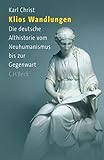
"Wissenschaftsgeschichte [ist] im Grunde Wissenschaftlergeschichte" ("The history of scholarship is basically the history of scholars"; p. 20). Karl Christ quotes these words of W. M. Calder III in justifying the biographical emphasis of this chronological overview of the study of ancient history, focusing primarily on the Germanophone world. Christ has previously produced two volumes of substantial biographical essays on some of the major figures in this field of research, but in this book his presentation is necessarily more concise.[1] His goal, which he certainly achieves, is to situate individual achievements and scholarly views in their larger historical and intellectual contexts.
Christ sketches the work of the greats of the nineteenth century in chapter 3 (Theodor Mommsen, Johann Gustav Droysen, and so on) before beginning his main account in chapter 4 with a description of the situation within the discipline in the early years of the twentieth century. The following pages deal with researchers active during each of the succeeding epochs of this eventful century--the end of the Wilhelmine era and the Weimar Republic (chapter 5), the years of National Socialism (chapter 6), the Cold War period (chapters 7-8), and the pre- and post-Wende (1970-2005; chapter 9).
At varying length, roughly in proportion to the prominence enjoyed by each, Christ discusses the life and times of dozens of historians, considering their scholarly lineages, the stations of their careers, and the most significant and characteristic of their publications. The author's breadth of knowledge of both classical history and of university politics in modern Germany stands him in good stead in this endeavor.
Of course, the elephant in the room in any discussion of personalities active in German intellectual life between around 1930 and 1970 is their behavior during the Twelve-Year Reich. Since most professors holding positions in ancient history during the Nazi period continued to teach after the war--at least in what became the Federal Republic--and several indeed came to dominate the field, little examination of their records preceded Volker Losemann's 1975 dissertation.[2] However, with the retirement and passing of the protagonists, this area of inquiry has blossomed in recent years.[3]
Here Christ is as fair as it is probably possible for a German of his generation to be in his treatment of such figures as Helmut Berve, Fritz Schachermeyr, Joseph Vogt, and Fritz Altheim. He stresses that it is necessary "to differentiate among particular individuals, to evaluate not only writings, but also personal records, and to judge scholarly contributions as well as political and human conduct" (p. 58). His general conclusion is that while certain authors made occasional gestures toward the Nazi party's ideology, a convinced National Socialist would have had reason to be disappointed with the development of the study of ancient history after 1933.[4] Nonetheless, the reaction of the profession to the expulsion and persecution of Jewish colleagues was "deeply disappointing" (p. 94).
The Cold War witnessed divergent and ideologically conditioned emphases in ancient historical research in the two Germanys: In the Federal Republic, scholars developed great interest in the early democratic systems of Greece, while those working in the GDR concentrated on the study of slavery in the classical world--that is, when their leading figures were not busy berating their western colleagues. With the collapse of the GDR in 1989-1990 came the reorganization of the eastern universities and scholarly institutions under western hegemony. Christ comments succinctly: "Already today it is clear that in the process highly problematic proceedings took place" (p. 152).
For the most recent years, Christ alters his approach and organizes his material by institution or by region, referring the reader to a very interesting chronological table of the most important publications to appear since the Second World War. This listing, as well as the detailed notes to the various chapters, will serve as an excellent starting point for anyone investigating the course of classical studies in twentieth-century Germany.
Notes
[1]. Karl Christ, Von Gibbon zu Rostovtzeff(Darmstadt: Wissenschaftliche Buchgesellschaft, 1979); Christ, Neue Profile der Alten Geschichte (Darmstadt: Wissenschaftliche Buchgesellschaft, 1990).
[2]. Volker Losemann, Nationalsozialismus und Antike. Studien zur Entwicklung des Faches Alte Geschichte 1933-1945 (Hamburg: Hoffmann und Campe, 1977). On p. 138, Christ mentions some of the difficulties that Losemann, his doctoral student, encountered after this publication.
[3]. See, for instance, Antike und Altertumswissenschaft in der Zeit von Faschismus und Nationalsozialismus, ed. Beat Naef (Mandelbachtal: edition cicero, 2002).
[4]. Note especially Helmut Berve's Thukydides (Frankfurt am Main: Diesterweg, 1938), in which he identifies a number of themes in the work of the Greek writer with those in Mein Kampf; and Joseph Vogt's Kaiser Julian und das Judentum. Studien zum Weltanschauungskampf der Spätantike (Leipzig: J. C. Hinrichs, 1939).
If there is additional discussion of this review, you may access it through the network, at: https://networks.h-net.org/h-german.
Citation:
Gary Beckman. Review of Löffler, Ursula, Dörfliche Amtsträger im Staatswerdungsprozess der Frühen Neuzeit: Die Vermittlung von Herrschaft auf dem Lande im Herzogtum Magdeburg, 17. und 18. Jahrhundert.
H-German, H-Net Reviews.
July, 2008.
URL: http://www.h-net.org/reviews/showrev.php?id=14764
Copyright © 2008 by H-Net, all rights reserved. H-Net permits the redistribution and reprinting of this work for nonprofit, educational purposes, with full and accurate attribution to the author, web location, date of publication, originating list, and H-Net: Humanities & Social Sciences Online. For any other proposed use, contact the Reviews editorial staff at hbooks@mail.h-net.org.

