

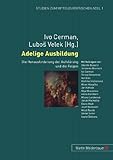
Ivo Cerman, Lubos Velek. Adelige Ausbildung: Die Herausforderung der Aufklärung und die Folgen. München: Martin Meidenbauer Verlag, 2006. 305 S. EUR 44.00 (cloth), ISBN 978-3-89975-057-7.
Reviewed by J. Trygve Has-Ellison (School of Arts and Humanities, University of Texas at Dallas)
Published on H-German (July, 2008)
How Aristocrats in the Habsburg Monarchy Became Enlightened
Ivo Cerman and Lubos Velek's edited volume evaluates the Enlightenment-influenced educational strategies of some central European aristocrats during the transition from the early modern to the modern era. This is the first volume in what promises to be a series of studies on nobles in greater central Europe with a particular emphasis on Bohemia. The overarching theme of the symposium (held in Prague in November 2004) and this volume is twofold: the Enlightenment should not be construed as exclusively anti-feudal in ideology, nor should the aristocracy be considered as implacably hostile to the Enlightenment.
The volume is divided into four sections on the role of education in Enlightenment theory; aristocratic educational institutions informed by the Enlightenment; the practice of education in aristocratic families, with special attention given to the role of Enlightened ideas; and aristocratic participation in the republic of letters. With a few exceptions, these essays focus on the small group of noble families who both dominated Habsburg court society at Vienna, and were the greatest landowners in the provinces, such as the Schwarzenberg, Lobkowicz, and Windischgrätz. The contributors to this volume conclude that many members of the central European aristocracy received the Enlightenment, particularly the writings of Rousseau, favorably. Even so, the aristocracy applied the theories of Enlightenment writers in a way that reinforced pre-existing ideas about the state, society, and the family. In other words, the extent of the aristocratic reception of the Enlightenment was the same as that of the middle class, but the two groups' interpretation and transmission of these ideas differed considerably.
Overall, this collection of essays is a starting point for further research rather than a detailed analysis of aristocratic families' reception of the Enlightenment in the lands of the Habsburgs. The general focus of this volume on Catholic families may skew the sample used for its general argument, insofar as the eighteenth-century Catholic Church tended to react negatively to the Enlightenment, accusing it of descending from the Protestant Reformation. Considering the almost exclusive focus of this volume on Catholic aristocrats in Habsburg lands, one wonders how this dichotomy appeared to them. Were their religious attitudes far more laissez-faire than we have previously considered? And, how do the arguments about religious identity and milieu that have arisen in the wake of the confessionalization thesis fit with the enthusiasm in many strongly Catholic aristocratic families for the writings of Rousseau and Condorcet? None of these questions are explicitly answered, and in fairness to the authors these questions do not matter as much as the overall thesis that Habsburg aristocrats were receptive to the ideas of the Enlightenment.
A few of the essays are particularly thought-provoking. Olga Khavanova's article on the educational strategies of the Hungarian nobility assumes that to be Hungarian meant limited to full integration into the Catholic cultural sphere of the Habsburgs. Certainly Khavanova is correct to assume that ambitious Hungarian nobles had to accommodate themselves to the culture of the Viennese court in order to compete for court, military, and bureaucratic positions with the Bohemian, Austrian, and Italian families. However, Khavanova implicitly ignores the significant (in numbers and literary output) Protestant nobility (bene possessionati) of eastern Hungary and Transylvania. Only a few of these families had a limited relationship with the Viennese court (Banffy, Bethlen, Teleki); nonetheless, it seems self-evident that Hungarian nobles had trouble competing with their Austrian, Bohemian, and Italian counterparts, as Khavanova notes but does not explain, because they were neither trusted in Vienna, nor did they trust the Habsburgs, whom they regarded with deep-seated antagonism. If it was Khavanova's intent to exclude this group, she should make this explicit at the beginning of her otherwise excellent contribution.
Zdenek Bezecny's thought-provoking essay on the educational bequest of the last Count of Straka is another contribution that raises a number of further questions. As Bezecny details in the essay, Straka left explicit orders for the creation of an academy based on Enlightenment educational principles to be reserved exclusively for agnates from old Bohemian noble families. Bezecny does not address the implicit questions this bequest raises about leftover resentments after the Thirty Years War, even among families who had made their peace with the Habsburgs and the Counter-Reformation. It is interesting that the administrators of the Straka academy focused on educating descendants of Bohemian-Czech noble families that had been derogated after the war (Pisecky von Kranichfeld, Ruzek von Rovny, Trmal von Toussitz, Hubka von Cerncitz). Their actions suggest that the Bohemian aristocracy was well aware of many families that were no longer to live in the style to which their aristocracy had entitled them after surviving the religious and civil conflicts of the seventeenth century. This possibility, if true, calls for a complete reinterpretation of R. J. W. Evans' discussions of the uses and misuses of the battle of White Mountain. In The Making of the Habsburg Monarchy: 1550-1700 (1979), Evans argued that the destruction of Czech liberties in the wake of a vengeful German and Counter-Reforming dynasty was a legendary construction of Czech nationalists in the nineteenth century. As Evans noted, the same families that dominated the political and cultural landscape of Bohemia and Moravia before 1620 and the battle of White Mountain were still dominating this same landscape after 1620. What had changed was the impoverishment, emigration, or derogation of many lower noble families whose existence had become precarious before 1620 and were therefore more willing to embrace radical solutions to their problems--not fundamentally different from the radical choices made by impoverished nobles in Pomerania and Prussia in the 1930's, with much the same result. Conceivably, in its efforts to redress the perceived wrongs of White Mountain, the state of Czechoslovakia should have carried out land reform in the name of derogated families that would have provided the core of a nationalist Czech nobility--a literal return of the living dead.
Ultimately, this volume does not present groundbreaking new insights, but it does revisit some old questions in novel ways. More importantly, it brings the reception of the Enlightenment by the traditional Habsburg elite into focus. Hopefully, future volumes in this series will attempt to answer some of the questions raised by this monograph.
If there is additional discussion of this review, you may access it through the network, at: https://networks.h-net.org/h-german.
Citation:
J. Trygve Has-Ellison. Review of Cerman, Ivo; Velek, Lubos, Adelige Ausbildung: Die Herausforderung der Aufklärung und die Folgen.
H-German, H-Net Reviews.
July, 2008.
URL: http://www.h-net.org/reviews/showrev.php?id=14745
Copyright © 2008 by H-Net, all rights reserved. H-Net permits the redistribution and reprinting of this work for nonprofit, educational purposes, with full and accurate attribution to the author, web location, date of publication, originating list, and H-Net: Humanities & Social Sciences Online. For any other proposed use, contact the Reviews editorial staff at hbooks@mail.h-net.org.

