



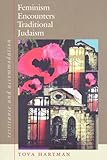
Tova Hartman. Feminism Encounters Traditional Judaism: Resistance and Accommodation. Waltham: Brandeis University Press, 2007. 162 pp. $29.95 (cloth), ISBN 978-1-58465-658-6; $19.95 (paper), ISBN 978-1-58465-659-3.
Reviewed by Vanessa L. Ochs (Department of Religious Studies, University of Virginia)
Published on H-Judaic (July, 2008)
Tova Hartman, a feminist psychologist and a Modern Orthodox Jew living in Israel, recognizes, in writing the essays that compose Feminism Encounters Traditional Judaism (which won a 2007 National Jewish Book Award), that she stands on the shoulders of other Orthodox Jewish feminist scholars who have come before her. The first is Blu Greenberg, whose book On Women and Judaism: A View from Tradition (1981) was the first to acknowledge that Orthodoxy posed real problems of exclusion and silencing for women who cherished its practices. These problems could be resolved within the system, Greenberg hoped, if its gatekeepers--rabbis--chose to take women's concerns with due seriousness. The second scholar is Tamar Ross, who, in Expanding the Place of Torah: Orthodoxy and Feminism (2004), proposed that the challenge feminism offers to Orthodox Judaism should be viewed not as a source of danger or contamination, but rather as a source of revelation, divine in origin, which has emerged in the contemporary period. In this work, she defined new theological understandings that the faithful are challenged to embrace.
Hartman, like those who have come before her, acknowledges that the process of bringing feminism and Orthodox tradition into conversation with each other--"reengagement" is what she calls it--is a task she cannot shy away from forever, however tempting that had once been (p. 3). Simultaneously, she admits that while the process of gazing deeply into feminism and Orthodoxy is deeply frustrating (the image she uses to reflect the contradictions and tensions with which she grapples is banging her head "against the rock" of tradition), it can yield insight (p. 75). While Hartman covers issues that many other Jewish feminist scholars have already addressed, she brings to the task brilliance and erudition, expressed in the feminist theological, psychological, and literary strategies that she marshals.
In her first essay, "Facing the Legacy of the Canon," she looks at the absence of women's voices in traditional Jewish texts, and offers three psychoanalytical models (reaffirmation, reinterpretation/revisionist, and rejection) as ways of reading women's perceptions back into sacred texts. In her second essay, "Modesty and the Religious Male Gaze," she considers how a woman's voice and the presence of her body have traditionally been seen within Orthodoxy as sources of dishonor, and examines why a return to modesty (tzniut in dress and head covering) has come to appeal to many Modern Orthodox women. Here, she proposes that it should be possible for men and women both "to view themselves not according to the images of each other that we have generated through generations of cagey anxiety and misguided notions, but in the far more fearless and forgiving gaze of the divine" (p. 61). The third essay, "The Paternal Voice in Liturgy," suggests an alternative to addressing the maleness of liturgy by creating new prayers using gender neutral language or introducing non-gendered, more immanent, and less transcendent metaphors into prayers (as the progressive branches of Judaism have all successfully done, and incorporated in their official prayer books). For the feminist Orthodox Jew who sees the language of prayer as immutable, Hartman proposes saying the old words, but reconfiguring "some of the meanings we assign to them" (p. 73). (She concedes that this approach raises the critique of apologetics, and it certainly does.) Hartman considers the menstrual practices that regulate a couple's sexual intimacy in her fourth essay, "The Hands of Rabbis: Orthodox Women and Niddah." Here, she explores an interesting phenomenon: when feminists are critiquing these as patriarchal practices that demonize and regulate women's bodies, they rarely look at how real women experience their observance of niddah and going to the mikva (ritual bath) as richly complex spiritual experiences that they would not jettison. In the final essay, one that covers the freshest territory, "Roles, Rules and Responsa: The Backlash against Feminism," she examines why, in the last one hundred years, so many rabbis have violently villainized those who have championed the cause of increased religious participation of women. Here, she explains that "backlash is thus the patriarchy's weakest place: it both gives voice to the unwritten quality that has been so long taken for granted, and shows the extent to which it has ceased to be taken for granted, to which traditional authority has lost control" (p. 120).
I believe that what distinguishes Hartman's work, and makes it particularly compelling, is the narrative backdrop on which the ideas unfold. This is not just an academic exercise, but the kind of thinking that fortifies one's courage to challenge tradition from within. Hartman's synagogue in Jerusalem resisted all her efforts to render it more welcoming to women. Hartman felt she had no choice but to leave; who would ever embrace her vision if it were deemed transgressive? Along with like-minded collaborators, she spearheaded the creation of a new Orthodox synagogue (shul), Shira Hadasha, that goes farther in its support of women as (nearly) full participants and its embrace of feminist thinking than her own community was willing to go. At Shira Hadasha, the mechitza (separation) divides men and women equally; often men and ten women constitute the quorum for communal prayer. Women as well as men read from the Torah, have Torah honors, give sermons, and celebrate life-cycle events, all within the boundaries of liberal readings of halachah (Jewish law). Respecting halachah, women may lead only those parts of the liturgy not officially designated as "prayer." For those who have been drawn to the rigorousness, seriousness, energy, and level of learning of Orthodox worship, but found it alienating nonetheless because women appeared treated as second-class citizens in the context of communal worship, this new kind of shul (called a partnership minyan), which has been established in more and more communities in America and in Australia, proves to be an exciting solution, one that many thought they would never imagined realized in their lives. There is a moral here: it is not always possible to innovate within a community, however beloved it is to you, if the threat of change is simply untenable to the majority. You may have to break away (or allow yourself, in effect, to be banished) to freely model the possibilities of sound and enduring religious innovations and to prove their feasibility and respectability.
While Feminism Encounters Traditional Judaism is not presented as a manifesto for the partnership minyan, it does serve that function. Hartman seeks to prove that through engaging with traditional Jewish texts and by creating facts on the ground through the establishment of a new (and before, unthinkable) Jewish institution, it is possible not just to be an Orthodox feminist, but for Orthodoxy to be improved and made more holy when it is subject to a feminist critique.
There will be readers who do not share Hartman's optimism, readers who cannot be persuaded that dramatic institutional changes that allow for greater expression of piety can ever make Orthodoxy sufficiently hospitable to women, given its rigid separation of the sexes, the primacy of the heterosexual family, followers who believe that the presence of women compromises sanctity, and so many legal limitations on women's agency. Such readers will not be fully persuaded that it is possible to be simultaneously avant-garde and traditional, no matter how many contortions are attempted. But Hartman makes her case carefully and persuasively: it is but an illusion that traditional practices never change and are never made more adaptive through creative solutions that incorporate new knowledge and new values. As she writes: "the capacity for some creative adaptation within the parameters of a rigorous legal system is what has given postbiblical Judaism its time and space-spanning vitality in the first place" (p. 17).
If there is additional discussion of this review, you may access it through the network, at: https://networks.h-net.org/h-judaic.
Citation:
Vanessa L. Ochs. Review of Hartman, Tova, Feminism Encounters Traditional Judaism: Resistance and Accommodation.
H-Judaic, H-Net Reviews.
July, 2008.
URL: http://www.h-net.org/reviews/showrev.php?id=14734
Copyright © 2008 by H-Net, all rights reserved. H-Net permits the redistribution and reprinting of this work for nonprofit, educational purposes, with full and accurate attribution to the author, web location, date of publication, originating list, and H-Net: Humanities & Social Sciences Online. For any other proposed use, contact the Reviews editorial staff at hbooks@mail.h-net.org.

