



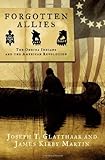
Joseph T. Glatthaar, James Kirby Martin. Forgotten Allies: The Oneida Indians and the American Revolution. New York: Hill & Wang, 2006. 434 pp. $30.00 (cloth), ISBN 978-0-8090-4601-0; $19.95 (paper), ISBN 978-0-8090-4600-3.
Reviewed by Jon Parmenter (Department of History, Cornell University)
Published on H-SHEAR (July, 2008)
Convenient Amnesia
My first, unwitting, interaction with the contested memory of Oneida involvement in the American Revolutionary War came in 1985 on a hockey rink at the Six Nations Reserve in southwestern Ontario, Canada. My hometown invited youths from the nearby Oneida of the Thames community to participate on its "travel" hockey teams, and among my fifteen- to sixteen-year-old teammates that year were two Oneidas.[1] Shortly after our game against Six Nations commenced, we realized that our opponents were paying more than usual attention to finishing their checks on the Oneidas on our team. "I don't get it," one of the non-Native voices on the bench exclaimed, "they're all Indians, aren't they?" We had no inkling that such a distant (to Canadian teens, at least) thing called the War for Independence might have had something to do with the very physical contest we and especially our Oneida teammates experienced on that winter evening. In retrospect, however, I am quite certain that the Six Nations players, descendants of Iroquois people nominally loyal to the Crown during the Revolutionary War, retained their own memory of the implications of the Oneidas' decision to ally with the United States in 1777.[2]
Historians Joseph T. Glatthaar and James Kirby Martin take up the question of the Oneidas' overlooked role in the American Revolution in their compelling new monograph. They describe the book as an effort to ensure that the Oneida allies of the rebellious American colonies "achieve their deserved place as significant historical figures" (p. 406). To accomplish this end, the authors combine their formidable talents to produce a "swift-moving narrative," unencumbered, as they put it, by any "artificial theoretical analysis" (p. 405). The book does an excellent job of rendering a complex series of events in comprehensible terms. It stands on a foundation of exhaustive archival research and represents a dramatic leap forward in our understanding of an all-too-often neglected element of the history of the American Revolution: the involvement of Native nations as allies, rather than enemies of the United States.
Glatthaar and Martin offer a fresh interpretation of how the Oneida Nation became allies of the new United States in the first four chapters of the monograph. The book begins with the authors' effort to establish an ethnographic baseline for the Oneidas prior to 1760. Drawing on existing ethnohistorical scholarship, Glatthaar and Martin highlight the gradual "slip in power" for clan-matron-appointed hereditary Oneida leaders vis-à-vis younger (often military) leaders of achieved status following the Oneidas' first-documented contact with Europeans in 1634 to the end of the Seven Years' War (p. 32). This internal political transformation, in Glatthaar and Martin's view, played a crucial role in the Oneida response to Presbyterian Reverend Samuel Kirkland in their homelands between 1766 and 1775. Arguing that Kirkland arrived in a context of significant cultural change, when Oneida values of "communalism and collectivism that had stood unchallenged for centuries" yielded increasingly to an abiding interest in "personal acquisition and private ownership of property," the authors detail the multiple ways in which Kirkland's Christian message aligned with the sentiments and priorities of the emerging Oneida warrior-leader class (p. 48). If Glatthaar and Martin are correct on this point, they appear to have identified an unprecedented moment of alignment between Christian and Iroquois values in the pre-Revolutionary history of Iroquois engagement with missionaries. At times, Kirkland appears to even "out-Oneida" the Oneidas themselves, as Glatthaar and Martin suggest that Kirkland's early generosity toward his Oneida hosts at the warrior-leader-dominated town of Kanonwalohale "constantly reminded" the Oneidas of "critical cultural and religious values deeply embedded in their traditional belief systems" (p. 63).
It is worth noting, however, that much of the evidence supporting the authors' claims of pre-Revolutionary social stratification among the Oneidas--including a striking explicit statement that at least one Oneida town by 1770 constituted a "world of haves and have lesses"--derives primarily from their straightforward reading of ex post facto documentation of Oneida Revolutionary War loss claims (p. 56).[3] Additionally, the authors follow the lead of dominant interpretive trends in Iroquoian scholarship equating the eighteenth-century "decay" of traditional longhouse architecture and the "scatter[ing]" of Oneida towns throughout "diverse locations" with social disintegration (p. 48). Limited published archaeological evidence for eighteenth-century Oneida sites neither confirms nor rules out the authors' documentary claim.[4] But, Kurt Jordan's crucial recent work on the Senecas, fellow members of the Iroquois League, poses a serious challenge to any facile linkage between dispersed Iroquois settlement and/or changing residency patterns and cultural decline.[5]
Although Glatthaar and Martin emphasize religious and political factionalism among the Oneidas after 1768, which they associate with altered patterns of settlement, residency, and economic individualism, the Oneidas appear to have retained an impressive degree of national unity as late as June 1775. In a national council at the Presbyterian, warrior-dominated town of Kanonwalohale that month, Oneida leaders generated a draft statement asserting their consensus on neutrality in the nascent conflict between the colonies and Great Britain in a Kirkland-drafted document signed by twelve Oneida: "Chiefs, headmen, Councilors, warriors, and young men" (p. 88). The Oneidas' sentiment favoring neutrality included leaders of hereditary and achieved status and representatives from all four Oneida settlements.
Paying careful attention to the spatial location of the Oneidas, who by 1776 assumed the role of the Iroquois League's "Eastern Door" (its primary interface with colonial officials in New York), the authors note correctly that the Oneidas were no longer in a position to "actively oppose the rebellion" (p. 104). Patriot settlers in the Mohawk River valley were simply too close to permit an openly hostile stance. Yet, Glatthaar and Martin also note that the Oneidas' relationship with settler society was just distant enough in 1776 to prevent them from developing as critical a view of potential Patriot hypocrisy regarding claims to protecting Iroquois territorial integrity as their (by then nearly dispossessed) Mohawk neighbors held. These specific geographic circumstances, for Glatthaar and Martin, explain the Oneidas' effort to remain neutral for as long as possible. The authors carry this point even further, contending that the Oneidas' preference for neutrality represented an idea that the Nation attempted repeatedly, but ultimately failed, to persuade the rest of the league nations to adopt. In other words, the Oneidas became allies of the United States less by choice than by necessity, as the only means of providing for their national security against the "outright hostility" of all other league nations, save the Tuscaroras, by early 1776 (p. 112).
Evidence presented by Glatthaar and Martin, however, indicates substantial Oneida sympathy for the American "rebels." The Oneidas' "recent turn toward ownership of property" reportedly enabled them to understand and identify with American settlers' complaints about imperial taxation (p. 106). One Oneida, Thomas Spencer, son of an Oneida woman and an Anglo-American settler, became an open advocate of "American liberties" by 1775 (p. 90). The Oneida "Chief Warrior Han Yerry" raised a "band" of Oneida warriors friendly to the Americans as early as 1775 (p. 149). Oneida Bear clan titleholder Thomas Sinavis, who died at the May 1778 Battle of Barren Hill, was widely known as an "ironclad supporter of the revolutionary movement" (p. 218).[6] The public nature of these Oneida leaders' advocacy of the Patriot cause may well have led members of other Iroquois nations to express skepticism about the Oneidas' professed neutrality. By 1776, suspicion about the Oneidas' ties to the Patriots led other Iroquois nations to restrict Oneida access to intelligence about British movements at Niagara, a substantial departure from traditional patterns of information sharing among league members. On another occasion in 1776, a meeting of the league council at Onondaga elicited an Oneida confession to having aided "a few rebels who had befriended them for years" (pp. 109-110).
Whether or not the Oneidas became allies of the United States by choice or by necessity, the book's detailed, fluid narrative communicates a more significant message to its readers about precisely what allegiance actually meant to the Oneidas from 1777 to 1783. Although the authors at times seem to adopt the perspective of British officials, who regarded the Oneidas as "the primary obstacle to unified Iroquois involvement on behalf of Great Britain," their painstaking reconstruction of Oneida wartime activities reveals that the Nation's military legacy might be conceived in more positive terms (p. 99). Preservation of Iroquois lives represented the abiding concern of the Oneidas during the Revolutionary War.[7] Even after the Oneidas' formal alliance with the United States in 1777, Oneida warriors resisted killing "pro-British Iroquois" whenever possible, preferring to limit their service to theaters in which they were unlikely to find members of other league nations on opposing sides of battlefields (p. 166). Such activity represented more than simply an "asset" to the Continental army; it was also a "valuable and cost effective" expenditure of Oneida energies (p. 195).[8] At other times, when faced with the prospect of direct conflict with Crown-allied Iroquois warriors, the Oneidas followed a scrupulous economy of violence, making direct appeals to their supposed enemies for peaceful resolution, reducing the quality of their scouting for their Continental allies, taking captives for the express purpose of facilitating exchanges and thereby facilitating rapprochement with other league nations, and limiting retaliation against opposing Iroquois personnel to property damage. In January 1779, the Oneida National council issued a statement of its consensus on self-defense against "any Enemy that might be disposed to attack them" (p. 233). The Oneidas also resolved to preserve their alliance with the "American States," but pledged neither to be the aggressors in any attack nor to encourage any other Native nation to go to war (p. 233).
The Oneidas' limited, defensive-oriented alliance with the United States did not spare them from nearly three years of refugee status after September 1780. Approximately three hundred Oneidas relocated to Niagara, and the remaining six hundred Oneidas "still committed to the rebellion" took up temporary residency at Schenectady (pp. 270-272). But the alliance did enable the vast majority of Oneidas to return to their homelands after the end of hostilities. No Oneidas appear on a 1785 census listing the Iroquois people who followed Mohawk leader Joseph Brant to British-granted lands on Upper Canada's Grand River (later known as the Six Nations Reserve).[9]
In the book's final chapter, Glatthaar and Martin document the Oneidas' undeniable struggles after 1783 with factionalism, population loss, poverty, and alcoholism. They also note the shameful treatment of Oneida veterans and their widows by both New York state and the United States. Yet, here, the authors lapse into the unfortunate and all-too-common trope of psychohistorical explanations of postwar Oneida cultural decline. They contend that "confusion" among the Oneidas about their cultural and political foundations caused "a kind of consuming depression" that led to widespread disillusionment and a pervasive sense of hopelessness, and even a "loss of sense of spiritual connectedness to the land" (pp. 303, 307). The results of such "widespread despondency," we are told, "made it easier [for the Oneidas] to sell off huge parcels of once-sacred territory to speculators and land agents of various kinds" (p. 308).
By positing a direct causal link between Oneida demoralization and subsequent land loss, the authors miss a significant opportunity to answer the question of why citizens of the early American Republic--unlike Marquis de Lafayette, who recalled it vividly in 1825--managed to forget the Oneidas' wartime allegiance so quickly. Glatthaar and Martin summarize in dutiful fashion New York state's illegal dispossession of the Oneidas from 1788 to 1845, but they fail to make any connection between settler society's actions and the requisite, explicit acts of forgetting and erasure that made such extensive appropriation of indigenous nations' territory possible.[10] By overlooking early evidence of Oneida efforts to challenge New York state's depredations, the book's conclusion leaves the reader with the unfortunate and inaccurate impression that the Oneidas' quest for justice represents a post-1970 development.[11]
I opened this review with a personal anecdote, and I will close it with another. Since I moved to New York state to begin my professional career in 1999, I have confronted the contemporary reality of Oneida land reclamation and economic development in both academic and political contexts. As I work to keep abreast of rapidly moving legal developments and attempt to place them in historical context for my students and occasionally for the general public, I grow ever more aware that very little of the published scholarship on the Revolutionary-era history of Native peoples in what is now New York state has trickled down to the general public. The Oneida Indian Nation, which has been particularly successful with various forms of economic development and land reclamation in New York state in recent years, often finds itself the target of criticism from anti-Native sovereignty organizations whose members manifest a deficit in historical awareness not unlike the experience I had at Six Nations as a teenager.[12]
If there is a single unifying element of U.S. citizens' amnesia regarding Native Americans, it is the view that the latter do not represent national entities with inherent, territorially based political status, but rather are simply another ethnic group clamoring for rights and recognition at the expense of taxpaying citizens. As such, the anti-sovereignty advocates tend to care little about nuanced historical arguments detailing the state's past misdeeds toward Native nations. Even when some acknowledge history's injustices, they insist that twenty-first-century New Yorkers be held harmless for the sins of their fathers. Glatthaar and Martin make a poignant call for remembering the Oneidas' Revolutionary War allegiance to the United States. Each of us must decide whether memory of the Oneida contribution extends beyond commemorations on the anniversaries of particular battles and if so, what that recognition means for contemporary American society.[13]
Notes
[1]. On the Oneidas, see http://www.oneida.on.ca/.
[2]. On the Six Nations, see http://www.sixnations.ca/.
[3]. A published version of one document appears in Anthony Wonderley, "An Oneida Community in 1780: Study of an Inventory of Iroquois Property Losses during the Revolutionary War," Northeast Anthropology 56 (1998): 19-41. Wonderley contends that the monetary value the Oneidas assigned to their losses should be regarded as "generally dependable" despite their compilation fourteen years after the July 1780 destruction of the Oneida town of Kanonwalohale by British-allied Iroquois warriors under Joseph Brant and in lieu of any corroborating evidence on the reliability of reporting in Revolutionary War loss claims (p. 22).
[4]. Monte Bennett, "A Salvage Burial Excavation on the Lanz-Hogan Site, Ond 2-4," New York State Archaeological Association, Chenango Chapter Bulletin 19, no. 4 (1982): 1-41; and Monte Bennett, "The Primes Hill Site (Msv 5-2): An Eighteenth Century Oneida Station," New York State Archaeological Association, Chenango Chapter Bulletin 22, no. 4 (1988): 1-21.
[5]. Kurt Jordan, "Seneca Iroquois Settlement Pattern, Community Structure, and Housing, 1677-1779," Northeast Anthropology 67 (2004): 23-60.
[6]. See http://oneida-nation.net/bhill.html.
[7]. Karim M. Tiro, "The Dilemmas of Alliance: The Oneida Indian Nation in the American Revolution," in War and Society in the American Revolution: Mobilization and Home Fronts, ed. John Resch and Walter Sargent (DeKalb: Northern Illinois University Press, 2007), 215-34.
[8]. See http://oneida-nation.net/culture/pollycooper.html.
[9]. Charles M. Johnston, ed., The Valley of the Six Nations: A Collection of Documents on the Indian Lands of the Grand River (Toronto: Champlain Society, 1964), 52.
[10]. Jo Margaret Mano, "Unmapping the Iroquois: New York State Cartography, 1792-1845," in The Oneida Indian Journey from New York to Wisconsin, 1784-1860, ed. Laurence M. Hauptman (Madison: University of Wisconsin Press, 1999), 171-95. See also Franz Fanon, The Wretched of the Earth, trans. Constance Farrington (New York: Grove Press, 1968), 210.
[11]. Anthony Wonderley, ed., "'Good Peter's Narrative of Several Transactions Respecting Indian Lands': An Oneida View of Dispossession, 1785-1788," New York History 84 (2003): 237-73.
[12]. See http://www.turningstone.com/; http://www.dec.ny.gov/public/33109.html; and http://www.upstate-citizens.org/.
[13]. See http://oneida-nation.net/oriskany.html.
If there is additional discussion of this review, you may access it through the network, at: https://networks.h-net.org/h-shear/.
Citation:
Jon Parmenter. Review of Glatthaar, Joseph T.; Martin, James Kirby, Forgotten Allies: The Oneida Indians and the American Revolution.
H-SHEAR, H-Net Reviews.
July, 2008.
URL: http://www.h-net.org/reviews/showrev.php?id=14723
Copyright © 2008 by H-Net, all rights reserved. H-Net permits the redistribution and reprinting of this work for nonprofit, educational purposes, with full and accurate attribution to the author, web location, date of publication, originating list, and H-Net: Humanities & Social Sciences Online. For any other proposed use, contact the Reviews editorial staff at hbooks@mail.h-net.org.

