



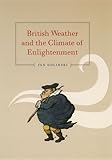
Jan Golinski. British Weather and the Climate of Enlightenment. Chicago: University of Chicago Press, 2007. 284 S. $35.00 (cloth), ISBN 978-0-226-30205-8.
Reviewed by Patricia Fara (Department of History and Philosophy of Science, Cambridge University)
Published on H-Albion (July, 2008)
Climates of Opinion: Discussing the Weather in Enlightenment Britain
"Whenever people talk to me about the weather," quipped Oscar Wilde, "I always feel certain that they mean something else." In his latest absorbing and topical book, British Weather and the Climate of Enlightenment, Jan Golinski explores what the weather meant to people living in eighteenth-century Britain. Then as now, comments on the current presence or absence of rain or sunshine were a form of phatic communication, a way of engaging in polite conversation while avoiding any significant interaction. As country diarists started keeping accurate records, they helped to consolidate a sense that the nation was divinely ordained to benefit from its own characteristic and superior climate. Yet at the same time, seasoned complainers were moaning about changes in the weather, which they blamed on recent innovations such as the growth of cities or deforestation. Their feelings resonate with modern reactions to disastrous events such as Hurricane Katrina, which struck the United States in 2005 and was regarded by both Christian conservatives and leftist environmentalists as retribution for human transgression.
Rather than examining the growth of meteorology, which only became a science in the nineteenth century, Golinski sets out to create a literary barometer of cultural transformation by retrieving discussions of how the weather was experienced and understood during the Enlightenment. As portrayed by the contemporary caricatures illustrating his book, the vagaries of the climate were held to affect both individual and national behavior. Recording the weather entailed not only making accurate measurements of temperature and rainfall, but also articulating personal responses to the day's climatic state. Drawing on a remarkable and previously undiscovered diary compiled in 1703, the year of Britain's memorable Great Storm, Golinski convincingly argues for a more idiosyncratic approach to weather documents, insisting that the eighteenth century should be appreciated as a continuation of the past rather than as a precursor of the future. Rural philosophers such as Golinski's unidentified diarist tried to furnish physical explanations for the storm's explosive force; in addition, inspired by earlier associations between the elements and the passions, they noted their own emotions, as if they had been sympathetically induced in temperaments attuned to the cosmos. Attributing extreme events to natural causes was consistent with interpretations based on God's will: although on this occasion Britain's fleet and crops had apparently been singled out for destruction, in general the island was blessed both by the fertile pastures of its temperate climate and the tropical fruits of its international trade.
Many historians place the origins of our modern commercial society in eighteenth-century Britain, and weather devices provide an excellent example of conspicuous consumption. In order to attract domestic purchasers wishing to advertise their wealth and discernment, instrument-makers supplied wares that were ever more accurate but also more finely crafted. As household ornaments, thermometers and barometers proved more popular than air pumps and telescopes, since they offered evidence of scientific interest yet demanded gratifyingly little expertise or accuracy. Initiating a practice that survives today, ingenious craftsmen integrated mirrors and barometer tubes, devising seductive marketing material: "Gentlemen and ladies at the same time they Dress, may accommodate their Habit to the Weather" (p. 124). Although instrument-makers also catered to more serious observers, there was no consensus on how quantifiable shifts in atmospheric pressure were related to perceivable alterations in the weather. By the end of the century experts remained, despite their meticulous record-keeping, unable to make accurate predictions, and this unreliability made it easy for critics to denigrate weather forecasting by associating it with astrology. Even so, long after the influence of the planets on human behavior had been generally discredited, the effects of the moon on the weather continued to seem significant. In the early nineteenth century, Luke Howard, now most famous for classifying cloud formations, struggled to reveal God's providential design for Great Britain by detecting a statistical relationship between lunar phases, barometric readings, and weather conditions, although his attempts were confounded by the complexity of the data.
As Golinksi observes, keeping a detailed weather diary over many years sounds a tedious exercise. Nevertheless, that obsessive compulsion to repeat routine tasks at regular intervals promised to bring order to the observer's own life as well as to the confusing diversity of natural phenomena. Focused on the weather, Golinski neglects to point out that such projects of massive data collection typified Enlightenment efforts to regulate nature by mathematical laws. He highlights the weather diaries of country clergymen, but they resembled the records of travelers who logged wind directions, or the observatory notebooks of rational experimenters who systematically counted the oscillations of a magnetic needle several times a day, or the time tables of Enlightenment philosophers who assembled historical data, some going back to biblical times, for special events such as an aurora borealis.
In this insightful book, Golinski draws a valuable historiographical lesson by warning against any search for a continuous success story of meteorological research. Over a century before Alexander Humboldt condensed his global data into smooth curves, the number-crunching astronomer Edmond Halley was urging "all Philosophical and Mathematical heads, to take under serious consideration the several Phaenomena, and to endeavour to reconcile them by some general rule."[1] Nevertheless, there was no uniform progress between Halley and Humboldt, reflecting the lack of any concerted program for organizing the weather. Pursuing their own interests, Enlightenment philosophers accumulated a great deal of information about regional climates and their effects on local character. Through cataloguing the weather, they hoped to understand the links between nature and humanity, while recognizing the impossibility of ever attaining this goal. As Golinski concludes, perhaps "it is a lesson we might feel is still worth attending to" (p. 214).
Note
1. Philosophical Transactions 13 (1683): 208-209.
If there is additional discussion of this review, you may access it through the network, at: https://networks.h-net.org/h-albion.
Citation:
Patricia Fara. Review of Golinski, Jan, British Weather and the Climate of Enlightenment.
H-Albion, H-Net Reviews.
July, 2008.
URL: http://www.h-net.org/reviews/showrev.php?id=14693
Copyright © 2008 by H-Net, all rights reserved. H-Net permits the redistribution and reprinting of this work for nonprofit, educational purposes, with full and accurate attribution to the author, web location, date of publication, originating list, and H-Net: Humanities & Social Sciences Online. For any other proposed use, contact the Reviews editorial staff at hbooks@mail.h-net.org.

