



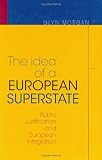
Glyn Morgan. The Idea of a European Superstate: Public Justification and European Integration. Princeton: Princeton University Press, 2005. xii + 212 pp. $18.95 (paper), ISBN 978-0-691-12246-5; $18.95 (paper), ISBN 978-0-691-13412-3.
Reviewed by Werner D. Lippert (Department of History, Indiana University of Pennsylvania)
Published on H-German (June, 2008)
Europe and Its Raison d'être
While in Germany during the tumultuous autumn of 1989, I rarely picked up a political magazine as the swift pace of events invariably outpaced any political publication with a print-cycle of more than a week. Similarly, explaining the often-unexpected fluctuations of the European integration process in the framework of an academic book also presents the challenge of being outpaced by subsequent events. Glynn Morgan nonetheless manages to make his words coalesce into many compelling thoughts on the topic of European integration.
First, he differentiates between project, process, and product of European integration and is thereby able to draw distinctions between the idea of a unified Europe, the process of integration, and the current outcome of said process. In doing so, he arrives at the conclusion that contemporary European struggles for integration do not stem from an institutional crisis, but rather from a crisis of justification. In clear language, he divides the integration debate into three distinct positions: Euroskeptics, who cling to the nation-state; Post-Sovereignists, who seek a new multilevel, decentralized polity; and Federalists, who look to the United States as a model for a federal structure with a centralized power. After breaking the debate down in this manner, he advances two central claims: first, that proponents of European political integration have failed to provide the "European Project" with a compelling justification and, second, that a European super-state akin to the United States is the most justifiable goal of European unity. These claims arise from the litmus test that Morgan applies to each justification for European integration: the "democratic standard of justification" (p. 41). This standard encompasses three factors: publicity (all Europeans must be able to accept such a justification), accessibility (any justification must be intelligible to ordinary citizens), and sufficiency (the justification must protect European goals and benefits effectively). Morgan then measures ideological nationalisms and conservative and social democratic ideologies alike against this benchmark. In both scenarios, Euroskeptic justifications in favor of strong nation-states come up wanting.
Next, Morgan takes steps to debunk justifications that favor European integration such as Friedrich Hayek's classic liberal concept of welfare and Jürgen Habermas's more contemporary social democratic concept of welfare. According to Morgan, these justifications also fail because of sufficiency and publicity. In other words, Morgan does not accept the economic argument as a raison d'être for a united Europe. Instead, he points to security as the overarching factor that could serve to unite Europeans, as it is the only justification that survives his requirement for a democratic standard of justification. Even so, not all models of European integration achieve this benchmark. In fact, he examines various forms of post-sovereignty and declares all of them too weak and indecisive to address Europe's security needs. A post-sovereign Europe would either be at the mercy of more centralized states, such as the United States, Russia, or China, or dependent on other states for its security. To Morgan, the only path to a truly sovereign Europe is the one that leads to a federal super-state with a central power at its core. To justify further the need for such a centralized Europe, he paints a bleak picture of current disagreements within the transatlantic alliance and, following the axiom that a uni-polar world cannot be stable, predicts the decline of NATO. To prove the need for an independent European military, he conjures up the rather unlikely scenario of a Europe that, faced with an Al-Qaeda attack, turns trigger-happy but finds its military wherewithal lacking, at the same time as the isolationist United States refuses to help Europe pursue military retaliation. For Morgan, the security provided by a federal European super-state, then, is the one compelling justification for European integration as it "provides Europeans with an additional option when multilateral institutions fail to serve their interests" (p. 166).
Morgan's work contains many valuable, truly insightful approaches for analyzing the European integration process. Focusing on the process of integration and its justification, rather than the current state of the European Union and its downfalls, renders this book a seminal theoretical work on European integration. Even though, as a historian, I am reluctant to embrace constructed benchmarks for fear of subjectivity, Morgan's first theme, the inadequacy of current justifications for European integration, is compelling and certainly rings true.
However effective the approach of focusing on the theoretical conditions for justifying integration as opposed to current circumstances, it nonetheless creates difficulties with his second argument. The claim that the real justification for European integration must be security, which is only achievable through a centralized structure, conflicts with reality "on the ground." As Morgan repeatedly admits, a centralized super-state seems less and less plausible. Beyond that, however, an emphasis on military security contradicts what Europeans have come to appreciate about the European Union. Most Europeans do not embrace a neorealist stance but have rather witnessed the highly effective spread of western democratic ideas throughout most of Europe by means of economic, but peaceful, coercion. I would, therefore, suggest that a strong, centralized European military would not only create political difficulties, it would also run counter to the very idea most Europeans have about what a united Europe symbolizes. Furthermore, the pressing need for a strong European military due to a presumed deterioration of NATO rests on questionable neorealist premises. Just as the deployment of mercenaries in Iraq or the transport of Bundeswehr soldiers to Afghanistan on Ukrainian long-range transport planes suggests, money serves security interests just as well as military prowess. For most Europeans, these military options seem sufficient and the likelihood that Europeans would wish to lash out unilaterally on a grand scale is slim. Even so, Glyn Morgan's book is highly insightful and a must-read for any upper-level class dealing with the European integration process.
If there is additional discussion of this review, you may access it through the network, at: https://networks.h-net.org/h-german.
Citation:
Werner D. Lippert. Review of Morgan, Glyn, The Idea of a European Superstate: Public Justification and European Integration.
H-German, H-Net Reviews.
June, 2008.
URL: http://www.h-net.org/reviews/showrev.php?id=14650
Copyright © 2008 by H-Net, all rights reserved. H-Net permits the redistribution and reprinting of this work for nonprofit, educational purposes, with full and accurate attribution to the author, web location, date of publication, originating list, and H-Net: Humanities & Social Sciences Online. For any other proposed use, contact the Reviews editorial staff at hbooks@mail.h-net.org.

