



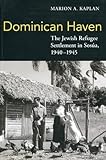
Marion A. Kaplan. Dominican Haven: The Jewish Refugee Settlement in Sosúa, 1940-1945. New York: Museum of Jewish Heritage, 2008. xiii + 256 pp. $19.95 (paper), ISBN 978-0-9716859-3-2.
Reviewed by Sonja Mekel (Department of History, University of Wisconsin-Madison)
Published on H-German (June, 2008)
Reluctant Farmers: Jewish Refugees in the Dominican Republic
The Evian Conference of 1938 sealed the fate of countless European Jews. This disgraceful conference marks a decisive moment in Marion Kaplan's intriguing book on one of the few havens for persecuted Jews, the refugee settlement in Sosúa in the Dominican Republic.
When the U.S. government called for a conference on how to deal with the imminent refugee crisis, its motto could have been Mark Twain's adage, "To be good is noble; but to show others how to be good is nobler and no trouble." Aware of the lack of pressure from the Americans, other participating nations did not make any effort to save the desperate, especially since the majority of the intended beneficiaries would be Jews. Considering the pervasive antisemitism or apathy that disinclined them to open their doors to Jewish refugees, it is all the more remarkable that one of them, the Dominican Republic, offered to take in 100,000 Jews. Even more remarkably, the Dominican Republic was not exactly a humanitarian's dream. The state was run by a dictator, Rafael Trujillo; the Dominican army had massacred several thousand Haitians just a few months prior to the conference; and the country did not have freedom of the press or any democratic institutions to speak of. What it had was a craving for settlers.
To be more specific: the Dominican elite craved "white" settlers. In the first chapter of her book, Kaplan offers a number of explanations for Trujillo's generous offer. While all of them may have played a role in his calculations, pragmatic considerations seem to have motivated him the most. One of the least populous islands in the Caribbean, the Dominican Republic was in dire need of farmers to cultivate the land. The most logical solution would have been to hire Haitians, but the generalissimo perceived the mostly black Haitians as an obstacle to his desire to "whiten" his population. This impetus was reflected clearly in his encouragement of Jewish settlers to intermarry with the locals. Jewish settlers were to become farmers, and, within limits, start industries that did not yet exist in the Dominican Republic (foreign Jews were barred from competing with already established industries). They were also intended to improve the government's image, another explanation Kaplan offers to account for the dictator's generosity. After the slaughter of the Haitians (the so-called "Parsley Massacre," or "El Corte"), Trujillo was interested in showing the world, or rather, the United States, his caring side. It did not matter to him that the refugees were Jewish: in contrast to other Latin American nations, many of which housed substantial German minorities, the Dominican Republic had a tradition of friendly relations with Jews. Beginning with the support the country had received from Jews in its struggle for independence, up to the personal friendship between Trujillo's daughter and a German-Jewish girl, Dominicans had discriminated but little against Jews. Philosemitism, however, was a much weaker motive than the wish to wrest economic favors and concessions from the United States. Trujillo hoped to end the U.S.-administered customs receivership and improve trade relations, especially in regard to sugar. Financial support from Jewish-American organizations was another promising prospect.
The actions of the Joint Distribution Committee and its agricultural branch, the Agro-Joint, which set up the Dominican Republic Settlement Association (DORSA), are the subject of the second chapter. DORSA's organizers, eager to prove that middle-class Europeans could, indeed, survive and even prosper in a tropical climate, did their best to find bona fide farmers for the settlement. Unfortunately, Jewish farmers were rare. Many of the refugees, anxious to leave Europe, nonetheless claimed to have experience in farming, or at least pledged to become "pioneers." At first, DORSA settled refugees in Batey, a makeshift encampment, from which some left for homesteads in another part of Sosúa. Some took to farming and more or less successful enterprises (dairy and meat production showed the best results), while others, lacking ability or motivation, remained in Batey. Not surprisingly, rather than remaining agricultural laborers or small artisans, most of the settlers left for other destinations after the end of the war. Kaplan's sixth chapter reveals the tensions between DORSA, whose leaders expected greater tractability from the people they had saved and continued to subsidize, and the settlers, many of whom were deeply traumatized and resented what they perceived as arrogance on the part of their benefactors. Gender imbalance and disagreements between Jews of different cultural backgrounds added to the discomfort.
The refugees' grievances were further aggravated by their fear for relatives left in Europe. With good reason: as Kaplan relates in chapter 4, several months after the first settlers arrived in Sosúa, the U.S. State Department withdrew its support for the project, even before the United States entered the war. A visa to the Dominican Republic (which could not have been more accommodating) was useless without a U.S. transit visa. The reasons for refusing the latter, foremost the alleged concern that the Sosúan refugees might be spies (a notion fueled by a spiteful article in a Washington newspaper), were mere pretexts to obscure officials' true motive: antisemitism. As a result, Sosúa never housed more than a paltry 476 settlers, rather than the projected 100,000. Readers may find this material infuriating to read, as it describes yet another instance of how thousands of Jews who might have been saved were left instead in German hands.
The intimate glimpses into the lives of those who did reach Sosúa make this chapter an even more upsetting read. Kaplan's intensive research of archival material, memoirs, the settlement newsletter, in addition to personal correspondence between her and surviving settlers and their children, gives the reader insight into the refugees' worries, relations with Dominicans, work routine, leisure activities, and romances. While the descriptions of the Sosúan settlers' daily life are entertaining and at times even funny, they leave a bitter aftertaste, as one wonders how many more might have taken beach photos, organized religious services, left cans of tomatoes in the heat until they exploded, and complained about the food, had they been permitted to leave Europe. Nevertheless, it is encouraging to read about the generally cordial relations between the refugees and their hosts, whose cooperation was vital for the survival of the settlement. The virtual absence of antisemitism among the Dominicans, according to a recent study that Kaplan cites, continues into the twenty-first century.
The book's many illustrations were part of a 2008 exhibition at the Museum of Jewish Heritage in New York, who is also its publisher. But Kaplan's excellent work is much more than only an accompanying volume: a case study of success within failure, it shows life after survival, on what was literally an island in the maelstrom of World War II. With a lively style, Kaplan describes the intricacies of international wartime politics with the same ease as the details of refugee life. Her research and writing make this a fascinating book for scholars and the general public alike.
If there is additional discussion of this review, you may access it through the network, at: https://networks.h-net.org/h-german.
Citation:
Sonja Mekel. Review of Kaplan, Marion A., Dominican Haven: The Jewish Refugee Settlement in Sosúa, 1940-1945.
H-German, H-Net Reviews.
June, 2008.
URL: http://www.h-net.org/reviews/showrev.php?id=14643
Copyright © 2008 by H-Net, all rights reserved. H-Net permits the redistribution and reprinting of this work for nonprofit, educational purposes, with full and accurate attribution to the author, web location, date of publication, originating list, and H-Net: Humanities & Social Sciences Online. For any other proposed use, contact the Reviews editorial staff at hbooks@mail.h-net.org.

