




Jon W. Finson. Robert Schumann: The Book of Songs. Cambridge: Harvard University Press, 2007. xvi + 318 pp. $49.95 (cloth), ISBN 978-0-674-02629-2.
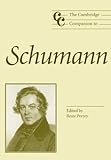
Beate Julia Perrey. The Cambridge Companion to Schumann (Cambridge Companions to Music). Cambridge: Cambridge University Press, 2007. xx + 302 pp. $90.00 (cloth), ISBN 978-0-521-78341-5; $29.99 (paper), ISBN 978-0-521-78950-9.
Reviewed by Sanna Pederson (University of Oklahoma School of Music)
Published on H-German (June, 2008)
Overturning the Verdict on Schumann's Late Works
Although Robert Schumann did not produce any more works after 1854, when he was committed to an insane asylum at the age of 43, he left behind a lifetime's worth of compositions of all shapes and sizes. Some of these have become beloved mainstays of the romantic repertoire, especially in the genre of the character piece for piano and of the Lied. Much of the music from the later part of his life experimented with form and genre, and these works are all but forgotten. Seven of the thirteen essays in The Cambridge Companion to Schumann survey the composer's work according to genre. The other essays fall under the headings "contexts" and "reception." Nothing is included on Schumann's important and influential career as a music critic and only a brief (eight-page) article on the romantic aesthetics of this extremely literary composer.
Instead of an editor's customary overview of the individual contributions, Beate Perrey's introduction gives a "necessarily cursory biographical sketch" (p. 5). Unsettling errors appear in this account of the main events of Schumann's oft-chronicled life. During the period 1829-31 Schumann trained to become a piano virtuoso; a hand injury ended these aspirations. This period, Perrey says, "coincides with two increasingly urgent concerns: to establish a public life and to create a private one with Clara" (p. 21). But these could hardly have been Schumann's concerns at this time, when he was a twenty-year-old piano student and his future wife Clara only nine. In her description of Clara and Robert's courtship, Perrey says that during their eighteen months of separation they "write to each other daily, sometimes two or three times" (p. 16). But one of the extraordinary aspects of this eighteen-month separation is that there were no letters or other communications. Perrey describes Schumann's output in the 1830s: "throughout the decade however, he composes, although comparatively little is published, let alone widely performed" (p. 16). A quick consultation of the useful chart on pp. 66-67 from another chapter, however, shows that almost all the piano music completed during the 1830s was also published in that decade. Finally, those who are familiar with the story of how the young Johannes Brahms became part of the Schumann circle months before Schumann's commitment to the asylum at Endenich, will be astonished to learn that "Brahms will remain faithful to Clara and Robert Schumann all his life, attempting at once to reconcile and consume his love for both by proposing marriage to their first child Marie--an attempt that fails" (p. 31). It is true that Brahms is known to have cherished a secret love for a Schumann daughter, not Marie but Julie. Far from proposing to her, however, he only revealed his attachment when she married someone else. The famous result of this episode in Brahms's life was the dark and anguished Alto Rhapsody (1869), which he dedicated to her.
After this disconcerting beginning, the book does include excellent chapters on the chamber music and the dramatic works. Linda Correll Roesner uses a career's worth of insight to examine the three String Quartets from Schumann's "chamber music year" of 1842. She argues for understanding the three quartets as a unified cycle on the basis of their tonal plan. She then compares them to two violin sonatas from 1851, showing that in both cases Schumann undermines sonata form in favor of thematic and tonal means of unification. In her essay, Elizabeth Paley examines a variety of types of works for voices and orchestra, describing in detail the oratorio Das Paradies und die Peri (1845) and the opera Genoveva (1851). She shows how Schumann experimented in his later works with new ways of text setting, using a more declamatory singing style in his opera, and making extensive use of melodrama (spoken declamation to musical accompaniment) in his setting of Byron's Manfred (1853). Paley argues a strong case for a major re-evaluation of these work's significance.
The distinguished musicologists Joseph Kerman and Scott Burnham give overviews of the concertos and symphonies, respectively. Burnham takes on the longstanding criticism of the symphonies as formally weak and poorly orchestrated. His openly affectionate descriptions focus on the local level of a sequence of contrasting episodes rather than on large-scale drama. Kerman analyzes the famous Piano Concerto in a minor (1846) and a variety of other more unusual pieces for solo instruments and orchestra.
Reinhard Kapp's essay on the reception of Schumann's life and work consists of a long list of assertions and a short amount of evidence and argumentation. He states at the beginning of his endnotes that "this essay is indebted to numerous earlier studies; here I will mention only the chapter on reception in Arnfried Edler's book on Schumann and the reports from the Artbeitstagungen in Zwickau" (p. 249). Neither of these studies are cited fully in the article, nor are they listed in the "select biography" at the end of the volume. This frustrating lack of documentation prevents the reader from making sense of many provocative claims. Why, for instance, does Kapp state: "The chapter on Schumann in the history of criticism is a sorry tale: composers acquit themselves scarcely any better than journalists (save for usually having something they want to say)" (p. 246)? Schumann's writing is usually seen as one of the more brilliant moments in the history of criticism! Why does Kapp claim: "A major biography has yet to be published, the new image of Schumann has yet to be consolidated" (p. 241)? John Daverio's 1997 book on the composer is certainly a major biography.[1] One wonders when this article was written, referring as it does to a 1990 publication as "very recent" (p. 251).
One issue that appears in several of the essays is Schumann's use of intertexuality--referred to variously as quotation, citation, allusion, or referencing. In his piano works, for instance, Schumann incorporated music by Clara and quoted himself. The symphonies allude to Classical-style symphonies both in general and in particular. Perrey notes that this practice is not restricted to music: "Schumann's compositions make rather generous use of, or allusions to, literature and poetry (through direct quotation, mottos, titles and various narrative techniques)" (p. 7). Examples include a quotation from a poem by Friedrich Schlegel at the beginning of the Fantasie, Op. 17 (1839), and the title Kreisleriana (1838), connecting the piano work to E. T. A. Hoffmann's mad musician Johannes Kreisler.
Reversing the negative evaluation of the late works, once dismissed as the product of a sick mind, is the other theme the essays have in common. Roesner, for example, sees the Piano Trio in g minor (1852) as one of the works that "embody the culmination of the composer's ever innovative approach to large-scale musical form" (p. 123). Compare that to an assessment in a collection of essays on Schumann published in 1972, in which the Piano Trio in g minor "belongs to the period of Schumann's increasing mental instability and shows a sad decline from the standard of the D minor Trio."[2] Besides Paley's article, which treats some relatively late works for chorus and orchestra, Burnham gives generous attention to the later orchestral pieces. Both Kerman and John Daverio in one of his two essays devote significant space to the Violin Concerto, a work from 1853 that was suppressed by Clara Schumann as a weak effort, performed and published for the first time only in 1937.
John Daverio devotes an entire chapter to Schumann's late style. In doing so, he brings up some points that certainly complicate matters. For instance, he notes that Schumann's work was criticized as dark, exhausted, and morbid earlier than one would think: "Even before Schumann's commitment, some of his later works were criticized for ... features that were subsequently ascribed to his deteriorating physical and mental state" (p. 274). Furthermore, while the late music was frequently described as exhausted, it was not called "mad." Unlike Schumann's early works, there is nothing wild or impetuous about the late style: if anything, there is "a draining of madness" from Schumann's last works (p. 272). And then there is the bottom line: "Needless to say, it is impossible to prove the aesthetic worth of Schumann's late music. Even the most painstaking motivic analysis will not convince the skeptical listener.... In other words, evaluations of Schumann's late works are very much dependent on the personal taste of the beholder" (p. 278).
The late style is also a major feature of Jon Finson's book, Robert Schumann: The Book of Songs. Schumann composed a total of 260 Lieder, mostly during two periods of his life: in 1840, his so-called "Lieder-Jahr," and in the period between 1849 and his incarceration. Because the first period produced his most well-known song cycles--Dichterliebe (1844), Frauenliebe und Leben (1843), and the Eichendorff Liederkreis (1842)--the second period tends to be overlooked. Indeed, it is not mentioned at all in Jonathan Dunsby's chapter on the songs in the Schumann Companion. The great song cycles offer so much that some feel no need to explore further. Doubts about Schumann's health have meant that many are quick to dismiss the later songs. For instance, in a very influential book on Schumann's songs first published in 1969, Eric Sams found "evidence of deterioration" in 1849.[2] Sams, who has been the most outspoken of many critics who discount the later songs, argued bluntly: "The evidence of the songs is plain. Schumann never again reached or even approached the level of his 1840 masterpieces" (p. 276).
Finson's explicit purpose is to replace Sams's guide to the songs. Finson examines every song in varying degrees of detail, giving an overview of the date and circumstances of composition, the poet, the form and content of the poem, and the way the music sets the poem. His treatment of the individual songs pays special attention to the aspect of text setting that determines how the music matches the poem's metric scheme. He also examines with great care how songs published together are related musically or thematically; he asks to what extent collections were also cycles of interconnected songs. As Finson treats the large number of song collections, he gives useful information about the more obscure poems and their authors. He also uses Schumann's correspondence with publishers to give an idea of the market for Lieder at the time. Staying focused on the songs, he avoids speculating on the state of Schumann's mind, instead finding interesting and beautiful things in the music.
Although this book functions for the most part as a guide--a source of helpfully organized information--Finson also presents a bold argument about differences in Schumann's style in his second phase of song composition. He notes a change in text-setting. Schumann moved away from the "quadratic" style of setting each line of poetry to a four-bar phrase, and toward a more irregular, more prose-like setting. This change in style is attributed not to mental deterioration, as Sams would have it, but to the influence of Richard Wagner. The two composers both lived in Dresden during the later 1840s and knew each other. Schumann's only written comments about Wagner's music describe his initially negative, later more positive impression of Wagner's opera Tannhäuser (1860). Finson surmises that after being exposed to this music and hearing Wagner expound his progressive theories first hand, Schumann adopted the Wagnerian stylistic characteristics of "irregular phrases, avoidance of periodicity, subversion of clear-cut cadences, and rapid alternation between lyrical and dramatic styles" (p. 175). This style favors dramatic expression over tunefulness. These qualities are exemplified in the last song from the collection Lieder-Album für die Jugend (1849), in which "Schumann means to tell us in a new style ... that he has the range to answer the 'New German' challenge" (p. 175). Finson further declares: "under the influence of his Dresden surroundings, he composed Zukunftsmusik in more than one sense of the word" (p. 181).
These assertions are debatable for a number of reasons. First, Schumann's style change in 1849 took place ten years before "New German" and three years before "Zukunftsmusik" began to be used to label Wagner's theories and music. Finson refers to the "'New German' challenge," but in 1849 no such challenge existed. Only after fleeing Dresden in May 1849 did Wagner himself start his own aggressive press campaign, which gathered steam in the Neue Zeitschrift für Musik. A showdown between the supporters of Wagner and of Schumann took place in the journal starting in 1850, as Finson notes (p. 264). This debate shows that the two composers were seen as practically polar opposites. If Schumann's music was taking on specifically Wagnerian characteristics, as Finson claims, then all the critics of the time completely missed it. Finally, if Schumann wanted "to respond to the challenge presented by 'music of the future'" (p. 159), why would he respond by adopting this style rather than countering it with his own? Finson's case for the late Schumann as musically progressive is convincing, but tracing the style directly to Wagner is problematic. Instead, it seems possible that general trends of the time allowed two temperamentally very different composers to pursue similar musical strategies.
Overall, despite these criticisms, both books evince a scholarly respect for the composer's late works that is more positive, perhaps, than anything since the nineteenth century. A large number of compositions have been authorized for appreciation and enjoyment. Who would want to argue with that?
Notes
[1]. John Daverio, Robert Schumann: Herald of a 'New Poetic Age' (New York: Oxford University Press, 1997).
[2]. Alan Walker, ed., Robert Schumann: The Man and the Music (London: Barrie and Jenkins, 1972), 218.
[3]. Eric Sams, The Songs of Robert Schumann (Bloomington: Indiana University Press, 1969), 227.
If there is additional discussion of this review, you may access it through the network, at: https://networks.h-net.org/h-german.
Citation:
Sanna Pederson. Review of Finson, Jon W., Robert Schumann: The Book of Songs and
Perrey, Beate Julia, The Cambridge Companion to Schumann (Cambridge Companions to Music).
H-German, H-Net Reviews.
June, 2008.
URL: http://www.h-net.org/reviews/showrev.php?id=14638
Copyright © 2008 by H-Net, all rights reserved. H-Net permits the redistribution and reprinting of this work for nonprofit, educational purposes, with full and accurate attribution to the author, web location, date of publication, originating list, and H-Net: Humanities & Social Sciences Online. For any other proposed use, contact the Reviews editorial staff at hbooks@mail.h-net.org.

