



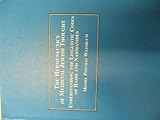
Moshe Pinchas Weisblum. The Hermeneutics of Medieval Jewish Thought: Understanding the Linguistic Codes of Rashi and Nahmanides. Lewiston: Edwin Mellen Press, 2007. 264 pp. $94.95 (cloth), ISBN 978-0-7734-5288-6.
Reviewed by Herbert W. Basser (Department of Religious Studies, Queens University, Canada)
Published on H-Judaic (June, 2008)
If the works of Rashi (1040-1105) and Maimonides had never been written, our understanding of Talmud and Jewish law would be much different than is now the case. Yet, had the works of Nahmanides (1194-1270) been unrecorded, not too much in Jewish learning would have changed. Perhaps scholarly interest in Kabbalah would not have been as great. Weisblum wants to show us the originality and lasting value of Rashi and Nahmanides (Ramban). Sadly, his book is filled with pseudo-academic language (including antiquated Latin abbreviations), inconsistent citations, serious ambiguities, imprecise attributions, and gross misunderstandings of primary and secondary sources. I was baffled by this note, "Professor Berliner notes that other commentators emulated Rashi in many ways, including using Rashi script," p. 71, n. 33). That script is really a relatively late Sephardic script used by printers to distinguish text from commentary and was never used by Rashi or other Ashkenazic commentators. The book suffers from excessive oversights. At times, half-sentences are intermingled with editorial error notations (e.g., "written in Mainz. Change to early Ashkenaz and is connected to...," p. 70, n. 32). Even more surprising, the reader will discover Maimonides had "scatological" ideas--I assume Weisblum had "eschatology" in mind (p. 221, n. 132). Weisblum gives no thought to textual accretions and changes from the time of Rashi's demise to the current printed editions of his commentaries and spins his sermons from printed minutiae in Rashi's readings. His major focus surrounds Rashi's usage of kelomar, "so to say" (this refers to paraphrase of a text by adding terse clarifying ideas). Weisblum claims it systematically deals with vowelization, etymology, parallel sources, separating verb from action (p. 95), ambiguous phrases, allegories, morals, metaphors, world outlook (chapter 3).
The work on Rashi is flawed throughout. I provide only two examples to represent the bulk. Where B. Shabbat (118a) remarks that anyone who enjoys the Sabbath is given nahalah belo metzarim, "unlimited rewards" (a phrase sung weekly in a Sabbath hymn Weisblum should know--we note his transliteration mitzrim [p. 94], which means "Egyptians"), Rashi cuts to the bone: "kelomar eyn lo ketz [the reward has no limit]." Weisblum thinks Rashi is in fact manufacturing a poetic image of a huge estate that cannot be fenced in. In fact, the Talmudic imagery saw the promise to Jacob to extend the land in all directions (beyond its boundaries) to intimate that the reward of those who delight in the Sabbath will also be equally extensive. Rashi clarifies what lies behind this imagery; he does not manufacture it. To cite another example: B. Berakhot 27a examines the limits of time expressed in the word "morning." The Talmud discusses the end limit for the morning Tamid offering and finds two conflicting opinions in the legal corpus: 1) morning is defined as ending at the fourth hour of the day or 2) ending at the sixth hour of the day. Yet, a Midrashic source seems to offer another time--the third hour. Rashi explains the Midrash's casuistry by adding a few clarifications to the Midrash: "kelomar...." What emerges is that the Midrash examines scriptures' precise terminology. It finds that by the fourth hour (when manna melted) morning had already passed. Rashi clarifies that (at this point of the day) scripture informs us that an unshielded sun is at its hottest (an hour after "morning" had finished) while in the sixth hour (when Abraham sat in the doorway of his tent) that same degree of heat could be felt even in the shade. The Midrash then would indicate a third opinion (third hour) for the end of "morning." Rashi annotated the Talmud's casuistry behind its query--which Mishnaic rabbi expressed the opinion of the Midrash that morning lasts only three hours and in turn that is when the Tamid sacrifice ended? The legal sources are silent about any such view. Now look at Weisblum's misconstruals: "Rashi, in comparing the two sources, determined that the halachah, "law" [to end morning prayer times]--should be six hours rather than four. He favored being lenient in this case, feeling that the manna was problematic, in that it dissolved after four hours because there was nothing to cast a shadow on it. On the other hand, even though Abraham sat in the shade of his tent six hours after sunrise, he nevertheless felt the heat of the sun" (p. 87). This is all nonsense. Rashi says nothing here about a fourth-hour prayer limit or a sixth-hour prayer limit and gives no ruling and does not feel the manna was problematic. Rashi explains how the midrash seems to establish a pre-fourth-hour time limit for morning (intimating the morning Tamid ended by three hours from sunrise).
Equally puzzling is Weisblum's work on Ramban's exegesis and works by Ibn Ezra and Maimonides (further confusing issues by calling them Kabbalistic). Only a student of Kabbalah and medieval philosophy will grasp the lack of critical analysis in many of his translations and conjectures. His detailed examination of Ramban's usage of derekh ha'emet ("true pathway," signaling unexplained allusions to hidden meanings in scripture) cites an impressive number of sources. But his presentation, while highly creative and original, is too obscure to communicate his points clearly. Also, Lurianic writings require more care in discussing Ramban than Weisblum allows since they often make use of a form of mysticism that post-date Ramban by close to three centuries. Since mysticism is by its nature so elusive and Ramban so secretive about his notions there is no decisive way to posit what he really intended to say. Still, there are some valuable insights in Weisblum's book. The strongest part of his work is in the discussions of reincarnation and of the sacrificial service. Nevertheless, in general, the work is amateurish and it looks like he himself gave up by impatiently publishing an unfinished draft which embeds suggestions for editorial revisions. Much of the time I was muddled and confused because of his lack of clarity and apparent lack of grasp of much of the subject matter.
If there is additional discussion of this review, you may access it through the network, at: https://networks.h-net.org/h-judaic.
Citation:
Herbert W. Basser. Review of Weisblum, Moshe Pinchas, The Hermeneutics of Medieval Jewish Thought: Understanding the Linguistic Codes of Rashi and Nahmanides.
H-Judaic, H-Net Reviews.
June, 2008.
URL: http://www.h-net.org/reviews/showrev.php?id=14603
Copyright © 2008 by H-Net, all rights reserved. H-Net permits the redistribution and reprinting of this work for nonprofit, educational purposes, with full and accurate attribution to the author, web location, date of publication, originating list, and H-Net: Humanities & Social Sciences Online. For any other proposed use, contact the Reviews editorial staff at hbooks@mail.h-net.org.

