



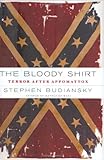
Stephen Budiansky. The Bloody Shirt: Terror after Appomattox. New York: Viking, 2008. Illustrations + maps + notes + bibliography + index. $27.95 (cloth), ISBN 978-0-670-01840-6.

Michael W. Fitzgerald. Splendid Failure: Postwar Reconstruction in the American South. Chicago: Ivan R. Dee Publisher, 2007. x + 234 pp. $26.00 (cloth), ISBN 978-1-56663-734-3.
Reviewed by Edward Blum (Department of History, San Diego State University)
Published on H-CivWar (June, 2008)
Still Bloody, Still Tragic: The History of Reconstruction
Almost twenty years ago, historian Michael Perman ended his review of Eric Foner's Reconstruction: America's Unfinished Revolution, 1863-1877 with a troubling question: "Ironically, because this synthesis is so successful and thorough, it does raise one unsettling question and leave it unanswered--what is left to be done?"[1] Thankfully, the last twenty years has seen its number of challengers to Foner. The entire field of Reconstruction is once again open for debate. Feminist scholars, such as Laura F. Edwards, LeeAnn Whites, and Nina Silber, have shown that Foner neglected issues of gender that were central to the postwar recreation of southern and northern societies. Labor and class historians, including Susan O'Donovan in her recent Becoming Free, uncovered the intricate relationships between labor, power, work, and gender at the local level of everyday life. Kirk Savage demonstrated how racial ideas were mapped onto the sculpture of Reconstruction. Heather Cox Richardson identified the American West as a crucial site of activity and imagination, while Cecilia O'Leary showed how new terms of nationalism were constructed in the decades following the war. David Blight followed the older work of Paul Buck to show how historical memories of the Civil War influenced Reconstruction, while Daniel Stowell and W. Scott Poole investigated the power of religion in the saga of Reconstruction. I have tried to tie notions of whiteness, religiosity, and American nationalism into the story with Reforging the White Republic. At this point, Reconstruction is without a definitive starting point (some begin in 1861; some in 1863; and some in 1865) and without a definitive ending point (some conclude in 1877; some in 1898; and some in 1917). Even Vernon Burton's new synthetic work on the Civil War, The Age of Lincoln, progresses further in time than Foner's account. There are a slew of new issues that need addressing in any broad work on Reconstruction, including notions of nationalism and whiteness, the gendering of labor practices, religion and popular culture, and art and literature.[2]
Two new books, Michael W. Fitzgerald's Splendid Failure and Stephen Budiansky's The Bloody Shirt, respectively demonstrate the brilliance of works that draw upon this new body of scholarship and the limitations of those that fail to keep up with the new literature. Ironically, while Fitzgerald's synthesis will receive far less national coverage (for instance, probably no review in the New York Times) it far surpasses Budiansky's study in intellectual creativity, freshness, and insight. Budiansky wrote what most historians already know and finds himself praised because he published with a trade press. Fitzgerald synthesized much new knowledge, but will probably still be overlooked in favor of Foner. This lack of justice fits perfectly with the era of Reconstruction.
The new body of Reconstruction scholarship is in need of a new synthesis, and Michael W. Fitzgerald does an admirable job seeking to provide one. Set Splendid Failure side by side with Foner's Reconstruction and one quickly sees that Foner's work dwarfs Fitzgerald's. Even Foner's A Short History of Reconstruction is almost one hundred pages longer than Fitzgerald's. But pound for pound (or perhaps page for page) Fitzgerald provides an excellent survey of the Reconstruction era. Much of the work parallels Foner. African Americans are once again at the heart of the study. They search and push and drive for freedom only to be thwarted in almost every way. Most southern whites are once again seen as intransigent, using violence, political bullying, and new laws to take back power. Northern whites once again lose interest in the mighty cause of Reconstruction and move onto other concerns. Yet Fitzgerald's study is unique in two ways. First, he shows that white and black Republicans eased the path to northern capitulation to white supremacy; and second, he incorporates recent work on gender, labor, and geography to show the workings of emancipation in the everyday lives of southern blacks and whites.
Fresh off Urban Emancipation: Popular Politics in Reconstruction Mobile, 1860-1890 (2002), Fitzgerald has long been thinking about Reconstruction politics. Splendid Failure is the culmination of more than twenty years of deep thinking and deep reading on the era of Reconstruction. As any short synthesis will be, it is not chock full of particular examples and anecdotes, or inundated with statistics or percentages. But it does wonderfully oscillate between the South and the North to discuss how the South changed (and failed to change) and how the North shifted its perceptions of African Americans, southern whites, and the South itself. All of the usual historical suspects are here: Andrew Johnson, Ulysses S. Grant, Klan terrorists, noble and tricky southern politicians, conservative Supreme Court members, Wade Hampton, and Rutherford B. Hayes. But Fitzgerald builds upon the new scholarship and includes a host of other pertinent characters and issues. For instance, he pays attention to the geographies of home building after the Civil War, the place of black women within these communities, and the ebb and flow of northern opinion.
Splendid Failure pulled me back to graduate school when I was first reading and adoring William Gillette's The Retreat from Reconstruction, Mark Wahlgren Summers's Railroads, Reconstruction, and the Gospel of Prosperity, and Richard Current's Those Terrible Carpetbaggers.[3] Reading Splendid Failure was splendid. The prose is quick, at times witty, and always readable. It reminded me of why I not only love to research in the period, but teach it as well.
Stephen Budiansky's The Bloody Shirt reminded me of why I find the trade press and the whims of media attention to historical works frustrating. Budiansky's is the study of violence committed against African Americans and their white allies in the years following the Civil War. Budiansky treks through southern white resistance to Reconstruction, northern white attempts to bring safety and sanity, and the substantial bloodshed at the core of "redemption." He focuses mostly on individuals, including John Richard Dennett, Lewis Merrill, Prince Rivers, James Longstreet, Albert T. Morgan, Adelbert Ames, Albert T. Morgan, and Ben "Pitchfork" Tillman. In an attempt to bring readers back in time, Budiansky includes dozens of newspaper and pamphlet snippets, along with some letters, that discussed the violence at hand. These primary document inclusions are fascinating, but they are no more remarkable than what my undergraduate students locate in primary document assignments. In fact, my students find far more creative information with simple Internet searches.
Budiansky "proves," as the dust jacket proclaims, "that terrorism is hardly new to America." What undergraduate who has taken a course on the United States does not already know that to be the case? What reader of the New York Times does not know that southern whites used violence during Reconstruction, that the Ku Klux Klan was formed during it, or that voter fraud ran rampant during the era? Sure, there are neo-Confederates who disagree; there are those who still love the "Lost Cause," but anyone reading this book will probably already know the main themes. If we turn to the bibliography, we see precisely why The Bloody Shirt lacks fresh insight. Budiansky looked into a few archives and read a few memoirs. But his great failing was in the reading of secondary scholarship. Fewer than fifty secondary articles and monographs are listed. I would imagine that Fitzgerald read more than that (and incorporated more than that) for half of each chapter in his work. In the classroom, Budiansky's main points could more affordably and more cleverly investigated by using either Albion Tourgée's A Fool's Errand or Howard Fast's later Freedom Road.[4]
But perhaps even more disturbing is Budiansky's lack of historical vision. In this work of popular history, women have one role: to be married. They exist to be romanced and wed, leaned on and cared for. They never act politically, unless they are supporting their husbands, and they rarely speak in the text. African Americans find themselves represented by one or two individuals, while there are several main white characters. Budiansky begins with a narrative that includes banners and architecture, but abandons this type of cultural studies approach very quickly.
My sense is that books like Budiansky's come and go. They receive their share of immediate media attention and in a few years they become relics on public library shelves, rarely checked out, and eventually sold for $1 by the "friends of the library." Fitzgerald's book will not inspire new conceptions of Reconstruction; it will not challenge Foner's book as the grand synthesis of the era of Reconstruction. But it will serve as a counter to Foner's study. In its brevity and range, its depth and inclusiveness, Splendid Failure is the kind of short synthesis we need. It would have been nice if Fitzgerald had pushed beyond 1877, but for what it is, Splendid Failure is a model for studies of other key moments in American history.
Notes
[1]. Michael Perman, "Eric Foner's Reconstruction: A Finished Revolution," Reviews in American History 17, no. 1 (March 1989): 73-78.
[2]. Laura F. Edwards, Gendered Strife and Confusion: The Political Culture of Reconstruction (Urbana and Chicago: University of Illinois Press, 1997); LeeAnn Whites, The Civil War as a Crisis in Gender: Augusta, Georgia, 1860-1890 (Athens: University of Georgia Press, 1995); Nina Silber, The Romance of Reunion: Northerners and the South, 1865-1900 (Chapel Hill: University of North Carolina Press, 1993); Susan E. O'Donovan, Becoming Free in the Cotton South (Cambridge: Harvard University Press, 2007); Kirk Savage, Standing Soldiers, Kneeling Slaves: Race, War, and Monument in Nineteenth-Century America (Princeton: Princeton University Press, 1997); Heather Cox Richardson, West from Appomattox: The Reconstruction of America after the Civil War (New Haven: Yale University Press, 2007); Cecilia E. O'Leary, To Die For: The Paradox of American Patriotism (Princeton: Princeton University Press, 1999); David W. Blight, Race and Reunion: The Civil War in American Memory (Cambridge: Harvard University Press, 2001); Paul Buck, The Road to Reunion (Boston: Little, Brown and Company, 1937); Daniel Stowell, Rebuilding Zion: The Religious Reconstruction of the South, 1863-1877 (New York: Oxford University Press); W. Scott Poole, Never Surrender: Confederate Memory and Conservatism in the South Carolina Upcountry (Athens: University of Georgia Press, 2004); Edward J. Blum, Reforging the White Republic: Race, Religion, and American Nationalism, 1865-1898 (Baton Rouge: Louisiana State University Press, 2005); and Orville Vernon Burton, The Age of Lincoln (New York: Hill and Wang, 2007).
[3]. William Gillette, Retreat from Reconstruction, 1869-1879 (Baton Rouge: Louisiana State University Press, 1979); Mark W. Summers, Railroads, Reconstruction, and the Gospel of Prosperity: Aid under the Radical Republicans, 1865-1877 (Princeton: Princeton University Press, 1984); and Richard N. Current, Those Terrible Carpetbaggers (New York: Oxford University Press, 1988).
[4]. Albion W. Tourgée, A Fool's Errand: A Novel of the South (1879; reprint, New York: Harper Torchbooks, 1961); and Howard Fast, Freedom Road (1944; reprint, Armonk, NY: M. E. Sharpe, 1995).
If there is additional discussion of this review, you may access it through the network, at: https://networks.h-net.org/h-civwar.
Citation:
Edward Blum. Review of Budiansky, Stephen, The Bloody Shirt: Terror after Appomattox and
Fitzgerald, Michael W., Splendid Failure: Postwar Reconstruction in the American South.
H-CivWar, H-Net Reviews.
June, 2008.
URL: http://www.h-net.org/reviews/showrev.php?id=14599
Copyright © 2008 by H-Net, all rights reserved. H-Net permits the redistribution and reprinting of this work for nonprofit, educational purposes, with full and accurate attribution to the author, web location, date of publication, originating list, and H-Net: Humanities & Social Sciences Online. For any other proposed use, contact the Reviews editorial staff at hbooks@mail.h-net.org.

