



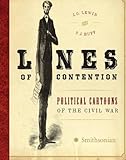
J. G. Lewin, P. J. Huff. Lines of Contention: Political Cartoons of the Civil War. New York: HarperCollins, 2008. xi + 212 pp. $19.95 (paper), ISBN 978-0-06-113788-4.
Reviewed by Robert Cook (Department of American Studies, University of Sussex)
Published on H-CivWar (June, 2008)
Cartoon Carnage
In his promotional comments of this book, Daryl Cagle, a professional cartoonist, contends that "Lines of Contention gives a great picture of the Civil War through the lens of the cartoonists. There is no better way to understand the attitudes of a divided nation than through cartoons" (back cover). This is quite a claim. Ninety-seven political cartoons of the Civil War era, most of them published between 1860 and 1865, are reprinted here. Drawn mainly from Frank Leslie's Illustrated Magazine, Harper's Weekly, Punch, and Vanity Fair, they also include a smattering of other images from sources as diverse as the short-lived Republican campaign sheet, The Rail Splitter, and patriotic envelopes of the day. The artists range from well-known illustrators, such as Thomas Nast and Sir John Tenniel, to the obscure Baltimore copperhead, Adalbert J. Volck. Topics authors J. G. Lewin and P. J. Huff cover include the 1860 and 1864 presidential election contests, the secession crisis, Abraham Lincoln's revocation of John C. Fremont's emancipation edict, the Trent affair, sundry military events, the New York City draft riots, and Lincoln's assassination. There are, unfortunately, no prints from Reconstruction.
Some of these cartoons will be well known to specialists of the Civil War. Among them are Nast's brilliant renderings of the consequences of a George B. McClellan victory in 1864, in which a disabled, humiliated Union veteran reluctantly shakes hands with a haughty Confederate over a gravestone marked "In Memory of the Union Dead Who Fell in a Useless War," and the dark depiction of Jefferson Davis in Harper's Weekly as the grim reaper harvesting the bones of America's war dead. Others, however, may be less familiar. This reviewer, certainly, had never seen the envelope illustration of Davis as a cunning fox carrying off geese marked "Virginia" and "Tennessee" in the aftermath of Fort Sumter, or Volck's chilling vision of Lincoln as a jester in "The Comedy of Death."
As these examples suggest, humor was often in short supply during the war years. Many images, however, draw real power from their satirical bite, not least the merciless lampoons of James Buchanan or the risqué depiction of a federal tax collector peering under a woman's stays for items bearing duty. Buchanan, seemingly powerless in the face of secession, features heavily at the start of this collection, depicted variously as an old Irish housemaid on the verge of dismissal; an aloof father unimpressed with the actions of his son, "Bobby" Anderson; and an incompetent cowboy unable to master the bucking bronco, South Carolina.
There are numerous images of Lincoln. Many demonstrate perfectly the great cartoonists' abilities to pass comment on complex issues and events with the simplest of drawings. One arresting illustration, from Frank Leslie's Illustrated Magazine at the time Lincoln revoked Fremont's emancipation edict in Missouri, depicts the president clinging onto a life raft marked "Union" while pushing a drowning slave beneath the waves of a stormy sea. Several Lincoln images are broadly positive, deepening our awareness of the contributions some cartoonists made to his burgeoning grassroots popularity. Others, however, emphasize that the president was not always held in high regard during the war. The angry figure of Columbia pointing accusingly at Lincoln (who can only respond with a pathetic offer of folksy humor) speaks for hundreds of thousands of angry Northerners after the Union debacle at Fredericksburg.
While the authors are to be commended for making available a treasure trove of political cartoons that will be of use to all teachers of the Civil War, it is unfortunate that their accompanying text is generally simplistic and lacking in analytical penetration. The fact that the book has been designed for the mass market is no excuse for the vapid chapter introductions that are hampered by a superficial grasp of historical scholarship or for the many individual commentaries inattentive to the nuances of the images to which they are attached. The authors' commitment to an outdated paradigm is evident from the start in their contention that "Slavery was an abomination, according to the abolitionists in the North. Preachers throughout New England, the Mid-Atlantic region, and the new western states railed against it and demanded that it end. So it ended in those states. But that wasn't enough for them. Slavery needed to be abolished every-where and for all time" (p. 4). The superficial quality of the commentary is clearest in a depiction of a cartoon of two disabled Union veterans--one black, the other white--shaking hands, which is reprinted without any observation of the degree to which concepts of loyalty reconfigured race relations in the wartime North. Worryingly, too, there are plenty of elementary mistakes. States are confused with territories in a botched definition of popular sovereignty. The description of Steven Douglas as "a staunch believer in democracy" is an alarming way to describe a racist demagogue (p. 41). Fort Donelson is misspelled as Fort Donaldson. And, even Adalbert is rendered "Aldabert" (pp. 65, 130).
This is a serviceable book, but had the authors, evidently nonspecialists, immersed themselves more deeply in current historiography, they would have written a much better one. How did readers respond to these images? What was the relationship between the cartoons and the fierce partisan conflicts of the era? How did the prints influence changing white attitudes to blacks in the 1860s? Unfortunately, these are important questions that Lewin and Huff do not ask, let alone provide answers. As for Cagle's outspoken claim for the explanatory significance of Civil War cartoons, one is bound to observe that virtually all of these images were produced in the North or Great Britain. Presumably, historians will have to look elsewhere to understand the Confederate side of the story.
If there is additional discussion of this review, you may access it through the network, at: https://networks.h-net.org/h-civwar.
Citation:
Robert Cook. Review of Lewin, J. G.; Huff, P. J., Lines of Contention: Political Cartoons of the Civil War.
H-CivWar, H-Net Reviews.
June, 2008.
URL: http://www.h-net.org/reviews/showrev.php?id=14583
Copyright © 2008 by H-Net, all rights reserved. H-Net permits the redistribution and reprinting of this work for nonprofit, educational purposes, with full and accurate attribution to the author, web location, date of publication, originating list, and H-Net: Humanities & Social Sciences Online. For any other proposed use, contact the Reviews editorial staff at hbooks@mail.h-net.org.

