



Stephen Budiansky. The Bloody Shirt: Terror after Appomattox. New York: Viking, 2008. Illustrations + maps + notes + bibliography + index. $27.95 (cloth), ISBN 978-0-670-01840-6.
Reviewed by Michael Fitzgerald (Department of History, St. Olaf College)
Published on H-Law (June, 2008)
This is a difficult book for an historian to review, because it is not clear what the appropriate standards should be. The author makes no secret of his goal: this is "a work of popular history" (p. 10). This apparently encouraged some odd editorial choices; the author explains his own occasional use of the word "colored," as "true to the spirit of the day" (p. 10). So far as I can determine, Mr. Budiansky is a journalist who has published a dozen books with titles like The Character of Cats (2002) and If a Lion Could Talk (1999). Several are historical in nature, dealing mostly with military espionage, but none bear on the Civil War era. This is not a work of mature scholarship, and the limited bibliography reflects that. The book does not cite George Rable's study of violence during the postwar era, the scholarly work that best mirrors the topic of this book. Still, historians of the Civil War era rest on the cusp of a large popular audience; we are under some obligation to pay attention to works directed beyond the profession, as with this one bearing the Viking imprimatur. The work may have utility for the Barnes and Noble set, given the intellectual universe with which it shares shelf space.
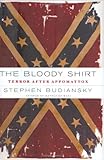
The title, The Bloody Shirt, suggests the emphasis, as does the outsize Confederate battle flag gracing the cover. The opening sentence refers to a "brutal war of terrorist violence," and Budiansky demonstrates that central contention effectively (p. 1). This will not be a startling thesis in a field long dominated by revisionists, but the basic argument is consistent with modern scholarship. Historians will be thankful for that much.
The book retells some of the better-known accounts by prominent Republican eyewitnesses, supplemented by some research in manuscript collections. Virtually all of these voices were white, predominantly of northern origins. The names might almost be guessed: Adelbert Ames and A. T. Morgan of Mississippi, for example, are well known to scholars. Ex-Confederate General Longstreet provides a vignette of a well-known "scalawag," who was reviled for his Republican politics. More unusual is the close reading of the career of Major Lewis Merrill, one of the officers involved with the repression of the Klan in South Carolina. The book also features an effective retelling of the columnist John Dennett's 1865 tour of the southern states, which sets the stage for the bloodletting to come. Though African American sources are infrequently featured in this account, several of the episodes do permit examination of their motivation; the Hamburg massacre allows an effective grounds-eye look at race relations in a black-governed community. The strength of this book is to spotlight several of the more notorious episodes, and to illuminate the horrific scale of the era's one-sided violence through concrete examples. The author interweaves his episodes with appalling snippets from the Democratic press, and also letters from both proponents and victims of terrorism. For readers who are unfamiliar with the history, this retelling will be effective. I read the book in a day, finding myself diverted.
Still, there is little new here for historians, and they are explicitly not the target audience. Indeed, the author's decision to omit ellipses from his quotations actually poses problems for scholars. It offers those who skip the author's introduction an opportunity for introducing errors into their own work. Be warned, we will likely be seeing misquoted material from this book disseminated through the Internet; the work presents something of a moral hazard for the profession. This decision by the author is doubly unfortunate, in that the book is not marred by many factual errors. Nor do the interpretations of individuals or events described seem particularly biased to me. Reconstruction is complex and unfamiliar to modern audiences, and one expects to find political details wrong. Readers will be agreeably disappointed in that regard.
On the other hand, the limitations of this work are evident. The book is long on description, short on analysis. The social context for the emergence of Klan-style terrorism is vague, or perhaps, unduly specific. Disappointment over the loss of slavery, and the restoration of white supremacy, are nearly the exclusive motivations. Other factors like the legacy of the antebellum patrol system, or the evolution of plantation production toward sharecropping, are not in evidence. Indeed, the terms antebellum "patrol" and postbellum "sharecropping" never appear in the index. The topics of taxation and railroad promotion only appear as excuses for the insane violence. Corruption charges primarily appear in the context of Mississippi, where Republican governance was relatively upstanding, as the author correctly notes. All the complex of overlapping terrorist motivations familiar from the work of Allen Trelease, Eric Foner, and other scholars is only slightly in evidence here. The author does not even quote Foner's trenchant encapsulation of the Klan as intended to restore white supremacy in all the ways it had been threatened. A fair amount reflecting the southern Democrats' viewpoint is quoted, but primarily to demonstrate their savagery. Fair enough, given the episodes Budiansky accurately describes; they do lend themselves to a recitation of barbaric acts. But historians probably expect more than this.
In particular, the author never really engages with the motivation of southerners. The freedmen's own voices receive surprisingly short shrift. Now the surviving primary sources available certainly nudge one in that direction, but African American voices are not so scarce as this work would suggest. Such sources would provide a better sense of black agency in this tempestuous era; the whole point of Foner's magnum opus--little reflected upon in this work--was that Reconstruction really was a revolutionary challenge to white supremacy. Nor does Foner's point that the Grant administration effectively repressed the Klan in the early 1870s get much attention; the Republican sellout theme gets a heavy workout here. As for the conservative whites, we do not get much sense of the raw fear that encouraged night-riding activity, the sense that emancipation meant anarchy. The widely denounced Union Leagues do not much appear in the text, nor does the deployment of Reconstruction state militias in South Carolina, despite its obvious relevance for the outrageous Klan violence there. Klan participation often looked like prudent self-defense to rural whites, a belief-system that probably deserves some exploration. Nor does the ebb and flow of conservative opinion on violence get more than passing reference. The interplay of Democratic faction and economic interest Michael Perman examined in The Road to Redemption (1984) gets short shrift here.
In sum, I don't think this book has much to offer historians, nor would I recommend it for classroom use. The things it does well are probably done as well by specialists, providing a better sense of the social context for students. On the other hand, the author may well have accurately read what his intended market will bear. The work is consistent with the direction of modern scholarship on Reconstruction, and is generally vivid in presentation and accurate in detail. For that much, and with the target audience it seeks, it probably deserves some credit.
If there is additional discussion of this review, you may access it through the network, at: https://networks.h-net.org/h-law.
Citation:
Michael Fitzgerald. Review of Budiansky, Stephen, The Bloody Shirt: Terror after Appomattox.
H-Law, H-Net Reviews.
June, 2008.
URL: http://www.h-net.org/reviews/showrev.php?id=14581
Copyright © 2008 by H-Net, all rights reserved. H-Net permits the redistribution and reprinting of this work for nonprofit, educational purposes, with full and accurate attribution to the author, web location, date of publication, originating list, and H-Net: Humanities & Social Sciences Online. For any other proposed use, contact the Reviews editorial staff at hbooks@mail.h-net.org.

