



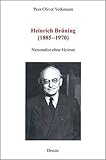
Peer Oliver Volkmann. Heinrich Brüning (1885-1970): Nationalist ohne Heimat: Eine Teilbiographie. Düsseldorf: Droste, 2007. 883 pp. EUR 58.00 (cloth), ISBN 978-3-7700-1903-8.
Reviewed by C. Edmund Clingan (Queensborough Community College, City University of New York)
Published on H-German (May, 2008)
Assessing a Weimar Chancellor
The name of Weimar chancellor Heinrich Brüning often disappears from historical accounts after his resignation from the position in 1932. But Brüning lived a long life afterwards. Brüning fled to the United Kingdom in 1934 and joined the faculty of Harvard University in 1937. His postwar return to Germany was soured by a poor relationship with Konrad Adenauer, which stemmed from his criticism of the western orientation of Adenauer's foreign policy, and he returned, disgruntled, to the United States, where he died. Peer Oliver Volkmann provides a second funeral for Brüning in this lengthy "partial" biography. Volkmann has done a masterful and exhaustive job of detailing the stations of Brüning's life after 1933, but does not always connect this narrative effectively to the earlier portions of the chancellor's life.
A number of studies have been made of the controversial chancellor who governed Germany from 1930 to 1932. Volkmann's approach is to skirt Brüning's rise to power and his chancellorship and focus on the period after he left office. In 795 pages of text, the first 226 bring him to 1932, and only 135 pages address his chancellorship. Perhaps Volkmann felt that the detailed biographies of Brüning's career to 1933 by William Patch (1998) and Herbert Hömig (2000) did not leave enough room for another detailed analysis. Volkmann pays little attention to Brüning's tenure as the tax and finance expert of the Catholic Center party, when Brüning forged ties to like-minded fiscal conservatives from other parties such as Rudolf Hilferding of the SPD, who supported Brüning during his chancellorship. The book does not much discuss the maneuvers of 1929 and 1930 that landed Brüning in the top position. In contrast to earlier works, however, Volkmann uses a minute description of the years from 1933 to 1970 to reflect on Brüning's time in power and demonstrates that Brüning's anti-democratic, antisemitic, monarchistic, and nationalistic views were all present before his 1934 exile from Germany.
In order to make this case, Volkmann has to establish that Brüning had embraced certain attitudes even before his tenure as chancellor. For his discussion of the earlier period of Brüning's life, Volkmann appears to work around the biographies by Patch and Hömig, as well as older work by Werner Conze, Josef Becker, and Rudolf Morsey. Volkmann's work treats many themes in a different way. For instance, Volkmann demonstrates Brüning's nationalism on many occasions, yet oddly does not discuss the role of Brüning's brother Hermann during the Ruhr occupation. Although he makes allusion to written attacks during World War II against "my beloved brother," Volkmann does not mention charges that Hermann was an anti-French terrorist. Volkmann does try to cut through the murk of Heinrich Brüning's activities in the years before 1924, when he became a Reichstag representative and cut his ties to the radicals. He was a member of the radical right-wing Juniklub but opposed the violent overthrow of the Republic. For close to four years he worked with the Political College (PK) for Nationalist Political Education and Promotion. Volkmann speculates that Brüning left the PK because he was uncomfortable with its ties to the Pan-German League and the right wing of the German National People's Party (DNVP).
An important question in previous research has been the extent of Brüning's fascism. Here, Volkmann compares Brüning's views with those of Mussolini and finds some similarities. Both were revisionists in foreign policy. Volkmann follows Klaus-Ulrich Benedikt's argument that Brüning was a main force behind the "Essen Program" speech (1920) delivered by Adam Stegerwald. This speech contained fascist elements. It identified the Marxist parties as the main enemy. Brüning was clearly anti-liberal. He constantly referred to the constitution of the Kaiserreich as the ideal for Germany. However, Brüning never cultivated the taste for violence and blood that fascist leaders need. He also lacked magnetism. One of my old professors, Andrew Whiteside, took a course from Brüning at Harvard and found him "as interesting as a lukewarm mug of coffee."
A second major point of studies of Brüning has been the matter of Brüning's economic policies during the Depression. Here, Volkmann says little, but does explain the meaning of Brüning's claim, "I sharpened the crisis" (p. 762). This claim does not mean that Brüning embarked on his ruinous policies to drive Germany into hunger and unemployment deliberately--a position that would attribute to him an inappropriately exaggerated mastery of economic policy. According to Volkmann, the "crisis" should be taken to mean only the reparations question: "But Brüning took into account the social result of this policy: the mass impoverishment.... The ascetic Brüning expected the German people to make any sacrifice to free Germany from the 'chains' of the Versailles 'peace dictate" (pp. 762-763).
But the burden of the study falls on Brüning's later years, where Volkmann does make some new assertions. John Wheeler-Bennett, for instance, believed that Brüning became an antisemite only in the 1950s, but Volkmann demonstrates a long pattern of bigoted statements on his subject's part. Brüning charged that the German revolution of 1918 was carried out by men with "stuttering strong eastern accents" (p. 43). In his memoirs, Brüning complained that war profiteers and international speculators filled Berlin in 1919, which Volkmann takes to mean Jews. By the 1940s, Brüning was claiming that Hitler was a foreign agent backed by French and British industrialists and certain Jewish bankers such as Oskar Wassermann. At this point, I wish Volkmann had discussed Brüning's behavior during the German bank crisis of 1931. Wassermann led the Deutsche Bank and the Disconto-Gesellschaft (or "Dedibank"). The Dedibank was the second major bank to fall into trouble after the Danat. Did Brüning's animus play any role in making this worse? Why did he single out Wassermann? Brüning also claimed that a "Zionist clique" sank his budget proposals in 1930 (p. 99). He blamed Jewish Reichstag representatives for the passage of the Enabling Acts in 1933.
Although present earlier, as Volkmann shows, Brüning's antisemitism intensified after the war. In a May 1945 interview, Brüning denied reports of the Holocaust; privately, he called them "vicious propaganda" (pp. 532-533). He warned that the Jews planned the biological eradication of Germans as revenge. He claimed that Catholics and Protestants had been persecuted more severely in the 1933-37 period than the Jews. According to him, antisemitism was inspired by "eastern Jews who returned with German troops from Russia and made speculations in the inflation" (p. 547). By the 1950s, he was saying that a "Jewish camarilla" around Prussian minister president Otto Braun had gained control of the police in the 1920s and plotted indirect control of the Reichswehr (p. 536). Brüning also turned against Hans Schäffer, the former state secretary of the Finance Ministry. In his memoirs, written in the 1930s and up to 1947, Brüning had been favorable to Schäffer, and Schäffer in turn had defended Brüning's policies. This constellation was apparently disrupted after Adenauer consulted Schäffer on the Schumann Plan. By 1956, Brüning was calling Schäffer a traitor in private letters and claiming that Schäffer sabotaged negotiations. This information also gives us an excellent insight into right-wing opposition to Adenauer's foreign policy. Brüning was not quite a neutralist, but he opposed the European Defense Community and had deep misgivings about the Coal and Steel Community.
"Like nearly any anti-Semite," Brüning could single out some "good Jews": Rabbi Leo Baeck, Berlin police president Bernhard Weiß, the Warburgs, and banker Jakob Goldschmidt (pp. 538-539). In 1957, Brüning wrote, "[t]he fate of the Jews had been so frightful that one forgets that several of them brought about the catastrophe and my fall" (p. 537). What Volkmann calls "his perverted love for Germany, his wrong-headed patriotism" led Brüning to blame the victims (p. 539). Aside from his politics, though, Brüning is also shown as personally obnoxious. He drove away Americans who befriended him, such as Hamilton Fish Armstrong and George Shuster, with pro-German statements during World War II.
Orienting his account on the former chancellor's later years allows Volkmann to explore Brüning's character in detail. Brüning was a shy and reticent man. Volkmann shows this at times without quite driving home the point. When I read Brüning's cabinet records, I was amazed how passive he seemed to be toward his own cabinet and how little he spoke during meetings. This behavior was in marked contrast to that of nearly every other Weimar-era chancellor. He might have preferred more quiet one-on-one meetings, although he does not seem to have been more persuasive in such settings. His longtime assistant, Claire Nix, provided Volkmann a glimpse into Brüning's private life in exile. The only things that gave him pleasure were walks and listening to records of classical music. He did not go to the theater or movies or concerts. No indication survives that he shared intimacy with anyone or even had a pet.
Volkmann, like most other biographers before him, omits a discussion of Brüning's spiritual beliefs. He obviously was a strong Catholic, raised with the traditional leanings and grudges of the Catholic Center party in Münster. Brüning loathed Eugenio Pacelli, the later Pope Pius XII, and clearly had issues with other parts of the Catholic hierarchy. In a 1943 discussion, Brüning indicated that the pope was essentially fascist in his outlook. A closer look at Brüning's religious sympathies, however, would illuminate a number of historical issues. How did he square the problems raised by economic catastrophe and fascism with his religion? How did he react to the American Catholic Church? Did he ever attend mass in New England? Did he feel forsaken by God? I do not know of sources that could provide answers to these questions, but for a man whose identity was tied to his religion, they need to be pondered. Most intriguingly, a discussion of Brüning's spiritual life might reveal whether something in his belief system left him unable to empathize with other people, or whether this attitude resulted from posttraumatic stress after combat in World War I.
These questions point to the only fault in the book: that Volkmann concentrates on the dark threads of his subject's life. It is hard to understand from this account and others how this dull, introverted, surly, bigoted man ever gained political support. Yet, he was first choice for the leadership of the Catholic Center and the natural choice for the chancellorship, and he held the position for more than two years under trying circumstances. After a performance that can only be called catastrophic, his loyalists defended him for decades. Even men he secretly belittled and insulted, such as Schäffer and Hans Luther, justified his policies in retrospect. In 1945, Luther told Allied officers that Brüning should return as Chancellor to which they replied, "[w]e were afraid you would mention him."[1] Luther offered no alternatives. This persisting appeal may stem from the mystique of the front-line soldier to noncombatants. Alternately, it may be that the dirty secret of the members of the Weimar ruling class was that Brüning represented their real views quite well, even if they were never so forward themselves.
Volkmann makes his case, effectively supporting his conclusion that Brüning's memoirs accord well with his life and statements before 1918 and after 1934. Brüning's socialization in the Kaiserreich, his membership in the Juniklub, the Essen speech of 1920, and his article in Junges Zentrum all mirror the beliefs he espoused in the memoirs. Even so, despite several attempts, no one has yet written the definitive biography of this unpleasant man. Such a work would need to combine Volkmann's evaluation of Brüning's political views and character, Patch's political biography, and Dieter Hertz-Eichenrode's explanation of Brüning's economic views with an analysis of Brüning's religion and spirituality to explain how these factors molded the rest of his personality. In short, despite the many strengths of this book, readers who want a full sense of Brüning's career should take Volkmann's subtitle seriously and read at least one other account.
Note
[1]. Bundesarchiv Koblenz, N1009 (Luther papers), vol. 379.
If there is additional discussion of this review, you may access it through the network, at: https://networks.h-net.org/h-german.
Citation:
C. Edmund Clingan. Review of Volkmann, Peer Oliver, Heinrich Brüning (1885-1970): Nationalist ohne Heimat: Eine Teilbiographie.
H-German, H-Net Reviews.
May, 2008.
URL: http://www.h-net.org/reviews/showrev.php?id=14540
Copyright © 2008 by H-Net, all rights reserved. H-Net permits the redistribution and reprinting of this work for nonprofit, educational purposes, with full and accurate attribution to the author, web location, date of publication, originating list, and H-Net: Humanities & Social Sciences Online. For any other proposed use, contact the Reviews editorial staff at hbooks@mail.h-net.org.

