



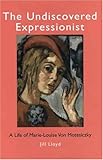
Jill Lloyd. The Undiscovered Expressionist: A Life of Marie-Louise von Motesiczky. New Haven: Yale University Press, 2007. 288 pp. $45.00 (cloth), ISBN 978-0-300-12154-4.
Reviewed by Julie Johnson (Department of Art History, University of Texas at San Antonio)
Published on HABSBURG (May, 2008)
Art Overcoming Death
Written by a highly respected scholar of German expressionism, this biography of Marie-Louise von Motesiczky (1906-96) is much more than just a biography. By recreating the milieus and wider historical circumstances of Vienna and London, the artist's two main residences during her life, Jill Lloyd also tells the story of emigration, loss, displacement, and starting over that so many Central European Jews faced. It is an immensely valuable resource because it is so complete and particular--the author had access to all of the artist's papers, correspondence, and paintings. She moves from describing political events to personal life and art with ease, and is a master of the art of suspense, never giving away the horrible disappointments and sudden shocks that the artist faced in her life.
Lloyd's biography provides one answer to a question currently under discussion among art historians who are recovering the stories of women artists: what is the relationship between art and life? A question of methodologies of reading representations is at the heart of this concern and has been an ongoing debate in the case of Artemisia Gentileschi. But, in the case of Marie-Louise von Motesiczky, the answer to the question is undoubtedly: "everything." Lloyd writes a convincing story in which paintings are read as autobiographical representations of Motesiczky's life; there are autobiographical elements in nearly all of her early works, and many of her later works are self-portraits alone or with friends that depict psychological situations. But, this is no naive art history conflating intention with meaning; it is a biography written by a sophisticated reader of images with all of the tools of theory and history at her disposal.
As Lloyd demonstrates, Motesiczky's art and her life were intimately connected. To give just two examples, in Two Women and a Shadow (1951), the artist shows herself seated on a couch with Olda Kokoschka, with whom she had begun a friendship. Their poses are formal and awkward, and between them looms a recognizable shadow: Oscar Kokoschka's lantern-chinned profile. He did, indeed, interrupt, dominate, and even pay inappropriate attention to Motesiczky, who enjoyed a friendship with his wife. In another portrayal (In the Garden [1948]), she shows herself with clipping shears in a garden, exchanging glances with a grim Elias Canetti (her lover, who lived with her in her English garden home when he was a refugee during the war). In front of them, her Aunt Ilse dominates, oblivious to the relationship behind her. The dynamic of the trio sums up her life during that time, when Motesiczky negotiated the complicated relationships at her new home in exile, while trying to find the time and psychological space to create her own art.
The first two chapters of The Undiscovered Expressionist are devoted to describing the world that Motesiczky was born into: a third-generation aristocrat, she grew up in the Todesco palace and a large, eighteen-room villa outside Vienna, in Hinterbruehl. The Todescos held salons and parties, and Vienna's musicians, writers, and scientists frequented the palace. Her grandmother, Anna von Lieben, was one of Sigmund Freud's earliest patients, and was crucial for his insights on the unconscious. Her mother fell in love with Hugo von Hofmannsthal as a young girl, a relationship that became part of the family mythology. Motesiczky was privileged and protected; she was allowed to drop out of school at age thirteen, which she later regretted. Her story buttresses Steven Beller's proposal in his Vienna and the Jews, 1867-1938: A Cultural History (1991) that the fin-de-siecle Vienna that we know was predominately Jewish, although class and gender were more significant concerns of the time. Lloyd tells us that the artist negotiated and understood her Jewish identity as a delicate balancing act--being a woman artist was a much bigger category with which to deal--but this inevitably changed after the Holocaust.
Lloyd devotes her next chapters to Motesiczky's development as an artist and her life as an art student and "bohemian." While a young girl, she met Max Beckmann, and the meeting changed her life. She decided to become an artist. While she reinterpreted Dutch art, El Greco, Manet, and others, she kept a catalogue of Beckmann's work in her studio all her life. It was marked with paint stains, and it was clear that she always thought his art was worth studying. The book then moves to Motesiczky's exile in England and the loss of her brother, who started a resistance group in Hinterbruehl but was tricked, denounced, and sent to Auschwitz, where he died. Throughout his life, she had been loyal and devoted to him, and after she learned of his death, she painted a still life that commemorated him beautifully. It was based on the last bag of apples from Hinterbruehl, which a visitor had delivered--what might appear at first glance to be a simple still life in the modernist tradition is a melancholy meditation on her brother's plans to turn the estate into an apple orchard.
Over the course of her life, Motesiczky had many friends; among the famous were Theodor Adorno, who was married to her cousin, and Wolfgang von Paalen, whom she met as an art student in Germany. Kokoschka and Beckmann were lifelong supporters of her, as was Ernst Gombrich. Her tormented relationship with Canetti, which at its nadir, kept her from painting for two full years, was something she described as her "personal catastrophe" (p. 192). In Lloyd's narrative, we learn that Motesiczky's mother repeatedly interfered with her love interests; the artist sometimes regretted what might have been, but she remained open to new people and experiences throughout her life.
In the sixties, she began painting portraits of people she saw on London's streets and invited home to sit for her. They, too, became friends. One even became a traveling companion to Mallorca in 1989 and Israel in 1994, when Motesiczky was over eighty years old. Lloyd's last chapters focus on the artist's care of her mother and a new lease on life in old age. As her mother become frail (she died in 1978 at the age of ninety-six), Motesiczky's movements were constricted because she was her mother's primary caregiver. In the end, this part of her personal life led to the creation of what many consider her greatest works. Motesiczky solved her painting problem by simply painting her mother. Gombrich compared the resulting portraits of her aging mother to Albrecht Durer's honest appraisal of his own mother.
Throughout the book, Lloyd points to some particularly original compositions. In At the Dressmaker's (1930), the artist shows herself in a self-searching image while her dressmaker drapes and pins her (she loved shopping and spent enormous amounts of money on clothing). Lloyd also notes that the artist had a sense of humor--paintings that have been referred to as "expressionist surrealism," or that seem allegorical, are also filled with humor and a love of banality. One of her better-known paintings, The Travellers (1940), references ship of fools imagery in a story of exile: in a boat are four figures. A woman looking at a mirror allegorizes vanity (although it is her own dear nursemaid), while a portly nude woman with jewels and a headscarf looks out at the viewer, embracing what seems to be a Torah to her bosom (Henriette, her mother). The artist insists this is a sausage (one that is large enough to look like a Torah). The "black humour," as Lloyd calls it, is human and endearing, especially given the circumstances that led to it: the shock of having to leave one's home suddenly (p. 102). Motesiczky is in the boat, in a nearly unrecognizable state, with her mouth open in shock. The painting strikes me as typical of her allegorical tendencies. She used the language of expressionism, psychological insight, and objects from the everyday to tell her stories--something that a later critic called her "poetic realism" (p. 168). The personally coded sense of humor does not keep the paintings from touching on more universal psychological issues--in part, because she employs art historical prototypes, but also because of her penetrating analysis of human beings. For these reasons, she was compared by a critic to Rembrandt, who was able to portray human emotion with great psychological depth (p. 173).
Lloyd suggests that while Fluxus artists were dealing with reuniting art and everyday life, Motesiczky could be understood as recreating the lost world of Vienna. Lloyd compares many of the later still lifes that Motesiczky painted to the objects and comforts of old Vienna, which the house outside London recreated for many of its visitors (her brother was able to ship most of their belongings to London). But the artist was also open to new things, and these appear in her later paintings. For example, Lloyd notes that Motesiczky's mother had an electric car in which she careened around recklessly, frightening the neighbors (a subject of her painting that was hardly an item from old Vienna). A faddish new sport toy that Motesiczky called her "Gummiball" also appears in paintings. In her own way, the artist reunited art and everyday life through penetrating psychological representations of her own daily experience.
In the preface to the book, Lloyd writes that the theme of art overcoming death was one of Motesiczky's major concerns. Canetti believed that art could overcome death, and this was a constant theme in their relationship; he encouraged Motesiczky in this regard, always supporting her work privately and publicly. Since her death in 1996, there is some evidence that her art will indeed overcome her death. She has already been commemorated in her native Vienna with two major exhibitions at the Belvedere, including one while she was alive--a rare honor for an artist. She is well known in Vienna, in part through the efforts of Sabine Plakolm-Forsthuber, who has pioneered much of the research on women artists there, including Kuenstlerinnen (1994). The Marie-Louise Motesiczky Charitable Trust has commissioned not only Lloyd's beautifully written biography, but has also supported a traveling exhibition of her work, which was seen in four European cities, and a catalogue raisonne, compiled and written by Ines Schlenker (forthcoming).[1]
Lloyd's biography is illustrated well with several color reproductions, but Lloyd also discusses many paintings that were not illustrated, leaving the reader wanting more. This is a compliment of the highest order: to be left wanting to see the paintings and to spend more time looking at them must be what the artist would have wanted. The book is affordable because of the omission of many reproductions of her paintings; readers can access additional color reproductions in the exhibition catalogue supported by her estate. When Schlenker's catalogue raisonne is published, the images will be made available on the trust's Web site (www.motesiczky.org).
All art historians know (and some artists regret) that objects take on new lives and meanings when they are sent out into the world. Motesiczky kept most of her works with her, giving a few out as gifts, but was only truly happy when they went into major museum collections. There were few exhibitions of her work during her lifetime, and these came late. The meanings of the works then have been doubly tied to the artist, for not having been sent out into the world earlier.
Motesiczky's work is primarily an art of personal witness and psychological penetration of human experience. Because of her ability to portray emotional content, her art is strong enough to invite new interpretations that go beyond the personal connections to her biography. Lloyd's biography has paved the way for such future readings of the artist's work. It will be a key work for reading the artist's oeuvre for the foreseeable future. While it is written well enough to appeal to a general audience (it would make an excellent gift), the author has laid a solid foundation for researchers to embark on new interpretations of individual paintings. It is well researched and convincing. To have such a resource in English is an important contribution, especially in the area of Central European women artists, many of whom remain to be discovered by a larger public. I hope that there will be many more readings of Motesiczky's paintings to come, for this is the only way in which memory can be secured--through repetition and renewed assessment.
Note
[1]. Jill Lloyd, Birgit Sander, and Ines Schlenker, eds., Marie-Louise von Motesiczky, 1906-1996 (Munich, Berlin, London, New York: Prestel, 2006). The exhibition traveled to the Tate Liverpool, Museum Giersch, Wien Museum, and Southampton City Art Gallery.
If there is additional discussion of this review, you may access it through the network, at: https://networks.h-net.org/habsburg.
Citation:
Julie Johnson. Review of Lloyd, Jill, The Undiscovered Expressionist: A Life of Marie-Louise von Motesiczky.
HABSBURG, H-Net Reviews.
May, 2008.
URL: http://www.h-net.org/reviews/showrev.php?id=14518
Copyright © 2008 by H-Net, all rights reserved. H-Net permits the redistribution and reprinting of this work for nonprofit, educational purposes, with full and accurate attribution to the author, web location, date of publication, originating list, and H-Net: Humanities & Social Sciences Online. For any other proposed use, contact the Reviews editorial staff at hbooks@mail.h-net.org.

