



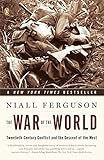
Niall Ferguson. The War of the World: Twentieth-Century Conflict and the Descent of the West. New York: Penguin Books, 2007. lxxi + 808 pp. $18.00 (paper), ISBN 978-0-14-311239-6; $35.00 (cloth), ISBN 978-1-59420-100-4.
Reviewed by Talbot Imlay (Département d'histoire, Université Laval, Québec)
Published on H-German (April, 2008)
An Awfully Bloody Awful Half-Century
As a historian, Niall Ferguson is in a class by himself. He is the author of several best-selling books on topics such as the First World War, British and American empires, the role of money over the past three centuries, and the Rothschild banking family. Along the way, he has presented several television documentaries related to the subjects of his books and has written scores of editorials, book reviews, and articles for prominent newspapers and magazines. But Ferguson is not merely a successful--not to say, the most successful--public historian. Also to his credit is an academic monograph on politics and business in Hamburg during the opening three decades of the last century as well as an important edited collection on counterfactual (or virtual) history. If this were not enough, Ferguson has also published and continues to publish articles in leading academic journals.
As befits someone of Ferguson's talent and energy, his latest book offers a panoramic study of war, conflict, and violence during the first half of the twentieth century. As with most of his earlier books, this one is ambitious in design and wide-ranging in scope. Its arguments are often convincing, sometimes provocative, and occasionally frustrating. The book, in short, is eminently readable despite its considerable length. Following recent scholarly trends that underscore the dark, not to say, catastrophic history of the twentieth century, Ferguson sets out to explain why its first five decades experienced such high and, indeed, unprecedented levels of violence and especially death. The answer, he argues, lies in three overlapping factors: ethnic conflict, economic volatility, and the decline of empires. The presence of these three factors distinguishes the period from earlier and later ones, and the changing mix of the three accounts for the variegated nature of the violence, whether in terms of place and time or in terms of the identity of victims and perpetrators. This variation notwithstanding, Ferguson suggests that the period should be viewed as a whole, as a "fifty years war" (or "war of the world")--one defined by multiple, sometimes overlapping regional conflicts that overflowed the temporal boundaries of 1914-18 and 1939-45. To this schema, Ferguson tacks on an additional argument concerning the decline of the West: the twentieth century, he insists, witnessed a transformation in world politics marked by the rapid end of western dominance over the East (Asia), a process due in no small part to the rippling effects of conflict and war.
Ferguson constructs this sort of macro-narrative history as well as anyone, but that does not make it easy to review. Much is to be praised in Ferguson's book, not least the display of encyclopedic knowledge in confident, punchy prose. Typically for his work, Ferguson points to paths for further research, as with his argument that a key to explaining why wars end when they do is the question of whether combatants believe they can surrender without being killed by the enemy. When they do, they are more likely to surrender en masse, effectively ending a war.[1] And, as usual, Ferguson raises interesting questions, such as that of who really won World War II. One obvious answer is the western Allies, but their victory, he remarks, was "tainted" both by their association with the Soviet Union and by their questionable choice of weapons, most notably the strategic bombardment of enemy cities and, of course, the dropping of two atomic bombs. Another answer is that the Soviet Union won the war, but the magnitude of Soviet material and human loss cast a long shadow over this success, even if a German victory would have been unbearably worse. Taking a longer perspective, Ferguson suggests that Asia and especially China won the war, although here one might add that the price of Asia's rise (the presumed counterpart to the West's descent) was borne largely by Asians. Another and related question posed by Ferguson is the precise beginning and end of World War II. Any dates proffered are open to dispute, but Ferguson is certainly right to stress that 1939 and 1945 are inadequate markers for much of eastern Europe and Asia.
Even in a work as laudable as this, some readers may find themselves questioning some of Ferguson's decisions about what to include in his narrative. To be sure, even books of this scope necessitate choices. But one does wonder whether two whole chapters on British appeasement policy towards National Socialist Germany are necessary in such a study. In other chapters, Ferguson gives prominent billing to the Nazi regime's revolutionary racial aims and policies, which culminated in genocide, as well as to the violence that the Stalinist regime inflicted on untold millions inside and outside of the Soviet Union's shifting borders. If the extended treatment of Nazi and Soviet atrocities is entirely justified, a more systematic discussion of Japanese war aims towards, and occupation policies in, Asia and the Pacific would have been welcome for comparative purposes. At various points in the book Ferguson suggests that Nazi Germany and Josef Stalin's Soviet Union can be grouped under the rubric of totalitarianism. Perhaps so, but what about imperial Japan (not to mention fascist Italy)? Are the differences between the three regimes of a fundamental or merely incidental nature? More generally, Ferguson is clearly at his best when discussing events in Europe, with the result that Britain and Germany figure prominently, perhaps disproportionately. Asia, by comparison, appears to be given somewhat short shrift.
One might also question the book's periodization. The "war of the world," Ferguson proposes, concluded in 1953 with the armistice in Korea. This choice, however, leads him to relegate the complex and sometimes brutal process of decolonization after 1945 to the book's afterword, a slightly odd choice for a study concerned with the reasons for the West's decline. More to the point, Ferguson's tripartite explanation might usefully be applied to several cases of decolonization. To take the example of the Algerian war, in addition to ethnic conflict and a declining empire, a good deal of economic volatility was present despite consistently strong growth, most obviously in the form of France's recurrent budget deficits and balance of payments crises but also in its inconsistent economic policies in Algeria.[2]
For specialists in German history, a more important question for assessing this book will be the extent of its engagement with relevant literature. Even though the book is aimed principally at a non-specialist audience, and Ferguson can hardly have been expected to address all or even most of the specialist arguments in the vast literature on twentieth-century war and conflict in Germany, he might have done more to incorporate some recent, relevant scholarship. For example, in discussing the origins of war in 1914, Ferguson makes much of the point that investors and financiers appear to have discounted the possibility of war, which he takes as a starting point for two related arguments: that Europeans did not expect war in 1914 and that Europe was less militarized than is often portrayed. But if investors and financiers certainly had a stake in anticipating war, so too did general staffs, whose principal task was to contemplate and prepare for the eventuality of war. More to the point, the subject of pre-1914 German military strategy in particular has attracted a good deal of recent attention. Ferguson does refer to Terence Zuber's controversial thesis that there was no "Schlieffen Plan" and that Germany did not possess an offensive war plan, although it should be added that Annika Mombauer, Robert Foley, and others have effectively refuted Zuber's arguments. Zuber aside, however, Ferguson neglects the intriguing work of Stig Förster in particular on what might be termed the irrational elements of German war planning before 1914. For Förster, German military planners appear to have been far from confident that a future war would be short or that Germany could win it if it were prolonged. But rather than fostering caution, these doubts encouraged the belief that Germany must be willing to risk and wage war since the alternative, to admit that war was too uncertain an option, was simply unacceptable.[3] In the pressure-cooker of the 1914-18 period, moreover, this refusal to consider unacceptable options transmuted into a rejection of any outcome short of outright victory. As Germany's prospects dimmed, military and civilians leaders increasingly insisted that the decisive factor was not material capabilities but the will of the nation and people to triumph. From here, it was small step to the conviction that utter destruction of the nation was preferable to admitting defeat--a conviction that underpinned various proposals in 1918 for a national uprising and that became a self-fulfilling prophecy for the Nazi regime during the Second World War.[4]
The "irrational" nature of German war planning and war conduct raises the question of the extent to which Germany should be treated as a case apart--a version of the Sonderweg thesis. Despite the lack of an obvious answer, it is worth remarking that Ferguson's global perspective has the effect of crowding out a discussion of the question. In any case, given Ferguson's interest in the common elements of conflict across countries and regions, he might usefully have drawn from an approach to the study of war known as "cultures de guerre." Proponents of this approach, who have labeled themselves the "École de Péronne," after the war museum in the Somme, stress the importance of lived experience, of examining how war and its aftermath were understood by soldiers and civilians. How, they ask, did individuals and social groups respond to the omnipresence of danger, violence, death, and loss? Rejecting portrayals of people as largely passive victims of a massive, insatiable war machine, they prefer to see soldiers and civilians as active participants in giving meaning to their experiences. In fact, one common theme of their work is consent--the idea that people willingly accepted the increasingly onerous burdens of war, convinced as they were that their cause, unlike that of their enemies, was just, if not divinely sanctioned.[5] Given Ferguson's interest in the phenomenon of collaboration, most notably but not solely in terms of the Holocaust, the École de Péronne's work on the reasons for and nature of consent might have been worth exploring. More generally, the notion of war culture (or cultures) as pervasive, as marking language, the arts, family life, and political rituals among other things, not only merits further study in its own right, but also might be used as an additional means of distinguishing the period from others.
Finally, Ferguson might have addressed the debate over the usefulness of the term "total war." The term is employed periodically and offhandedly here, always without definition. Partly in reaction to this sort of use of the term, several scholars working with the German Historical Institute in Washington, D.C., launched an extended project into the meaning of total war from the mid-nineteenth to the mid-twentieth centuries.[6] Although after five published volumes, no consensual definition of the term emerged, the project identified several factors, such as the increasing lethality of weapons, the mounting ability of governments and societies to mobilize resources, the collapsing distinction between combatant and non-combatant, and the expanding scope of war aims, which together helped to make wars longer as well as more deadly and destructive. But much remains to be explored, including the question of the inevitability--or otherwise--of the totalizing process of war. In his book, Ferguson underscores the role of ideologies, especially racist, expansionist ones, in the massive violence of the period. Yet, as the war on the Western Front during 1914-18 suggests, before the advent of thermonuclear weapons, any war involving several great powers would likely have been long, bloody, and cruel for both soldiers and civilians, independent of murderous ideologies.[7] This is not to say that latter are irrelevant to the course and to the origins of the conflicts of the period, but rather that it is not easy to distinguish, let alone to classify, the various factors that account for the unprecedented levels of violence. One advantage of engaging with the debates over the definition of total war is that it pushes one into thinking further about the role of various factors and of the interaction between them.
In the end, this book is an extended, stimulating study of a complex and fascinating subject. If this makes it a good read, it also all but ensures that a reviewer will consider the book through the lens of his or her own research interests. If Ferguson has not produced the final word on why the first half of the twentieth century witnessed such massive violence and death, he has certainly provided ample food for thought not only about the period in question, but also about our own age, in which ethnic tensions, economic volatility, and declining empires appear to be factors of increasing importance.
Notes
[1]. Ferguson further develops this argument in "Prisoner Taking and Prisoner Killing in the Age of Total War: Towards a Political Economy of Military Defeat," War in History 11 (2004): 148-192.
[2]. On this question, see Matthew Connelly, "The French-American Conflict over North Africa and the Fall of the Fourth Republic," Revue française d'histoire d'Outre-Mer 84 (1997): 9-27; and Daniel Lefeuvre, Chère Algérie: comptes et mécomptes de la tutelle coloniale, 1930-1962 (Saint-Denis: Societe francaise d'histoire d'outre-mer, 1997).
[3]. Stig Förster, "Der deutsche Generalstab und die Illusion des kurzen Krieges, 1871-1914. Metakritik eines Mythos," Militärgeschichtliche Mitteilungen 54 (1995): 61-98. Förster tries to extend the argument beyond Germany in "Im Reich des Absurden: Die Ursachen des Ersten Weltkrieges," Wie Kriege entstehen: Zum historischen Hintergrund von Staatenkonflikten, ed. Bernd Wegner (Paderborn: Schöningh, 2000), 211-252.
[4]. See Michael Geyer, "Insurrectionary Warfare: the German Debate about a Levée en masse in October 1918," Journal of Modern History 73 (2001): 459-527; and Bernd Wegner, "Hitler, der Zweite Weltkrieg und die Choreographie des Untergangs," Geschichte und Gesellschaft 26 (2000): 493-518.
[5]. For the approach, see Antoine Prost and Jay Winter, Penser la Grande Guerre. Un essai historiographique (Paris: Seuil, 2004), 42-50, 217-233, 281-289; and Stéphane Audoin-Rouzeau and Annette Becker, "Violence et consentement: la 'culture de guerre' du premier conflit mondial" in Pour une histoire culturelle, ed. Jean-Pierre Rioux and Jean-François Sirinelli (Paris: Seuil, 1997), 251-271. It is worth adding that the argument about the dominance of consent has been vigorously criticized. For example, see Frédéric Rousseau, La guerre censurée. Une histoire des combats européens de 14-18 (Paris: Seuil, 2003), 7-23.
[6]. For the final volume in the series, see Roger Chickering, Stig Förster, and Bernd Greiner, eds., A World at Total War: Global Conflict and the Politics of Destruction, 1937-1945 (Cambridge: Cambridge University Press, 2005).
[7]. See John Horne and Alan Kramer, German Atrocities 1914: A History of Denial (New Haven: Yale University Press, 2001), parts 1 and 2; and Alan Kramer, Dynamic of Destruction: Culture and Mass Killing in the First World War (Oxford: Oxford University Press, 2007), 6-30.
If there is additional discussion of this review, you may access it through the network, at: https://networks.h-net.org/h-german.
Citation:
Talbot Imlay. Review of Ferguson, Niall, The War of the World: Twentieth-Century Conflict and the Descent of the West.
H-German, H-Net Reviews.
April, 2008.
URL: http://www.h-net.org/reviews/showrev.php?id=14466
Copyright © 2008 by H-Net, all rights reserved. H-Net permits the redistribution and reprinting of this work for nonprofit, educational purposes, with full and accurate attribution to the author, web location, date of publication, originating list, and H-Net: Humanities & Social Sciences Online. For any other proposed use, contact the Reviews editorial staff at hbooks@mail.h-net.org.

