



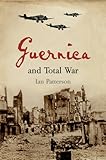
Ian Patterson. Guernica and Total War. Cambridge: Harvard University Press, 2007. 199 pp. $22.95 (cloth), ISBN 978-0-674-02484-7.
Reviewed by Mark B. Cole (Department of History, University of Florida)
Published on H-German (April, 2008)
Imagining War and Constructing Fear
"Guernica, town of 5,000 inhabitants, literally razed to the ground," wrote Wolfram von Richthofen, cousin of the famed Red Baron and commander of the Condor Legion, after assessing the damages wrought by the aerial bombardment of the tiny Basque village in northern Spain (p. 47). While Pablo Picasso's famous painting has cemented the destruction of Guernica in historical memory, Ian Patterson reminds us in the book under review that it is only one of many cultural artifacts that explored the newfound fear of death from above. Indeed, a key question for the author is why Guernica came to represent the horrible realities of modern warfare in the twentieth century, especially when so many other Spanish cities, like Barcelona, Durango, Guerricaiz, or Madrid, experienced similar or worse carnage. Although many scholars might look for the answer in the ideological clash between the Republican Popular Front and Francisco Franco's Nationalists and the ensuing civil war, Patterson attributes Guernica's symbolic stature to the proliferation of books, plays, poems, and films that increasingly brought the notion of death from the air, and its imminence, into the public sphere. Tracing the evolution and manifestations of this newfound fear in Britain, what he calls the "modern version of the sky falling on one's head" makes up the main thrust of this slender volume published on the seventieth anniversary of the tragedy (p. 3).
The book is comprised of three chapters framed by an introduction and an epilogue. In the first chapter, "Guernika's Thermite Rain," Patterson relies on well-known secondary literature to provide a general account of the Spanish Civil War, the bombing of Guernica, and the reasons for German involvement. The war not only provided Adolf Hitler and Benito Mussolini a chance to curb the further spread of communism in Europe but it also, as Hermann Göring allegedly admitted during the Nuremberg Trials, proved to be an excellent dress rehearsal for the Nazi blitzkrieg of the Second World War. On that fateful day in April 1937, over thirty tons of high-explosive bombs and thermite incendiaries flattened the town and left it ablaze. While it is likely that the exact death tolls will never be known, initial casualty figures suggested as many as 1,654 were killed and nearly 900 injured. Recent research places the death toll at roughly 250. The Guernika Peace Museum Foundation in Bizkaia also accepts this figure.[1] Patterson, however, maintains there is no reason to question the eyewitness account of Daily Express reporter Noel Monks, who claimed to have counted over six hundred corpses. This judgment is curious both because Patterson provides no new evidence to support the claim and because of the well-known sensationalist abuses from the press on both sides of the conflict.
Patterson then moves on to explain why Guernica, at least initially, gained international attention. His argument, echoing the (somewhat dated) work of Herbert Rutledge Southworth, is that the contradictory claims of responsibility and denial between Francoist rebels, the "Reds," and the Catholic Church played a decisive role in garnering such widespread notoriety. Moreover, the press, especially British reporter George L. Steer, was in large part responsible not only for disseminating news of Guernica around the globe, but also for establishing an accurate narrative of events.[2] Interestingly, Pablo Picasso's painting, commissioned for the 1937 World's Fair in Paris, is given short shrift by Patterson. The fact that a tapestry reproduction of the painting in the United Nations headquarters in New York was covered in February 2003, as U.S. secretary of state Colin Powell trumpeted the need for striking at Iraq, speaks not only to its resonance still today but also its evocative symbolism then.
In chapter 2, "Civilization and Its Discontents," Patterson turns away from Guernica and sets his sights on the deluge of apocalyptic literature that appeared with increasing frequency after the turn of the century. Here Patterson is at his best. Often ad hoc mixtures of fact and fancy, these works explored such themes as advances in science and technology, air-mindedness, and concomitant fears of death from the skies. According to the author, this literature became "almost as popular as the crossword puzzle and the detective story" (p. 78). The writings of Basil Liddell Hart, Bertrand Russell, H. G. Wells, and a host of others seemed to many to bear out Stanley Baldwin's premonition that "the bomber will always get through" (p. 75). Although much of this literature was speculative and exploratory, the use of bombing by the British, French, and Japanese to "pacify" colonial insurrections as well as the targeting of civilians during World War I meant that contemporary writers had a solid foundation from which their imaginations could run wild. Patterson's keen literary eye focuses on recurring tropes, such as "frightfulness," which became a sort of catchall term denoting any and all of the terrifying consequences of total war. The concept of the "frontier," or more accurately, the erasure of the frontier, made readers appear all the more vulnerable as the airplane negated boundaries once held for insurmountable. It was as if not only physical borders, like the English Channel, but the sky and time itself had been eclipsed. Moreover, the looming war threatened to dissolve social and cultural boundaries as well.
Chapter 3, "War begins at Home," examines literature from the 1930s and 1940s to gauge public fears as Europe teetered on the brink of a seemingly apocalyptic war as well as to plumb the changes in this reaction as new realities became apparent. For many, argues Patterson, the bombing of Guernica confirmed fears that civilians could be targeted and there was little that could be done about it. But once the war broke out and the bombs began to fall, as during the London Blitz, people realized that the initial shock was not followed by Armageddon and that surviving, even as strategic bombing campaigns proliferated, was possible. Though many in Britain sought refuge from the bombings in the countryside, air raid shelters, and the Tube, most stuck it out at home. Not surprisingly in such an atmosphere, images of home and private life became common themes for writers. The two- or three-walled house in particular, "already almost a cliché when Orwell used it ... in Coming up for Air", epitomized war's removal of another frontier, as demolished exterior walls revealed intact interiors and a "private life exposed to public gaze" (p. 153). For other writers, focus moved from aircrafts and bombs to perhaps the most enduring symbol of the Blitz: fire.
Patterson is an excellent and at times prophetic writer. His passion for the subject is apparent and his not-so-subtle disdain for area bombing, which he notes is still used, give the book a welcome, contemporary ring. Still, the book will leave many readers dissatisfied. Those attracted by its title will find neither an extended treatment of the bombing of Guernica nor a grappling with the extremely nebulous concept of "total war." Patterson's narrow, reductive understanding of this term is, in my opinion, the central weakness of the book. He defines "total war" as "the belief that the most effective way of winning wars was by obliterating, or the threat of obliteration, of the civilian population of the enemy's towns and cities by means of an annihilating attack from the air" (p. 2). For this reason, Guernica was the "first, and still in some ways the most striking, demonstration that this could be done" (p. 2).
In fact, strategic bombing of cities is but one aspect of total war, and even this focus only addresses one of numerous ways in which supposedly unambiguous lines of division between civilian and soldier became blurred. Patterson is certainly not the first scholar to mishandle the slippery concept of "total war" as it has been a "hegemonic narrative" in the study of war for at least a half century. As one historian has eloquently written, the narrative "has inspired enough bombast, confusion, misinterpretation, and historical myopia to invite the question whether it ought to be rethought and its central element, the concept of total war, be jettisoned."[3] By focusing on the strategic bombing of cities, Patterson thus gives us a rather one-dimensional view of fear, as it is inarguable that the most heinous, frightening acts of "total war" were perpetrated not from the air but on the ground and even at sea. One might only mention the British blockade of Germany during WWI, as a consequence of which roughly three-quarters of a million civilians died of starvation and related causes, or the persecution and murder of millions of "enemies" of the Third Reich during the Holocaust as cases in point. Indeed, the First World War, for many scholars the first true "total war," caused such unfathomable destruction, deprivation, and death that few contemporaries would have needed to imagine a hell on earth. They had already experienced it; subsequent generations lived under its long, dark shadow.
Despite this problem, the book will be useful for scholars and lay readers with a variety of interests as it is a fascinating study of the formation and history of fear in the first half of the twentieth century. Not only does Patterson add a much-needed cultural aspect to the history of war, but his focus on how fears are constructed also allows the book to serve as both an interesting departure from and addition to the scholarship on memory. Guernica itself, however, unfortunately remains an important, if elusive, backdrop.
Notes
[1]. See the museum's website at www.peacemuseumguernica.org .
[2]. Herbert Rutledge Southworth, Guernica! Guernica! A Study of Journalism, Diplomacy, Propaganda, and History (Berkeley: University of California Press, 1977).
[3]. Roger Chickering, "Total War: The Use and Abuse of a Concept," in Anticipating Total War: The German and American Experiences, 1871-1914, ed. Manfred F. Boemeke, Roger Chickering, and Stig Förster (Washington: German Historical Institute, 1999), 16. A book review does not permit an extensive discussion of the definition, origins, or place of the problematic concept of "total war" in scholarly literature. For a useful overview, see also the other edited collections that came out of conferences on total war held by the German Historical Institute in Washington, D.C.: Roger Chickering and Stig Förster, eds., Great War, Total War: Combat and Mobilization on the Western Front, 1914-1918 (Washington: German Historical Institute, 2000); idem, eds., The Shadows of Total War: Europe, East Asia, and the United States, 1919-1939 (Washington: German Historical Institute, 2003); and Roger Chickering, Stig Förster, and Bernd Greiner, A World at Total War: Global Politics and the Politics of Destruction (Washington: German Historical Institute, 2005).
If there is additional discussion of this review, you may access it through the network, at: https://networks.h-net.org/h-german.
Citation:
Mark B. Cole. Review of Patterson, Ian, Guernica and Total War.
H-German, H-Net Reviews.
April, 2008.
URL: http://www.h-net.org/reviews/showrev.php?id=14460
Copyright © 2008 by H-Net, all rights reserved. H-Net permits the redistribution and reprinting of this work for nonprofit, educational purposes, with full and accurate attribution to the author, web location, date of publication, originating list, and H-Net: Humanities & Social Sciences Online. For any other proposed use, contact the Reviews editorial staff at hbooks@mail.h-net.org.

