



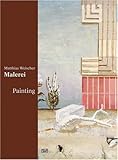
Markus Stegmann, ed. Matthias Weischer: Malerei. Ostfildern: Hatje Cantz Verlag, 2007. 148 pp. $55.00 (cloth), ISBN 978-3-7757-1904-9.
Reviewed by Eleanor Moseman (Department of Art, Colorado State University)
Published on H-German (April, 2008)
Visual Anachronism and the Semiotic Puzzles of Matthias Weischer
Readers of this visually appealing exhibition catalogue will find the volume useful for its high quality reproductions of recent paintings by Matthias Weischer, a rising star of the so-called New Leipzig School. The book includes large-scale images of forty-three works painted between 2004 and 2007, as well as thumbnail images of the complete work between 2001 and February 2007 with additional works selected by the artist dating to his years as a student at Leipzig's Hochschule für Grafik und Buchkunst (1993-2001/03). Included in the catalogue are two interpretive essays and an interview with the artist in addition to a comprehensive list of solo and group exhibitions and a bibliography of international art criticism addressing Weischer's work. The catalogue would have benefited from inclusion of the location for illustrated paintings, many of which have landed in the permanent collections of major museums.
The work of Matthias Weischer elicits associations with the Dutch Baroque, Dada collage and montage, Surrealism, Pop Art, and Superrealism, all with a decidedly central European flavor. The interiors that comprise the primary subject matter of his recent work seem to hover between two poles of the uncanny and melancholic nostalgia. Weischer is at home in the realm of signs and plays with semiotic valences in his often cryptic, one-word titles, which point to the impossibility of fixed meaning within the image itself. In a variety of ways, the artist pays veiled homage to painters of the past, including Rembrandt Harmenszoon van Rijn, Pieter de Hooch, Jan Vermeer, René Magritte, Richard Hamilton, and even Anselm Kiefer. Weischer's paintings reveal a sophisticated handling of the artistic legacy he has inherited; only rarely does he experiment with direct appropriation (as in Selbstportrait [2005], after Rembrandt). More often, he demonstrates a deliberate absorption and perceptive manipulation of art historical antecedents that reemerge in the paintings transformed into a personal vocabulary of set-like interiors with interpenetrating surfaces and anachronistic objects.
Markus Stegmann's essay, "Which Memory is Speaking," takes the reader on a poetic tour through a set of recurring themes in Matthias Weischer's paintings. Stegmann considers the odd combinations of objects derived from a life seemingly lived just before the time of recent memory, such that the furnishings and surface ornamentation appear slightly outdated but not obsolete. He refers to these interior spaces as "fragile containers of the past" that preserve the memory of vulnerable materials threatened by our contemporary throwaway culture (p. 18). In this way, ornament in Weischer's paintings becomes evidence of the transience of beauty; these ornamental surfaces coexist with others from different eras, creating a tableau of "aged, fragile patterns" that serve as simultaneous quotations of earlier tastes in design (p. 19). Stegmann's poetic tour pauses at Weischer's recent paintings, in which he sees a relative "poverty" in the sense of "deprivation and visual de-escalation" that creeps into the tableaux to replace the profusion of mysterious objects that populated the artist's earlier interiors (p. 20). Stegmann observes that this reduction causes the viewer to slow down and contemplate these "lapidary interiors" in a way that inclines one to "listen" to the image in the hope of transforming the sparse objects and impasto surfaces into comprehensible meaning (pp. 19, 20).
In his essay, "Nobody Lives Here Anymore," Rudij Bergmann visualizes sinister references emerging from the mysterious incongruity of features in the untitled Museion mural in Bolzano (2006), Weischer's only experiment in fresco to date. Bergmann probes the "uninformative" space for clues to explain why the scene has been vacated. His musing leads him to speculate on what he believes to be Weischer's cynical declaration on modernity's failings, signaled by the power of some invisible force that has driven the former residents out, leaving behind the detritus of the petit-bourgeois world. Bergmann warns against becoming ensnared in "the variegated traps of superficiality laid by the artist" (p. 88). Instead, he advocates a deeper reading, according to which "the reality of abandoned warehouses and ruined factories" is unmasked as the antecedent for Weischer's interiors that stand as "fortresses of economic disaster in a painfully real world" (p. 88). This pessimistic reading of the fresco and related canvases contrasts with Stegmann's poetic reading of the paintings as witnessing to an innocuous longing for objects and ornaments of a bygone era. What neither writer confronts directly is Weischer's clever experimentation with the physicality of layered surfaces, as can be perceived especially well in his witty tribute to Magritte, Pfeife (2007), and in textural details of the gouged wall in the Bolzano fresco.
The transcript of a December 2006 interview with Weischer, conducted by Jean-Christophe Ammann, reveals aspects of the artist's process and his approach to building up layers of paint, beginning with the "structure of the space" as is characteristic of Leipzig painters.[1] He explains his method as a "discovery process" that proceeds in layers from back to front and ends "automatically" once his disquieting interiors with their profusion of objects declare themselves complete. Determining specific meaning is anathema to Weischer, who prefers to "liberate these objects from meaning" by attempting to "dissolve" any relationship between signifier and signified. Any interaction between objects "happens unconsciously," claims the artist (pp. 92-93). All these statements reveal his indebtedness to the automatic processes and verbal-visual strategies codified by the Surrealists and taken up by successive generations of artists. Weischer remains evasive, however, regarding his relationship to art history. He asserts that he "see[s] art history through [his] own painting" rather than appropriating art historical models as any informed viewer can readily observe (p. 93). Prompted to account for his recent move away from the earlier congested interiors toward relative austerity, Weischer observes that his search for a new idiom involves a shift from "total overload to the succinct form" (p. 94).
The comments Weischer makes in the interview raise as many questions as they answer. For example, is his defensiveness toward art history, interpretation, and the recent change in his drawing practice a thinly veiled cover for his fears of vulnerability to pressure from the art market, in which artists of the New Leipzig School remain a hot commodity? Perhaps he also feels pressure to differentiate himself from other Leipzig artists, including their now-established leader, Neo Rauch, whose neo-surrealist paintings are replete with incongruous figures and objects in ways that find an echo in the profuse staffage of Weischer's anachronistic tableaux.[2] In any case, readers of this book will find themselves richly rewarded for looking closely at Weischer's compelling yet enigmatic paintings.
Notes
[1]. See Arthur Lubow, "The New Leipzig School," New York Times, January 8, 2006, http://www.nytimes.com/2006/01/08/magazine/08leipzig.html (accessed March 19, 2008).
[2]. See Markus Bruderlin, Gottfried Boehm, and Holger Broecker, Neo Rauch: Neue Rollen. Paintings 1993-2006 (Cologne: Dumont, 2007).
If there is additional discussion of this review, you may access it through the network, at: https://networks.h-net.org/h-german.
Citation:
Eleanor Moseman. Review of Stegmann, Markus, ed., Matthias Weischer: Malerei.
H-German, H-Net Reviews.
April, 2008.
URL: http://www.h-net.org/reviews/showrev.php?id=14446
Copyright © 2008 by H-Net, all rights reserved. H-Net permits the redistribution and reprinting of this work for nonprofit, educational purposes, with full and accurate attribution to the author, web location, date of publication, originating list, and H-Net: Humanities & Social Sciences Online. For any other proposed use, contact the Reviews editorial staff at hbooks@mail.h-net.org.

