



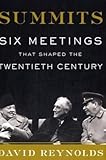
David Reynolds. Summits: Six Meetings That Shaped the Twentieth Century. New York: Basic Books, 2007. xi + 544 pp. $35.00 (cloth), ISBN 978-0-465-06904-0.
Reviewed by Antoine Capet (Université de Rouen)
Published on H-Diplo (April, 2008)
Hard Life at the Top
David Reynolds is, of course, a well-known author to H-Diplo subscribers, if only for his magisterial In Command of History: Churchill Fighting and Writing the Second World War (2004) and his superb collection of earlier essays From World War to Cold War: Churchill, Roosevelt, and the International History of the 1940s (2006).[1] His latest offering focuses on "modern summitry--made possible by air travel, made necessary by weapons of mass destruction and made into household news by the new mass media" (p. 36).[2] The first encounter between statesmen which met that definition was in Munich in 1938, the object of chapter 2 (chapter 1 examines the evolution of meetings between kings and emperors since antiquity). Neville Chamberlain unwittingly gave the perfect justification of these personal meetings during a sitting of the cabinet before he undertook his first trip to Germany: "you could say more to a man face to face than you could in a letter" (p. 49). But then--and it is a constant theme of the book--the personal dimension can be a very dangerous one, sometimes turning into what Reynolds terms "a battle of egos" or "a test of virility" (p. 6).
Reynolds offers a very interesting discussion of the origin and implications of the word "summit," arguing that Winston Churchill's famous remark on February 14, 1950--"It is not easy to see how matters could be worsened by a parley at the summit"--has to be replaced in the context of the conquest of Mount Everest, then a national obsession (p. 1). But then when Chamberlain arrived at Berchtesgaden on September 15, 1938, he still had to "climb" to Adolf Hitler's Obersalzberg aerie ("Berg" meaning, of course, "mountain" in German). "In a startling and almost literal sense, Mahomet goes to the mountain,'" a percipient New York Times journalist wrote (p. 455). Thus, what Churchill saw as a metaphor had in fact been a real-life experience for Chamberlain, and not a happy one if we accept Reynolds's verdict on this first visit: "By taking the Czech crisis to the summit, the prime minister had exposed Britain's status and prestige to an alarming degree" (p. 65). Yet, of course, "none of Chamberlain's cabinet was willing on September 17 to sacrifice London for the sake of Prague" (p. 63). On September 22, at Bad Godesberg, on the banks of the Rhine, Chamberlain was spared another literal "climbing of the mountain," but not a metaphorical one, and, at the end of the unpleasant meeting, "having staked his political future on the success of summitry, he had climbed too far to turn back" (p. 74). So, he went to Munich and came back triumphantly with the undertaking never to go to war again against Britain, which he had personally asked Hitler to sign during a private meeting. Everyone is familiar with the rest of the story. "Summitry had made Chamberlain's name and then destroyed it," Reynolds pithily concludes (p. 102).
The irony is that Churchill, who had always condemned Chamberlain's dealings with Hitler, became a great adept of one-to-one parleys--with the same result, namely, the accusation of having been outwitted by the Soviet dictator and having finally sold out to the Communists at Yalta. The description of the Yalta Conference in chapter 3 is both fascinating and illuminating. It is illuminating because Reynolds neatly sums up the constraints under which the two democratic leaders were laboring. Reynolds's central argument--a hard one to contradict--is that postwar Soviet domination of Eastern Europe is not the result of poor Western diplomacy at Yalta or Potsdam or wherever. Rather, it is the result of the military delay in opening the second front. This central constraint largely explains the accommodating attitude of the two leaders, within limits which Reynolds clearly explains.
This is largely, but not entirely true: here, again, their own faith in their personal rapport with Joseph Stalin (on top of the tripartite discussions, they each had one-to-one private talks with the dictator) led to grave mistakes. This is the fascinating aspect, because Reynolds has no illusions about human frailty, even among great statesmen, and he pitilessly demonstrates how their judgment can be tragically impaired by their hubris. He reports Churchill's overoptimistic delusions: "'If only I could dine with Stalin once a week, there would be no problem'"; and, on his return from Yalta, "'Poor Neville Chamberlain believed he could trust Hitler. He was wrong. But I don't think I'm wrong about Stalin'" (pp. 111, 145). Reynolds shows that Franklin Delano Roosevelt in 1942 also presumed too much: "'I think I can personally handle Stalin better than either your Foreign Office or my State Department. Stalin hates the guts of all your top people. He thinks he likes me better, and I hope he will continue to do so'" (p. 110). Here, again, the rest of the story is well known: almost exactly one year after his "I don't think I'm wrong about Stalin" speech, Churchill delivered the famous "Sinews of Peace/Iron Curtain" one. Summitry was discredited "for a generation" (p. 163). Ernest Bevin, the no-nonsense son of an agricultural laborer and a housemaid who made it to the top as foreign secretary in Clement Attlee's postwar Labour government made no mistake about it: "'I'm not enamoured of this individual business. It was tried by Mr. Chamberlain with Hitler and it did not work very well. It was tried at Yalta and did not work very well,'" he declared almost exactly five years after the end of the conference (p. 166).
Reynolds does not have anything positive to say about the disastrous resumption of the practice when John F. Kennedy and Nikita Khrushchev met in Vienna in 1961 (chapter 4). He states that their "bruising encounter ... constitutes almost a textbook lesson in how not to do summitry" (p. 163). He makes much of Khrushchev's inferiority complex and his "self-consciously proletarian" personality--but then this complicated man also had contempt for the "young" Kennedy, born in 1917, like Khrushchev's good-for-nothing son (who died in the war) (p. 272). In their "contest of wills," the author notes, "each probably believed in his persuasive powers, powers that had got him to the top of his own political tree," with devastating results for the sick American president, who gravely underestimated Khrushchev's "pugnacity, quick-wittedness and debating skill" (pp. 221, 219, 197).
Reynolds pursues his thread relentlessly, and, by the middle of the book, he makes his point: summits are almost always founded on a misperception of the difficulties they face by those who seek them. He quotes a letter from Harold Macmillan (then British prime minister, to whom Kennedy paid a visit in London on his way back to the United States, telling him of Khrushchev's toughness in Vienna) to Queen Elizabeth: "'[it] reminded me in a way of Lord Halifax or Mr. Neville Chamberlain trying to hold a conversation with Herr Hitler'" (p. 211). But then, Reynolds suggests, all great politicians are weak and vain. Even people like Macmillan--prima facie wary of these face-to-face encounters--eventually yield to the temptation, reminding us of Churchill's remark "how much more attractive a top-level meeting seems when one has reached the top" (p. 168).
Confirming the validity of this principle, eleven years later Richard Nixon ("a keen observer of the 1961 debacle in Vienna") and Leonid Brezhnev welcomed the idea of another summit, which Reynolds covers in chapter 5 (p. 223). Cleverly playing on the word "summit," Reynolds demolishes any ambition in the field of international summitry that this American president may have entertained: "The way Nixon got to the summit virtually ensured that he would not stay there" (p. 280). Nixon had scored an apparent success at Beijing in February 1972. Still, Reynolds convincingly argues, "The Beijing summit was about symbolism more than substance" (p. 244). The real prize for Nixon's presidency would be a personal agreement with Brezhnev--"'one of the greatest diplomatic coups of all time!'" as Henry Kissinger, the buoyant intermediary who clinched the Soviet leader's agreement for the summit, put it (p. 261). Reynolds does not deny that in the short term the Moscow summit of May 1972 produced positive results. As he reminds the reader, "The year 1972 did indeed mark a moment of détente in the Cold War" (p. 275). But then, there was Watergate, and Nixon's increasingly weakened authority, of which the Soviets did not fail to take advantage, in Indochina and eastern and southern Africa. "Nixon's failure, in other words, relegated not merely summitry but diplomacy to the back burner," Reynolds glumly concludes (p. 281).
But, of course, the back burner sustains the fire, however feebly. The 1978 meeting at Camp David, discussed in chapter 6, between Menachem Begin, Jimmy Carter, and Anwar Sadat on the settlement of the Middle East conflict was a special case, since it was "probably the best-prepared American summit of the twentieth century" (p. 283). The flame was rekindled under Ronald Reagan, who "could not keep away from summitry when he eventually had his chance" (p. 281). Reynolds makes two complementary points in chapter 7 that go against received opinion, at least among the general public. It is not true, "as is often claimed in the United States," that Reagan's "arms race simply forced the Soviets out of business"; they could somehow have scraped the funds to at least partly match the escalation in costs (p. 427). Nixon continued to predict in the mid-1980s that the Cold War would drag on "not just for years but for decades" (p. 364). Financial exhaustion was only a remote possibility--and we now know that by the end of the decade the Cold War was over. There must be some more compelling explanation for this speedy process.
In fact, behind his aggressive talk, Reagan was an idealist, who really believed in the natural goodness of man. "'We don't mistrust each other because we are armed, we are armed because we mistrust each other,'" Reagan is reported to have said to Mikhail Gorbachev in the opening phases of their Geneva summit in November 1985 (p. 370). By a sort of uncanny "chemistry" (the word was later used by both men), Gorbachev gradually came to be convinced that the archetypal cold warrior, for whom he initially had little respect, could put an end to this mistrust. In Reynolds's words, "he discovered that the ideologues of capitalism were more complex and more attractive than Marxist-Leninist dogma had allowed" (p. 398).
Reynolds has a very interesting discussion on the nature of the Cold War, with the security of each superpower depending on the feeling of insecurity in the other. What the summits at Geneva and later at Reykjavik achieved was a reversal of this proposition, he argues, with each superpower now feeling secure because it knew that the other was feeling secure, too. This allows him to conclude on what is undoubtedly the most durably successful of the six summits that form the substance of the book: "The encounters that began in frosty Geneva in November 1985 helped ensure that the Cold War ended not with a bang or a whimper, but with a handshake" (p. 400). A final, rounding-up chapter examines the preconditions for success, with serious preparation and teamwork featuring prominently among them. In contrast, a statesman's hubris, a notion that recurs through the book, is, of course, a sure recipe for disaster: "Individual leaders, however able, cannot hope to grasp all the issues at stake" (p. 425).
The book has no bibliography as such, but ample indications for further research are provided in the copious notes (seventy-five pages in all, inconveniently relegated to the end of the volume). The strength of Reynolds's work lies principally in the fact that it constitutes both an excellent introduction to international relations since 1938, ideally suited to students, and a great source of insightful reflections for established scholars on the ambivalence of the ostensible role of world leaders, whose personal encounters now dominate the media while traditional behind-the-scenes diplomacy continues to be essential to the success of these summit meetings.[3]
Notes
[1]. For a review, see Paul Addison, review of In Command of History: Churchill Fighting and Writing the Second World War, by David Reynolds, Cercles (2005), http://www.cercles.com/review/r24/reynolds.htm.
[2]. Allen Lane in London also published this book in 2007 (ISBN 0-7139-9917-9).
[3]. A series of three "tie-in" programs made for the British television channel BBC 4 and presented by Reynolds (2008) cover three summits: Munich 1938, Vienna 1961, and Geneva 1985.
If there is additional discussion of this review, you may access it through the network, at: https://networks.h-net.org/h-diplo.
Citation:
Antoine Capet. Review of Reynolds, David, Summits: Six Meetings That Shaped the Twentieth Century.
H-Diplo, H-Net Reviews.
April, 2008.
URL: http://www.h-net.org/reviews/showrev.php?id=14408
Copyright © 2008 by H-Net, all rights reserved. H-Net permits the redistribution and reprinting of this work for nonprofit, educational purposes, with full and accurate attribution to the author, web location, date of publication, originating list, and H-Net: Humanities & Social Sciences Online. For any other proposed use, contact the Reviews editorial staff at hbooks@mail.h-net.org.

