



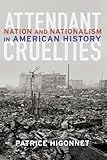
Patrice Higonnet. Attendant Cruelties: Nation and Nationalism in American History. New York: Other Press, 2007. L + 378 pp. $25.95 (cloth), ISBN 978-1-59051-235-7.
Reviewed by Lotfi Ben Rejeb (Department of History, University of Ottawa)
Published on H-Nationalism (April, 2008)
Split-Personality Nation
Patrice Higonnet is a distinguished professor of French history at Harvard. A specialist of the French Revolution, he also wrote a comparative history of France and the United States in Sister Republics: The Origins of French and American Republicanism (1988). His latest book focuses on the nature and history of American nationalism.
The title of his book is a reference to Theodore Roosevelt's historic statement during the American-Filipino War. The "fight with savages," said Roosevelt, often involves blamable atrocities, but "to withdraw from the contest for civilization because of the fact that there are attendant cruelties" would be "utterly unworthy of a great people" (p. xxii). For Roosevelt, America was essentially right and need not be hampered by minor and inevitable occurrences of collateral damage along the way. Higonnet argues that America's attendant cruelties are not minor, are deeply at odds with America's democratic and liberal creed, and are utterly unworthy of a great nation. Coinciding with the preeminence of American power in the world, Attendant Cruelties is meant to explain the behavior of the United States through an assessment of the causes and effects of American nationalism. This is a timely book that speaks of the past and to the future. To define the nature of the American national idea, Higonnet settled on a crucial nuance between patriotism and nationalism as argued by Ernest Renan, John Lukacs and Alain Touraine, among others. The gist of the nuance is that patriotism tends towards inclusion, while nationalism tends towards exclusion, patriotism is defensive while nationalism is aggressive, patriotism promotes democratic and egalitarian universalism while nationalism promotes imperial and divisive egoism. Yet both concurrently define America. Higonnet draws a portrait of America as a nation with a split personality syndrome which he refers to as a patriotic Mr. Jekyll and a nationalist Mr. Hyde, two alters that often suffer from amnesia concerning each other's existence (p. xxxvii). While the dichotomy may be found in all nations, it is heightened in America by a long-standing myth of exceptionalism. Viewing American history from this prism, Higonnet sees a patterned contest between the dichotomous forces of inclusive patriotism and exclusive nationalism, resulting in a perplexing mix of grand achievements and deplorable crimes.
Higonnet calls his book an "essay" rather than a chronological account of America's historical experience (p. xiix). In fact, it is both. It is a work of analysis and interpretation as well as a chronological survey of the course of the American national idea throughout American history. Higonnet makes his central analytical argument about the dichotomy in the introduction, and the rest of the book is devoted to applying his argument to familiar episodes from 1630 to 2006 without making any claim to new research or new discoveries.
Part 1 deals with the period 1630-1825. It begins with the Puritans who perceived themselves as God's agents of good, even as they waged a quasi-genocidal war against Native Americans, and it ends with a discussion of the rise of consensual republicanism based at once on libertarian inclusion and ethnic exclusion. Part 2 covers the period 1825-1912, a period of surging egalitarianism but also of abusive nationalism. It highlights the democratization of the national idea, with its apogee in the abolition of slavery, and its concurrent dark side in the institutionalization of racism, the near-elimination of Native Americans, and the wars of conquest against Mexico and Spain, which Higonnet describes as scandalous and lamentable.
Part 3 takes up the argument from 1912 to 2006. It shows how the revitalization of American universalism picked up again in the 20th century with the promise of a more inclusive social democracy (the New Deal, the Fair Deal, the Great Society and the Civil rights movement), but lost momentum and ended in inertia and retreat. In foreign policy, the period witnessed the idealistic universalism of Wilson but also the terrible decision to drop atomic bombs on Japan, disastrous mistakes in Vietnam, a double standard in the Israeli-Palestinian conflict and illegal interventionism in Iraq.
Two large but simplified pictures emerge from the book: one bright picture of great presidents like Abraham Lincoln and Franklin D. Roosevelt who did their best to foster inclusion and egalitarianism, and one dark picture of bad presidents who fostered exclusionist policies. George W. Bush would be the epitome and culmination of the worst that America has to offer, the last in a list of criminal presidents that includes Andrew Jackson, James K. Polk and John McKinley who perverted American ideals and used nationalism for exclusionist, racist and murderous policies. Higonnet pulls no punches in his denunciation of the dark side of American nationalism and uses provocative parallels such as "What Stalinism was to utopian communism, Bushism is to the American creed" (p. 288). His admittance that the book is "often critical" and "at times quite harsh" is an understatement (p. xiii). The book is passionate and will doubtless alienate some readers, but it would be myopic to ignore its message.
Higonnet's approach and analysis are not exactly new and will not come as a revelation for scholars familiar with American history in general and with studies of American nationalism in particular. The paradoxical dualities of America have been dealt with rather extensively with reference to themes or historical figures (Michael Kammen's People of Paradox, Edmund Morgan's American Slavery-American Freedom, to cite two famous examples). More recently, British journalist and policy analyst Anatol Lieven preceded Higonnet with a similar assessment of American nationalism. In America Right or Wrong: An Anatomy of American Nationalism (2004), Lieven contended that America kept "a splendid house but also demons in its cellar" and charged the "character of American nationalism" as "the most important reason" for U.S. failures in foreign affairs. Speaking of the Neoconservatives, Lieven also used the "Bolsheviks of the Right" analogy and quoted another British observer who denounced the American Enterprise Institute as "a kind of Cominform of the new world order" and Washington think-tanks as promoters of "a Stalinist-style dogmatism."[1]
Nor is this approach to American nationalism purely European and leftist. Both Higonnet and Lieven are treading in the footsteps of an illustrious American predecessor, Senator J. William Fulbright, who had reflected on American patriotism and nationalism at the height of U.S. involvement in the Vietnam War in his book The Arrogance of Power (1966). According to Fulbright, two strands have always co-existed in American history, "a dominant strand of democratic humanism and a lesser but durable strand of intolerant puritanism," and have engendered the mixed values of "moral patriotism" and "superpatriotism."[2] In order for America not to fail as a truly great power in the world Fulbright had cautioned that the first strand must remain dominant. But for asking his fellow countrymen to think critically about the national ethos in wartime, Fulbright had been vilified as unpatriotic by the superpatriots, just as Mark Twain had been vilified as unpatriotic for similar reasons at the end of the 19th century.
Higonnet's concerns echo those of Fulbright (and Lieven). Higonnet's critical assessment of the nature and history of American nationalism, like Fulbright's, is a morally-driven cri de coeur for the future. Americans, he thinks, could and should avoid the politics of arrogance that have darkened their history since the beginning. As America becomes increasingly trans-national, and as the world becomes increasingly complex and dangerous, he considers it imperative that Americans adhere closer to their professed universalist ideals at home and abroad. His assessment is a serious stance that deserves serious attention.
Notes
[1]. Anatol Lieven, America Right or Wrong: An Anatomy of American Nationalism (Oxford and New York: Oxford University Press, 2004), 1, 2, 4, 154.
[2]. J. William Fulbright, The Arrogance of Power (New York: Vintage Books, 1966), 250, 23, 20, 251.
If there is additional discussion of this review, you may access it through the network, at: https://networks.h-net.org/h-nationalism.
Citation:
Lotfi Ben Rejeb. Review of Higonnet, Patrice, Attendant Cruelties: Nation and Nationalism in American History.
H-Nationalism, H-Net Reviews.
April, 2008.
URL: http://www.h-net.org/reviews/showrev.php?id=14395
Copyright © 2008 by H-Net, all rights reserved. H-Net permits the redistribution and reprinting of this work for nonprofit, educational purposes, with full and accurate attribution to the author, web location, date of publication, originating list, and H-Net: Humanities & Social Sciences Online. For any other proposed use, contact the Reviews editorial staff at hbooks@mail.h-net.org.

