



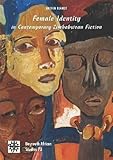
Katrin Berndt. Female Identity in Contemporary Zimbabwean Fiction. Bayreuth: Breitinger, 2005. 285 pp. $74.95 (paper), ISBN 978-3-927510-88-3.
Reviewed by Tony Simoes da Silva (School of English Literatures, Philosophy and Languages, University of Wollongong)
Published on H-SAfrica (April, 2008)
Gender Politics in Zimbabwean Literature
In Female Identity in Contemporary Zimbabwean Fiction, Katrin Berndt sets out to examine constructions of female identity in selected novels by male and female Zimbabwean authors, notably Chenjerai Hove, Yvonne Vera, Tsitsi Dangarembga, Vivienne Ndlovu, and Nozipo Maraire. Specifically, Berndt undertakes an exploration of what she calls "identity layers" in the "literary characters," juxtaposing them to "subject positions"; both "identity layers" and "subject positions" are defined as constituent of "postcolonial female identities" (p. 49). Through a detailed analysis of individual characters ("protagonists" is the term used often in the book to refer to characters) Berndt seeks to distinguish between the various identities available to "postcolonial Zimbabwean females." In the context of her discussion of key characters/protagonists, "identity layers" are at times defined as precursors to "subject positions" and the latter on occasion are read as part of a "personality." Moreover, "identity layers" are generally defined hierarchically (at one point five are listed sequentially, "first" to "fifth", pp. 99-109) and "subject positions" are discussed as perhaps the same as an "identity palimpsest" (p. 114), though that is not always clear. If this brief summary seems somewhat muddled, I apologize, because more of the same is yet to come; that is very much the nature of this book. Indeed, why the emphasis on "female" rather than on "women's" identity is a question we might already ask of the title, since the former is biological, the latter social, and fictional literature generally focuses on social rather than biological issues, but it is one I am prepared to gloss over at this point. If only the book as a whole could be so easily redeemed.
Drawing on research work undertaken for a higher degree, as noted in the acknowledgements, the book conveys Berndt's committed engagement with the material, reflected in her closely detailed readings of some of the most relevant works in contemporary Zimbabwean literary fiction. In the context of what is generally, if not entirely accurately, described as the conflict between "tradition" and "modernity" in Africa, the critical accent on "female identity" has the conceptual potential to support a rich and provocative analytical framework, though as I noted above, "women's" might have been a less contentious term here. For one thing, the conceptual nexus highlights the complex way African writing deals with the place of women in postcolonial societies caught up in complex processes of political and cultural transformation. Secondly, it allows for an examination of the many interlinked ways in which colonial and postcolonial discourses share in the definition of women's identities in formerly colonized settings. Theoretically therefore the study draws on postcolonial critical thinking, if loosely and not always convincingly, and feminism is invoked with reference to some of the writers whose novels Berndt analyses. Surprisingly, in a study that relies so clearly on an understanding of identity formation that owes its genesis to the discursive turn in critical theory, the work of gender theorists is totally ignored. This is especially odd since so much of their writings intersect closely with postcolonial writing. I have in mind Sara Mills, Gayatri Chakravorty Spivak, and Carole Boyce Davies, for example, but also Judith Butler and bell hooks, among so many others. That said, Berndt often makes some insightful observations in her readings of individual texts, particularly on Nervous Conditions (1988) and Hove's Bones (1988); much less so when dealing with the novels of Yvonne Vera, Nehanda (1993) and Butterfly Burning (1998).
In what Berndt calls her "theoretical chapter" (pp. 10-79), the work's main thesis is summed up thus: "The subject of my study is the construction of female identity in contemporary anglophone Zimbabwean fiction. I will analyse the constituents of female literary identity as well as the function female characters fulfil within the selected novels" (p. 49, sic). Although the claim is no less general and unfocused for the repetition, something that characterizes the work as a whole, this is a case of "so far, so good." Yet again, though, the use of "female" rather than "women's" stands out, as does the emphasis on "literary identity … within the selected novels"--where else should we be looking at "literary identity," whatever that might be, if not in novels, that is, literary texts? She goes on:
My basic assumption is that postcolonial female identity can no longer be described as an "Other" to a postcolonial male and/or European "Self." It has to be acknowledged as consisting of several different layers and subject positions, outside the mentioned dichotomies. These positions are actively interpreted identity layers and may be complementary or contradictory to each other. The identity layers can derive from personal characteristics and experiences of the literary figure, from its societal, cultural, or political surroundings and, obviously from the plot in which the characters of the text are embedded. I intend to define and explore these layers, their development within the text, their cultural origin and alteration, and I will seek to prove their negotiability. I want to demonstrate that postcolonial identity not only possesses a hybrid structure, but that within that structure, any hierarchy is negotiable and therefore unstable. In fact, it is this instability which guarantees the subject's ability to define his/her identity. Besides, I will show that the (post)colonial Self/Other dichotomy has outlived its appropriateness for the literary analysis of postcolonial texts since the emergence of concepts like "inappropriate other" and the idea of negotiable identity layers. (p. 49)
There is much to unpick in the above statements but the main problem they highlight, and one that undermines the study in its entirety is that the terminology is never explained with any degree of clarity, let alone persuasion. Crucially, though not surprisingly, once the discussion gets going Berndt herself is unsure of where to take her "identity layers" and her "subject positions," who may or may not be the same. Sometimes "identity layers" will transmogrify into "subject positions" and the latter then take on a number of other meanings, but how this happens is never clear. Paradoxically, while claiming to focus on negotiated identities, identity as Berndt discusses it throughout the book is a stamp-like mark imposed on "literary characters," thus on "people." Before long, the writer poses the following question about one of Yvonne Vera's characters, "the unknown woman": "What are her identity layers, if she holds any?" (p. 152, my emphasis). Indeed, but who is this creature without layers, not even a "flat character"? For "flat characters," invoked earlier via E. M. Forster, are defined as "containing one single identity layer," Berndt describing Forster's "round characters" as akin to her "subject positions" (p. 50). The "unknown woman" however does not even qualify as a "flat character." I wish I could make it all clearer, but I was defeated by the incredibly obtuse trajectories Berndt's thesis undertakes.
Thus elsewhere, referring to yet another of Vera character's, Marita, Berndt states: "Her 'identity layers,' as I call them following my basic theory, are not inscribed into her but ascribed onto her. Therefore, they are neither negotiated nor integrated, but sometimes contradictory beyond rationality" (p. 142, emphasis in the original). Grammar aside, make of that what you may, because only on page 141 Berndt had written: "Lacking contradictory or complementary identity layers, Marita is a typical oral element in a written metahistorical narrative." Is Marita's problem too much or too little "contradiction"? It is hard to tell. In fact, this same woman is described earlier on the same page as "ignorant" and "naïve" (might these, perhaps, be incipient subject positions, or at least aspects thereof?) and we read that "Her actions describe her as an unusually self-assured and culturally rooted woman, attributes which again indicate that this protagonist is not a coherent subject, but a vision, a symbol for the rural down-to-earth courage and straightness" (p. 141). Leaving aside the strangely fused "vision/symbol," I would have thought that "unusually self-assured" and "culturally rooted woman" might at least have counted as "identity layers," even as embryonic "subject positions," yet Marita is without layers, subject position, flatness or roundness. That the character, as depicted by Berndt herself, is so obviously a complex and difficult woman, occupying simultaneously or serially a number of diverse, often contrasting subject positions as "woman," as "spouse," as "storyteller," as "colonized," yet is "nothing" in the context of the book's thesis has to be one of the oddest assertions in a book replete with them.
Zimbabwean anglophone writing is a small field, sadly more depleted since the death in 2005 of Yvonne Vera and the exile of representative figures such as Hove, presently in Norway. It is also rich and nuanced, as the output of those two writers demonstrates so well and any form of sustained study that makes such writing better known needs commending. Ultimately, though, despite the enormous personal and scholarly investment Katrin Berndt brings to it, Female Identity in Contemporary Zimbabwean Fiction is a very disappointing read. Closer editing may have addressed some of the more crass lack of focus and coherence, and the repetition that mars the discussion. Repetition weakens all the readings of individual texts, none more so than Vera's, and is especially intrusive in the second half of the work. This ranges from a reiteration of certain points, not always a bad thing, to the recycling of statements that are problematic enough without needing reiteration. Although variously paraphrased, these include "the subject is dissolved in favour of identity strata attached to one or another of the literary characters" (p. 154) and "The protagonist ... has a single strong subject position but fails to appropriate other identity layers .... . Marita has neither identity layers nor subject positions but serves as interstice on which the other characters can project theirs" (p. 120). That at its halfway mark the book should be this muddled gives an idea of its beginning and ending.
It should be noted too that Berndt has been seriously let down by the series editors. Of course, the reader will make sense of such clangers as "I-persona" in place of "first person narration," or "third-persona" rather than "third person narration," for example, but they are distracting and further weaken the level of the thinking. At one point, we read that a novel has "5 I-persona narrators" (p. 120); soon after the writer states: "That means the novel possesses five I-persona narrators. It gives voice to the prominent literary characters involved, and thereby abandons the claim to objective truths in favour of an individual truth or, better, an approach to truthfulness" (p. 123). Yet, elsewhere in the book, there are references to "I-person" narration, and on at least one occasion to "third person narration." In keeping with a tendency noted earlier, the above comment on "truth" is then repeated, in a number of more or less noticeable variations, for the rest of the book. How easy it would have been to address such issues, bringing the argument into closer focus and to the writing greater persuasion. Yet, though the editors deserve a strong rap on the knuckles for the grammatical muddle of much of the book, including words used in the wrong context, the responsibility for the work's flaws must rest with its author. Conceptually, the thesis this book puts forward is ill-thought and unfocused and although passionately argued it is tiresome and unconvincing.
If there is additional discussion of this review, you may access it through the network, at: https://networks.h-net.org/h-safrica.
Citation:
Tony Simoes da Silva. Review of Berndt, Katrin, Female Identity in Contemporary Zimbabwean Fiction.
H-SAfrica, H-Net Reviews.
April, 2008.
URL: http://www.h-net.org/reviews/showrev.php?id=14390
Copyright © 2008 by H-Net, all rights reserved. H-Net permits the redistribution and reprinting of this work for nonprofit, educational purposes, with full and accurate attribution to the author, web location, date of publication, originating list, and H-Net: Humanities & Social Sciences Online. For any other proposed use, contact the Reviews editorial staff at hbooks@mail.h-net.org.

