



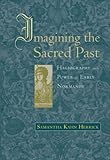
Samantha Kahn Herrick. Imagining the Sacred Past: Hagiography and Power in Early Normandy. Cambridge: Harvard University Press, 2007. xiv + 256 pp. $49.95 (cloth), ISBN 978-0-674-02443-4.
Reviewed by Anna Lisa Taylor (Department of History, University of Massachusetts, Amherst)
Published on H-German (March, 2008)
Rereading the Sacred Past
In this well-written, accessible, thoroughly researched book, Samantha Kahn Herrick argues that three Latin hagiographical works, the Vita Taurini, Vita Vigoris, and Passio Nicasii, which she dates to the 1020s and 1030s, reflect ducal agendas in early Normandy. Through their shared emphases on apostolicity, conversion, and power, these texts legitimate aggressive Norman expansion, making the rulers, especially Robert I the Magnificent, heirs to the saintly bishops who first evangelized the region. Following Felice Lifshitz,[1] Herrick argues that the Norman identity of the former Vikings was created and expressed through hagiography: "the stories of Taurinus, Vigor, and Nicasius thus opened to the new Christians the sacred heritage of their new region and gave them a means to place themselves within it" (p. 11). In the past two decades a number of historians, including Amy Remensnyder, Thomas Head, and Sharon Farmer have profitably used writings about saints to examine how various institutions told stories about their past to shape their identity.[2] Scholars have employed this methodology to show how monks told stories about their patron saints defying kings, local landowners, and others in earlier times to defend their rights and properties against rapacious lords and bishops in the writers' own time. In contrast, Herrick interprets the deeds of the saints in these three works as a symbolic endorsement of Norman secular authority. Taurinus, Vigor, and Nicasius were all obscure saints, which, argues Herrick, means that they were tabulae rasae for the writers' agendas.
The book has a repeated tripartite structure. In chapters 1 and 2, Herrick examines the three main sources in turn, while in each of chapters 3 through 5 each she discusses the themes of one vita or passio and places it within its historical context. In chapter 1, Herrick undertakes the extremely difficult task of dating these texts. She relies mainly on evidence from other works, supplemented by patterns of manuscript diffusion. The Norman works' sources provide termini post quem and the earliest known manuscripts provide termini ante quem. To refine the dates of composition further, Herrick looks at more firmly dated texts that show either awareness or ignorance of the details of the saints' cults elaborated in the Passio of Nicasius and the Vitae of Vigor and Taurinus. For example, Usuard's martyrology (ca. 865) notes only the barest details on the three saints, which suggests that the author was unaware of the more elaborate narratives the Passio and Vitae provided.
This method of dating is, of course, imprecise and an author's apparent ignorance of a vita or passio could reflect that work's limited circulation or a deliberate omission. (For example, an Office from Saint-Denis drew heavily on Hilduin's ninth-century Passio Dionysii, but ignored the conflation, which Hilduin had emphasized, of the Parisian Dionysius with Dionysius the Areopagite.)[3] The Vita Taurini proves the most problematic to date, and Herrick must use historical events that the life "resonates" with, "evokes," and "echoes" (p. 30). Herrick acknowledges the difficulties in assigning dates to these three works, but her arguments are persuasive through the sheer accretion of evidence, which she discusses with painstaking care and impressive clarity.
In chapter 2, Herrick asks why these saints' cults suddenly became popular in the early eleventh century, as evidenced by the translations of their relics and the composition of these works. In each case the territorial ambitions of Robert I the Magnificent, count of Evreux and archbishop of Rouen in Normandy, appear key. Herrick argues that the cult of Taurinus, Bishop of Evreux, capital of the volatile frontier county of Evrecin, promoted relations between Robert and the city of Chartres, whose cathedral probably received the saint's relics in the 1020s. By incorporating Robert, Bishop Fulbert of Chartres, and Odo II, Count of Blois-Chartres into the saint's "spiritual family" and encouraging their common veneration of the bishop, the cult encouraged the alliance between Evreux and Chartres (p. 36). Similarly, Robert founded the abbey of Saint-Vigor at the far-flung location of Cerisy around 1030, connecting it through his choice of patron with the monastery of Saint-Ouen in Rouen, which housed a relic of Vigor. In the 1020s, the relics of Nicasius were translated to Rouen, strengthening the bonds between Normandy and the Vexin, where Nicasius had been martyred. In each of these cases, religious ties that were strengthened or enacted through translations and new foundations and portrayed in new hagiographic narratives accorded with Robert's ambitions to extend his influence into marginal or contested territory.
In each of the following three chapters, Herrick examines the main themes of one text, locates the work in the political history of Normandy, and explains how these themes spoke to the region's recent and contemporary concerns. The Vita of Taurinus casts the saint as a militaristic apostle who engages in violent struggles with demons in order to gain political as well as spiritual dominion over the region of the Evrecin. In the Vita, an angel prophesies that after Taurinus's death the region will be deserted and then once again restored. Thus, argues Herrick, the region's repeated cycles of destruction (including the Viking raids), restoration, and conversion function as part of a larger divine plan in which the Normans are implicitly cast as Normandy's preordained saviors.
In the Vita Vigoris, the saint's Christianization of the Bayeux region of Normandy proceeds through struggle, force, and his repeated banishment of a serpent. This text, argues Herrick, simultaneously raises the troubling specter of paganism (the Normans had converted barely a century before and had recently been assisted by a Viking warlord) and resolves it by placing the region's conversion safely in the apostolic past. Additionally, the Vita emphasizes the lawful grants of land to the saint and his imposition of authority on the region. As Herrick so eloquently summarizes, "[t]he Vita lifts conversion and submission from their historical context and assimilates them to legend, to sacred antiquity, and to the divine plan. The influence in Lower Normandy to which Duke Robert aspired had been achieved by Saint Vigor long ago; the duke's aims were foreordained, divinely countenanced, and assured" (p. 93).
In the Passio Nicasii, the saint's martyrdom marks the region of the French Vexin. Vexin had been divided between France and Normandy in 911, when the latter territory was created and given to Rollo the Viking. Politically divided between France and Normandy, Vexin nonetheless remained a single spiritual realm under the authority of the archbishop of Rouen, who was usually a member of the Norman ducal family during the eleventh century. The Passio Nicasii emphasizes the Norman claim on the whole of this divided territory. Nicasius, who had been appointed bishop of Rouen but was martyred en route, marks out a claim to the region by bringing it under his spiritual authority. The places named in the Passio are all in French Vexin as Nicasius crosses the River Oise and follows the Seine towards his appointed see. After their martyrdom, Nicasius and his two companions carry their decapitated heads to a burial site in the Epte, the river that divided the two Vexins. Herrick argues, "by his deeds Nicasius wins as his own the territory bordered by the Oise, Seine, and Epte. The French Vexin belongs to Nicasius as apostle and bishop, and through him, it belongs to Rouen" (p. 108). The saint's claim to the territory and his militaristic image both correlate with the duke's attempt to extend his influence into the French Vexin.
In chapter 6, Herrick draws the main themes together to compare their appearance in these three sources with their occurrence in Frankish hagiography at large. Other Frankish vitae and passiones cast their leading saints as apostles, detail the conversion of pagans, and emphasize the saint's exercise of authority. Within the broad outlines of Frankish hagiography, the three texts Herrick examines have their own particular concerns. They present, argues Herrick, a particularly aggressive evangelization, and stress the conversion from paganism to Christianity.
Herrick's attention to the different nuances of the recurring themes of her three main texts allows her to build a convincing argument for the agenda they promote, despite the difficulty in assigning motivations to anonymous and pseudonymous works of uncertain provenance (the author of the Vita Taurini falsely claims to be the saint's godson Deodatus, the others are unnamed). The appendices are useful discussions of the manuscripts, whose careful examination must inform Herrick's argument, although they are largely absent from the body of the book meaning that Herrick, unlike Rosamond McKitterick in her recent work, privileges a normative text over the manuscript variations.[4]
Herrick is certainly a careful reader of vitae and passiones and does not attempt to push the works beyond the limits of what they can tell us, for instance, by extracting information about the saints (a tendency that Lifshitz calls "bobbing for data").[5] Nonetheless, she regularly refers to the genre of "hagiography" without engaging Lifshitz's seminal critique of the vexed and anachronistic term. Despite this omission, Herrick skillfully utilizes her neglected sources to add color and depth to the intersection of religious and political history in the eleventh century.
Notes
[1]. Felice Lifshitz, The Norman Conquest of Pious Neustria: Historiographic Discourse and Saintly Relics, 684-1090 (Toronto: Pontifical Institute of Medieval Studies, 1995).
[2]. Thomas Head, Hagiography and the Cult of Saints: The Diocese of Orleans, 800-1200 (Cambridge: Cambridge University Press, 1990); Felice Lifshitz, The Norman Conquest of Pious Neustria; Amy G. Remensnyder, Remembering Kings Past: Monastic Foundation Legends in Medieval Southern France (Ithaca: Cornell, 1995).
[3]. E. A. R. Brown, "Gloriosae, Hilduin, and the Early Liturgical Celebration of St. Denis," in Medieval Paradigms: Essays in Honor of Jeremy Duquesnay Adams, ed. Stephanie Hayes-Healy (New York: Palgrave Macmillan, 2005), 58.
[4]. Rosamond McKitterick, The Carolingians and the Written Word (Cambridge: Cambridge University Press, 1989).
[5]. Felice Lifshitz, "Beyond Positivism and Genre: 'Hagiographic' Texts as Historical Narrative," Viator 25 (1994), 95-113.
If there is additional discussion of this review, you may access it through the network, at: https://networks.h-net.org/h-german.
Citation:
Anna Lisa Taylor. Review of Herrick, Samantha Kahn, Imagining the Sacred Past: Hagiography and Power in Early Normandy.
H-German, H-Net Reviews.
March, 2008.
URL: http://www.h-net.org/reviews/showrev.php?id=14311
Copyright © 2008 by H-Net, all rights reserved. H-Net permits the redistribution and reprinting of this work for nonprofit, educational purposes, with full and accurate attribution to the author, web location, date of publication, originating list, and H-Net: Humanities & Social Sciences Online. For any other proposed use, contact the Reviews editorial staff at hbooks@mail.h-net.org.

