



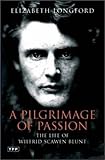
Elizabeth Longford. A Pilgrimage of Passion: The Life of Wilfrid Scawen Blunt. London: Tauris Parke Paperbacks, 2007. xii + 467 pp. $16.95 (paper), ISBN 978-1-84511-344-5.
Reviewed by Walter Arnstein (Department of History, University of Illinois at Urbana-Champaign)
Published on H-Albion (March, 2008)
The late Elizabeth Longford (1906-2002) was one of the most distinguished biographers of the twentieth century, the author of numerous works, Queen Victoria, R.I. (1964), a two-volume biography of the Duke of Wellington (1969-72), and The Life of Byron (1976) among them. Perhaps the oddest commission that she received was that of preparing a comprehensive account of Wilfrid Scawen Blunt (1840-1922). It was not until fifty years after his death that, in accordance with Blunt's will, the latter's "Secret Diaries" and private papers were opened to the scrutiny of researchers. The biography that resulted is a comprehensive account of Blunt's varied and often dramatic life as diplomat, traveler, explorer, amorist, poet, diarist, horse breeder, intermittent politician, and professed enemy of the British Empire. The work under review constitutes a new paperback reprint of a book first published in 1979.
Blunt's lengthy career provides readers with a useful reminder that the life of an upper-class Victorian Sussex squire could defy just about every common assumption as to what a typical Victorian gentleman believed and how he behaved. Born into a traditional Church of England family, his long-widowed mother emulated her friend Henry Edward Manning in 1851 by converting to Roman Catholicism. Young Wilfrid and his two siblings felt compelled to follow suit. At age twenty-one, however, Blunt "lost his faith in the Bible and in God as Creator of the world" (p. 26), but intermittently, for the rest of his life, he sought a mystical Holy Grail of his own as a substitute for, or a supplement to, scientific rationalism. His travels in the course of the 1870s to Lebanon, Arabia, and Egypt caused him to celebrate the Bedouin way of life, one based "on those three principles so much abused in Europe, Liberty, Equality and Brotherhood" (p. 150). He learned Arabic, and for a time he championed a rejuvenated Islam in contrast to a "European civilization … doomed to perish" (p. 158). He introduced Arabian horses to his new Sussex stud, and he often appeared in Arab dress at home. The mature Blunt came to resemble, indeed, an oriental potentate or pasha.
Blunt's "Pilgrimage of Passion" involved not only freedom for exotic oppressed peoples such as the Indians, the Egyptians, and the Irish, but also the acquisition of a veritable harem made up of white married English women--many of them cousins or relations by marriage--attracted by his face, his features, his magnetic personality, and his poetry. In 1869, he married Anne Isabella Noel, a granddaughter of Lord Byron, and they collaborated in many of their Middle Eastern travels, in the management of the Arabian stud in Sussex, and in the estate near Cairo in which they often lived in winter; it was sold only after Lady Anne's death in 1917. It was Blunt himself who sometimes saw himself as a new Lord Byron, even as his wife felt compelled to accustom herself to his successive infidelities. As Blunt's friend Robert Lytton phrased the matter: "I think you are very wise to give yourself occasional relaxations of the nuptial knot. Variety of sensation is the sole refuge from permanent insensibility" (p. 77).
Blunt's inamoratae were to include Catherine Walters (or "Skittles"), a well-remembered Victorian courtesan, Janey Morris (the wife of William Morris), Lady Gregory (a founder of the Gaelic Revival in Ireland), Lady Blanche Hozier (Winston Churchill's mother-in-law), and Georgie Summers (who, together with her husband, "were both members of the Prince of Wales's fast set" (p. 84)). As Georgie Summers was later to write to Blunt: "It's not excitement you give, but strength, distinct from anyone else I've ever met…. I believe it was you, not [the island of] Madeira made me well there" (p. 85). In 1895, Blunt's grand passion was Lady Mary Elcho (later Wemyss): "She is the ideal for which all my life I have been waiting" (p. 311). Despite occasional misgivings, Blunt felt persuaded that his numerous liaisons were justifiable if conducted discreetly within the framework of marriage and society: "The little sins of the flesh do not themselves degrade where there is love, any more out of marriage than in it" (p. 284).
As a youthful member of the British Foreign Office during the 1860s and as an explorer in the Middle East during the 1870s, Blunt was little known, but as both an author and as a political advocate during the 1880s he became something of a household name. On the occasion of the British incursion into Egypt in 1882 (after sixty Europeans had been killed by Egyptian nationalists), Blunt became a champion of Colonel Ahmed Arabi and an enemy of Prime Minister William Ewart Gladstone. By sending a British army to defeat the Egyptians at Tel-el-Kebir, the Liberal prime minister had shown himself (according to Blunt) "capable of any treachery and any crime" as well as the agent of "selfish financiers" and "greedy Jews" (pp. 189-190). After the Egyptian leader had been decisively defeated, Blunt succeeded in having Arabi exiled rather than executed.
It was in 1885, 1886, and 1888 that Blunt made his three efforts to obtain election to Parliament. Late in 1885 it was his purpose to defeat Gladstone's Liberals as a supporter of his friend, the Conservative "Tory Democrat" Lord Randolph Churchill. It remains surprising that in a London-area borough, a Tory candidate who advertised himself as a Roman Catholic, an Irish Home Ruler, and a professed champion of "the cause of Labour" (p. 220), lost by but a handful of votes, 3,137 to 2,975.
Less than a year later, after Gladstone's political conversion to the cause of Irish Home Rule and after Blunt's two personal visits to Ireland, Blunt had become an even stauncher enemy of Irish landlords and an even more militant champion of Irish self-government. During the general election of July 1886 Blunt stood for Parliament as a Gladstonian Liberal in the English borough of Kidderminister. He lost by 285 votes. A year later, with Lord Salisbury's Conservative government in power and with Salisbury nephew Arthur Balfour serving as secretary of state for Ireland, Blunt deliberately challenged laws designed to curb Irish unrest. As a result, he was charged with both "intimidation" and "Breach of the Peace." He was found guilty and spent the next two months in an Irish jail--a remarkable example of an English gentleman courting imprisonment in the cause of Ireland. While in jail, Blunt contested a Liberal (Anti-Coercion) by-election seat at Deptford. Unable to canvass the constituency in person, Blunt had both his own wife and Gladstone's wife do so on his behalf. He lost by a vote of 4,345 to 4,070. That election of February 1888 turned out to be Blunt's last quest for a seat in Parliament; yet, as a friend of Irish leaders such as Michael Davitt and John Dillon, this aspiring but frustrated tribune of the people remained persuaded that the "Irish struggle is the noblest our age has seen" (p. 269).
Despite intermittent invalidism, Blunt's final three decades--in the form of books, letters, and poems--were to encompass numerous other passions both personal and political. Thus he anathematized the British, French, German, Belgian, and American empires alike in a pamphlet, The Shame of the Nineteenth Century (1900), that the Times (London) had refused to print as an article. When Queen Victoria died three weeks later, Blunt commented in his "secret diary": "Privately all lovers of liberty will rejoice at the end of a bloody and abominable reign" (p. 345). Later he would publish Atrocities of Justice under British Rule in Egypt (1906) and The Land War in Ireland (1912), and still later in 1919-20, My Diaries: Being a Personal Narrative of Events (1888-1914).
During the Edwardian era, he remained too romantic to favor the cause of the suffragettes and yet too sympathetic to revolutionary militancy to condemn their tactics. As he reminded Margot Asquith (the wife of the then prime minister): "women have never ruled men anywhere, and never will except indirectly by being better and kinder and less selfish than we are." She should however realize "the folly of treating political enthusiasts as common criminals" (p. 375). In 1914 he deplored Britain's involvement in World War I: was it truly a matter of honor for British soldiers to fight "For Servia, a nest of murderous swine … for Russia, the tyrant of Poland, Finland and northern Asia, for France, our fellow brigand in North Africa and lastly for Belgium with its Congo record" (p. 400)? Two years later he could not see the war as "anything otherwise than a blundering and obstinate stupidity" (p. 410). To think that "contemptible little dog" (p. 409), David Lloyd George, should end up as Britain's prime minister.
No matter how outrageous his public and private dicta, Wilfrid Scawen Blunt remained on reasonably good terms with a veritable "who's who" of leading Victorians and Edwardians. Thus Prime Minister Arthur Balfour, his indirect jailer in Ireland, became Blunt's tennis partner. Thus Lord Cromer, the de facto British ruler of Egypt whom Blunt often criticized, superintended the wedding of Judith, Blunt's sole legitimate child. Despite his distrust for war and empire, Blunt became fond of the youthful Winston Churchill who, he predicted, would in due course become prime minister. His associates also included Roman Catholics such as Hillaire Belloc and G. K. Chesterton, playwrights such as George Bernard Shaw, poets such as Francis Thompson, William Butler Yeats, and the youthful Ezra Pound, and aspiring Labour leaders such as Ramsay MacDonald.
In his later years, he found it far more difficult to get on with members of his own family. Although he and Anne (herself a Roman Catholic convert) were never divorced, Blunt's association with his last love, Dorothy Carleton, whom he formally "adopted" as his niece, did not help; nor did the financial support he gave to an illegitimate son and an illegitimate daughter. It had been a misfortune for Blunt as an aspiring paterfamilias that his wife had suffered numerous miscarriages and that three of their four children had died soon after childbirth. His relationship with his daughter Judith (who was to marry a son of his old friend, the Earl of Lytton) proved to be a tempestuous one that included a celebrated lawsuit in which father and daughter found themselves on opposite sides in a dispute over his wife's will. His three grandchildren were to look back on him more fondly.
Elizabeth Longford's conclusion in her final chapter (the best in the book) is that Wilfrid Scawen Blunt's multifaceted career as poet and rebel anti-imperialist brought him "immortality" (p. 425). Such a verdict seems doubtful. In Gladstone's eyes, Blunt was "a charming person, but on politics mad" (p. 217), in Queen Victoria's a "red hot revolutionary and ex-political prisoner" (p. 339). This sometimes admirable and often audacious postcolonialist tended to confound folly with courage. Admittedly, he was rarely dull.
A Pilgrimage of Passion is not the most successful of Lady Longford's many books. Both the scope of her research and her sensibilities are commendable, but too often she leaves the raw materials undigested. All successful biographies must reconcile chronology and topicality, but in this case she errs in too often providing month-by-month or even week-by-week accounts. Thus on a single page (e.g., p. 322) she intermingles sentences involving disputes Blunt had with his wife, his reports to the Royal Geographical Society, two wars in Africa, an encounter with his illegitimate son, and Blunt's obituary of the artist and author William Morris. In order to enable readers to understand Blunt's role and significance, the author takes for granted on the part of her readers a comprehensive knowledge of the history of Britain's empire and its international relations as well as its domestic political institutions. A yet greater challenge for readers is that of being expected to recall the details of the complex network of Blunt's vast cousinship and of leaders of upper-class Victorian and Edwardian society generally. When Elizabeth Longford drafted A Pilgrimage of Passion, she may well have been the last biographer who could personally still remember, and take for granted, both that social structure and the Great War that was to serve as its epitaph.
If there is additional discussion of this review, you may access it through the network, at: https://networks.h-net.org/h-albion.
Citation:
Walter Arnstein. Review of Longford, Elizabeth, A Pilgrimage of Passion: The Life of Wilfrid Scawen Blunt.
H-Albion, H-Net Reviews.
March, 2008.
URL: http://www.h-net.org/reviews/showrev.php?id=14276
Copyright © 2008 by H-Net, all rights reserved. H-Net permits the redistribution and reprinting of this work for nonprofit, educational purposes, with full and accurate attribution to the author, web location, date of publication, originating list, and H-Net: Humanities & Social Sciences Online. For any other proposed use, contact the Reviews editorial staff at hbooks@mail.h-net.org.

