



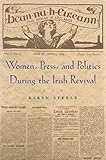
Karen Steele. Women, Press, and Politics during the Irish Revival. Irish Studies Series. Syracuse: Syracuse University Press, 2007. xii + 273 pp. $24.95 (paper), ISBN 978-0-8156-3141-5.
Reviewed by John F. Quinn (Department of History, Salve Regina University)
Published on Jhistory (March, 2008)
Ireland's Forgotten Women Rebels
In Women, Press and Politics during the Irish Revival, Karen Steele argues that Ireland has suffered a "national amnesia" over the role women played in its struggle for independence (p. 203). To remedy this problem, Steele, a professor of women's studies and English at Texas Christian University, examines several women who were deeply involved in the nationalist movement in the years leading up to the 1916 Easter Rising. Her list of forgotten heroines includes Constance Markievicz, Maud Gonne, Lady Augusta Gregory, Delia Larkin, and Hanna Sheehy Skeffington. Steele believes that they have been forgotten in part because of their gender but also because of their involvement with journalism.
Probably the best known of Steele's subjects is Countess Markievicz. An ardent republican (and socialist and suffragist), Markievicz served as the deputy to James Connolly, who was one of the leaders of the Easter Rising. Convicted of treason and sentenced to death, she received a reprieve at least in part because of her gender. In 1918 she was the first woman elected to the House of Commons, but she never took her seat in England. Instead she stayed in Ireland and joined the underground legislature, the Dail Eireann, and served as the minister of labor. In 1921, when Michael Collins and the other Irish delegates signed a treaty ending the Anglo-Irish War and establishing the Irish Free State, she sided with the intransigent rebel leader Eamon DeValera and condemned the treaty.
Steele acknowledges that Markievicz has not been ignored. Yeats devoted several lines to her in his "Easter 1916" poem. He labeled her "shrill," though, and historians have tended to share his dismissive view. Steele focuses on Markievicz's contributions to a short-lived newspaper, Bean na hEireann (Woman of Ireland), which published from 1908 until 1911. Markievicz wrote regular columns on gardening which also happened to be filled with anti-English allusions. For example, in several of her essays she stressed that gardeners needed to kill slugs and snails and other pests if they wanted their Irish plants to flourish. Steele insightfully analyzes the many subversive messages in Markievicz's seemingly innocuous essays.
Maud Gonne and Lady Gregory have also received considerable attention from scholars, but Steele believes that they too have been underappreciated. She claims that Gonne is today mostly remembered as the heartthrob who entranced Yeats and starred in his plays, but Steele wants her to be remembered as a writer as well. To that end, she chronicles Gonne's militantly anti-English contributions to a small nationalist newspaper, the United Irishman(1899-1906). Reflecting on Queen Victoria's visit to Ireland in 1900, Gonne condemned her for her "vile and selfish and pitiless" soul and wondered why she would bother to visit a country that she hated (quoted, p. 90).
Lady Gregory is now remembered mostly as Yeats's patron and as the founder and manager of the Abbey Theatre, but Steele wants her also to be known for her politically engaged plays and journalism. Steele points out that this Anglo-Irish aristocrat became increasingly militant in her later years, expressing sympathy for the Irish Republican Army in the 1920s.
Steele's other heroines have been largely forgotten by historians. Delia Larkin served as general secretary of the Irish Women Workers' Union and helped edit the Irish Worker (1911-14), a small labor-oriented weekly. Steele laments that this brash socialist and nationalist has been overshadowed by her brother, Jim Larkin, who led the Irish Transport and General Workers' Union. Steele is also interested in reviving the memory of Hanna Sheehy Skeffington, a fervent suffragist who would heckle prominent politicians and throw rocks at them to draw attention to the issue. Jailed for her actions, she began a hunger strike to press her cause. When not in prison, she helped her husband, Francis, edit a small suffragist newspaper, the Irish Citizen (1912-20).
While there is much to recommend in Steele's book, there are some notable drawbacks as well. Historians will certainly be frustrated by her imprecise accounts of key figures and events in Irish history. For example, she speaks of the "Cromwellian settlements of the early seventeenth century" (p. 46). Oliver Cromwell occupied Ireland from 1649 to 1652. In describing the content of a nationalist newspaper, she notes that it ran articles on "Henry Joy McCracken,William Smith O'Brien and Thomas Davis, who sacrificed their lives for Ireland" (p. 24). McCracken was executed for his role in the 1798 Rising, but both O'Brien and Davis died in their homes of natural causes. The more significant problem is Steele's contention that there were three key issues of the day--nationalism, feminism, and socialism--and that her protagonists were torn about which issue to prioritize. While that is undoubtedly true for these women, the vast majority of Irish men and women of that era were influenced by nationalism and Catholicism and were not drawn either to feminism or socialism. While Steele admits that each of these newspapers had very small circulations, at times she seems to forget how far removed these women were from the Irish mainstream. At one point, she says that it is ironic that the Irish Free State of the 1920s and 1930s did not recognize the achievements of these women and did not do anything to promote feminism (p. 199). Considering the strong Catholic loyalties of most of the Free State's leaders, it is not ironic at all that feminism would not have been one of their priorities.
The book also suffers from the author's heavy academic prose. In her introduction, Steele begins with a rousing nationalist quotation from Markievicz and then comments: "Markievicz's anaphoric cadences insistently return to the ideal of radical, militant feminity" (p. 1). The general reader who persevered for a few more pages would encounter a brief allusion to the Marxist historian Eric Hobsbawm and then the following passage: "The press remains a unique site for Hobsbawmian analysis of nationalist discourse because, in Ireland, its history and development so closely parallel the colonization of Ireland" (p. 19).
By employing this sort of terminology, Steele is limiting her audience to specialists. This is a shame because Steele is engaged in an important project and is right to want to recover the lives and work of these women. Perhaps other scholars will be able to draw on Steele's work and find a way to make it accessible to general readers.
If there is additional discussion of this review, you may access it through the network, at: https://networks.h-net.org/jhistory.
Citation:
John F. Quinn. Review of Steele, Karen, Women, Press, and Politics during the Irish Revival.
Jhistory, H-Net Reviews.
March, 2008.
URL: http://www.h-net.org/reviews/showrev.php?id=14274
Copyright © 2008 by H-Net, all rights reserved. H-Net permits the redistribution and reprinting of this work for nonprofit, educational purposes, with full and accurate attribution to the author, web location, date of publication, originating list, and H-Net: Humanities & Social Sciences Online. For any other proposed use, contact the Reviews editorial staff at hbooks@mail.h-net.org.

