



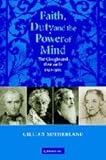
Gillian Sutherland. Faith, Duty and the Power of Mind: The Cloughs and Their Circle, 1820-1960. Cambridge: Cambridge University Press, 2006. 262 pp. $75.00 (cloth), ISBN 978-0-521-86155-7.
Reviewed by Marynel Ryan Van Zee (University of Minnesota, Morris)
Published on H-Women (February, 2008)
Family Matters: The Cloughs, Newnham College, and the Ties That Bound
In Faith, Duty and the Power of Mind, Gillian Sutherland offers a multigenerational portrait of a well-connected family that is also illustrative of the broader importance of family and other ties within the history of the English middle class. Although the best-studied Clough, the poet Arthur (1819-61), figures in Sutherland's narrative, the focus of this book is on the Clough women. Annie, Arthur's sister, and Blanche Athena (Thena), his daughter, were key figures in the establishment and expansion of Newnham College, which Sutherland characterizes as "both symbol and agent of the transformation of educational opportunities for women" in Britain (p. 3). Their biographies are interwoven with the institutional history of the college in a way that illuminates vividly the significance of familial, social, and other networks in the expansion of higher education for women.
Sutherland's story opens in the 1820s as the Clough family moved to Charleston, South Carolina, where their father James traded in cotton. Although they lived in genteel circumstances there and later on their return to Liverpool, James declared bankruptcy twice before Annie's twenty-first birthday. The financial instability of commercial ventures and the importance of familial ties and networks to the maintenance of middle-class status (maternal relatives kept the wolf from the Cloughs' door) were the lessons of Annie's early years. A childhood love of reading, encouraged by her mother, grew into a rigorous program of self-education by Annie's young adulthood. Her initial goals were self-improvement and self-discipline, according to a journal entry of 1841: "'I desire knowledge I do not think so much for its own sake but for the sake of exerting my faculties in acquiring it'" (p. 25). Like many young middle-class women, she also engaged in voluntary teaching through Sunday schools and home visits to working-class children. While Arthur studied at Oxford, and it became increasingly clear to Annie that she was unlikely to marry, she began to consider the potential of teaching as a livelihood. In 1842, partially in an effort to contribute to the family at a moment of financial insecurity, she established her first school in the Clough household.
Following the death of their father in 1844, Annie and Arthur traveled abroad together, and contemplated "'the necessity, or rather the great benefit of women finding work, and considering it a duty to do so, and also whether they are at liberty to choose their own paths in some cases (I mean single women) without reference to their families'" (p. 40). This reference from Annie's journal reflects the combination of motivations she felt (duty and desire) in pursuing goals of her own. But, when financial stability returned to the Clough family, Annie's mother appears to have insisted on the closure of the school. A new plan took shape. Annie sought training at one of the new normal schools in London to more firmly establish her credentials for teaching. As Annie wrestled with duty, Arthur experienced a serious and public crisis of faith that compromised his career prospects. Annie realized that she would bear the primary responsibility for her aging mother. As Sutherland phrases it, these realizations "confirmed a vocation" for Annie in the field of education, while her experiences convinced her that she wanted to work with a different population of students. Her next school, established in the Lake District with the assistance of friend Harriet Martineau's Building Society, enrolled middle-class children and allowed Annie to support and nurse her mother until the latter's death in 1860.
Arthur's surprising and early death one year later brought Annie into contact with the Langham Place Set, a network "campaigning to enhance the public work of women" (p. 73). Through Arthur's widow, a close relative of Florence Nightingale, Annie also became connected to the Social Science Association and its work for the expansion of girls' education. Annie's proposals, relatively modest in scope, were well received by the Royal Commissions established to consider the institutionalization of girls' education. But, Annie's most significant contribution was to women's higher education: the development of a visiting lecture program. During the 1860s, rather than bringing women to Oxford and Cambridge, the lecture program brought professors from those leading British universities to other towns and audiences that included women. Annie joined with the well-known reformer Josephine Butler to establish the Higher Local examinations that would be the first prerequisite for the recognition of women's educational and teaching credentials. This was an interesting alliance. Butler's high profile was balanced with Annie's growing reputation as "an authority on the education of women and one who quietly, with disarming modesty, could make things happen" (p. 83).
The lecture program and Annie's reputation came together in the founding and early administration of Newnham College. From 1870 forward, the Clough family history and the history of the college was intertwined. The offering of lectures in Cambridge led to strong and continued demand from young women for living quarters, and Annie was invited to serve in what would eventually become the role of principal. Sutherland traces the intricate web of connections that supported Newnham's steady expansion and Annie's work to institutionalize higher education for women at Cambridge. By the 1880s, Newnham had trained several hundred women who went on to teach in England and elsewhere. Annie drew on a network of influential women and men, including Henry Sidgwick, Alfred Marshall, and John Stuart Mill, who cooperated to influence university authorities and the British government in favor of continually expanded access for women.
By the early 1880s, she had help, as the next generation arrived. Annie's niece, Thena, came to Newnham as a student and remained as Annie's assistant. Sutherland outlines the motivating factors of duty and desire that compelled her to do so. Newnham was making the transition, in Thena's later recollection, from "'a domestic enterprise, a pair of over-grown country houses'" to a well-established institution with its attendant rules (p. 119). Following Annie's death in 1892, Thena was eventually persuaded to follow her desire back to Cambridge (she had never felt as comfortable anyplace else) but also to face what she described as an "'ought'" in her, a sense of duty (p. 138). As vice principal and later principal of Newnham, Thena coped with some of the most severe challenges faced by the college. Continual petition to the authorities at Cambridge and later to the government to allow greater access and recognition for women by the university were rejected, and the intransigence of many professors and male students was a disappointment. At the same time, Thena was responsible for developing Newnham along academic lines; research fellowships, salary and pension structures, and self-governance were established under her administration. Like her aunt before her, she understood the importance of connections; her networks included the Stephen, Strachey, and Balfour families. She left her post in 1923, but remained an advisor to the college until the 1940s. The year 1947 marked both the first year of a silence that extended until Thena's death in 1960 and the granting of full membership for women in the University of Cambridge.
In the introduction to her book, Sutherland describes her story of the Cloughs as "more than a biography and a family history" (p. 2). Faith, Duty and the Power of Mind is an admirable success in this regard, as Sutherland is careful to connect her close examination of the Cloughs' experiences and personalities to their relevant contexts. For example, Arthur's crisis of faith at Oxford is tied to the broader sectarian conflict underway there in the 1840s and the politics of belief that structured career opportunities. Annie's and Thena's internal conflicts are analyzed relative to the limitations they faced, the expectations that families held for middle-class women (and how those shifted over the course of the period in question), and their own senses of duty to care for those around them. Annie was constantly preoccupied with the question of how to contribute to the Clough family's support for the first twenty years of her working life. Both women felt duty bound to nurse their ailing mothers, and Thena adopted her own niece. It is in illuminating the details of these women's lives that Sutherland really gives us a sense of their middle-class positions and how crucial women were to the financial and emotional stability of their families. Sutherland also provides exhaustive detail of the networks and processes by which higher education for women advanced.
That the history of Newnham College and the history of the Clough family appear together is both a strength and weakness of Sutherland's study. The development of Newnham and the roles of Annie and Thena within it are part and parcel of their life stories and would be difficult to excise. Newnham was an intellectual and professional home for these two women as much as it was an educational institution. It is difficult for the reader, however, to wade through the multiple petitions and commissions, building of new halls, appointments of new vice principals, and details of various rules and regulations, and still maintain attention to the powerful figures at the center of this story.
Sutherland also describes Faith, Duty and the Power of Mind as "a case-study so situated as to help us follow the evolution and expansion of professional opportunities and roles for the English middle class over almost a century and a half--a crucial period" (p. 2). Although I believe that the story of the Cloughs and Newnham College has real value as a case study, partially because of the exhaustive detail that Sutherland provides, I was disappointed to find the study insufficiently situated for the reader to understand its value or significance. There are very few references to the larger literature on middle-class formation and differentiation, the development of the professions, or the history of women's higher education. If profession, the power of mind, perhaps takes over where the property of Family Fortunes served in earlier middle-class formation, it would be expected to have a central position in a case study intended to help us understand its evolution and expansion.[1] But Sutherland rarely mentions profession, and leaves it to the reader to make many of these connections. A specialist will find her way, but the implicit character of her argument makes it likely to escape the notice of those with little background.
Note
[1]. Leonore Davidoff and Catherine Hall, Family Fortunes: Men and Women of the English Middle Class, 1780-1850 (Chicago: University of Chicago Press, 1987).
If there is additional discussion of this review, you may access it through the network, at: https://networks.h-net.org/h-women.
Citation:
Marynel Ryan Van Zee. Review of Sutherland, Gillian, Faith, Duty and the Power of Mind: The Cloughs and Their Circle, 1820-1960.
H-Women, H-Net Reviews.
February, 2008.
URL: http://www.h-net.org/reviews/showrev.php?id=14204
Copyright © 2008 by H-Net, all rights reserved. H-Net permits the redistribution and reprinting of this work for nonprofit, educational purposes, with full and accurate attribution to the author, web location, date of publication, originating list, and H-Net: Humanities & Social Sciences Online. For any other proposed use, contact the Reviews editorial staff at hbooks@mail.h-net.org.

