



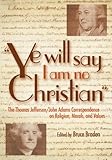
Bruce Braden, ed. Ye Will Say I Am No Christian: Thomas Jefferson/John Adams Correspondence on Religion, Morals, and Values. Amherst: Prometheus Books, 2006. 258 pp. $26.00 (cloth), ISBN 978-1-59102-356-2.
Reviewed by Kamila Stullerova (Department of Political Science, University of Alberta)
Published on H-Ideas (February, 2008)
Adams and Jefferson for Your Mailbox
Bruce Braden's selection of John Adams's and Thomas Jefferson's correspondence aims at a wide audience. In addition to students of U.S. history who would naturally consult this rich letter collection, those engaged in studying contemporary political discourse will find in it a rewarding contrast to the intellectually poor discussions of contemporary political leaders. With one exception, the letters come from their writers' last fourteen years of life, after they renewed their friendship in 1812. Adams and Jefferson both died, hours apart, on July 4, 1826, the fiftieth anniversary of the Declaration of Independence they co-drafted. Topics covered in the letters invite attention of those interested in ideas about religion and morality, the book's primary aim, as well as those with interest in political ideas and the meeting points of ethics/religion and politics. Braden's new edition will be a useful resource to all of the above, but only when accompanied with a couple of caveats.
The book comes beautifully packaged, at least in the metaphorical sense. Braden is a postman by profession and, like both Adams and Jefferson, an amateur, dedicated book lover and collector. He begins his editorial introduction by linking his day job with the present volume, writing: "I have been a letter carrier in Indianapolis, Indiana, for twenty years. Now, I carry letters of Thomas Jefferson and John Adams to you" (p. 17). What follows is a brief, personal essay on Braden's love of ideas of those who came before, which he wants to endow with new voice and have them widely heard again. Rarely does a professional scholar disclose so much engagement in and care for an editorial project as Braden does here. History, religion, and mythology are Braden's chief interests, and he wants to provide readers with a "reference volume centered on the Jefferson--Adams correspondence relating to religion and philosophies to live by" (p. 19). One can only regret that the book's low paper and typesetting quality diminish the intensity of experience of reading old letters by men of gravity brought to us by a concerned carrier. Compared to the present volume, Lester J. Cappon's edited compilation, The Adams--Jefferson Letters: The Complete Correspondence between Thomas Jefferson and Abigail and John Adams (1959)--of incomparably better printing quality--looks like a cold academic work in two thick volumes. Cappon's footnotes are scholarly (often crossreferenced between single letters, using numerous abbreviations); Braden has a general reader in mind, one who would welcome notes on all persons Adams and Jefferson discuss, whether these be Plato or the French organist Michel Richard de la Lande.
The chief attraction of Ye Will Say I Am No Christian, however, comes from the tension between contemporary flattening popular belief and historical complexity, one that is suggested by the volume's title. The United States is nowadays often (self-) perceived as a country built on Christian foundations, established by men of great intellectual and religious integrity. Moreover, the very term "Founding Fathers" tends to carry a reference to a monolithic, single-minded group of dedicated leaders. In this respect, Braden's work has a clear demythologizing aim. His Jefferson and Adams are searching and skeptical. They endlessly probe Christianity and established religion in general, identify overlaps among the world's major faiths, question religious groups' credibility for the study of history, doubt the Bible's divine authorship, and struggle with their personal belief in God and the place such belief has in their personal ethical codes. Most important, these two former leading statesmen and erstwhile fierce political adversaries (Adams beat Jefferson in the 1796 presidential elections, while Jefferson defeated Adams in his 1800 reelection campaign) live out their epistolary friendship with deep mutual respect while disagreeing on many central issues of ethics and politics. The grace with which each accepted the other's different opinions is not a sign of indifference but of a belief that underlying philosophical and/or religious grounds of one's ethical behavior are matters of private choice and understanding.
Religion and morality are not the only perspective from which to read the correspondence. One can follow the line of political ideas, especially on the role of education and scholarly progress for body politics, as once did the political theorist Judith N. Shklar. In her insightful essay "Politics and Intellect," Shklar shows Jefferson viewing politics from the perspective of hope and Adams from that of the memory of the past.[1] Also those interested in the East-West dialogue and its history will find the volume intellectually rewarding. A number of letters addresses Eastern religions and philosophies disclosing their authors' quest to accommodate these into their essentially Western life-worlds. At moments, their bookishness and interest in new ideas, authors, and books sounds almost boastful, but toward the end, when both Adams and Jefferson suffer from illnesses and frailties of old age, it becomes clear that it is this very passion that keeps each one as well as their friendship pulsing with the joie de vivre.
There are two methodological difficulties with Ye Will Say I Am No Christian. The first one is Braden's failure to articulate the criteria for his selection and the concomitant unjustified editorial intervention in the form of headings he gives to each letter (although only in the index). The second one is his neglect to inform readers about the nature of the difference between the complete correspondence and his selection of the Adams-Jefferson letters. Braden's subtitle Correspondence on Religion, Morals, and Values discloses a general criterion of selection. Included are letters that touch any of the three areas. Moreover, there is also an addendum with "a sampling" of Jefferson's and Adams's letters to other people on the same topics. But, arguably, some letters included in the volume are not on matters religious (or moral), although they use religiously inspired language, including, for instance, Adams's famous letter on aristocracy from November 15, 1813. Equally, a few omitted letters, like Adams's to Jefferson from December 30, 1818, can be claimed to directly disclose their authors' ideas on religion. Braden's headings do not suffice to articulate why he included a particular letter.
The correspondence between Adams and Jefferson comes from two periods: the first spans the years of their political collaboration and rivalry, and the second their friendship in old age. Braden starts with an excerpt of one letter from the first period. Out of the 158 letters from the second period, as enlisted in Cappon's Complete Correspondence, Braden includes 106. The 52 letters left out are mostly short notes, often dealing with nothing more than greetings and book acquisition instructions or serving as introductory notes to their carriers. Only a couple make the picture of the Adams-Jefferson relationship, and their ideas of God and religion, more complete, especially those from the last few years of their lives when they shared reports of their illnesses and expressed concerns about each other's health. Nevertheless, readers should have been informed that they are given an almost complete letter exchange from the second period. Neither do readers learn that the striking misbalance between the number of letters written by Adams as opposed to Jefferson, making the former seem much more vocal in the volume, simply copies the dynamics of this epistolary relationship in which Adams wrote to Jefferson much more frequently.
Once one knows what the book's editor did and did not do when selecting the letters for this volume, Ye Will Say I Am No Christian becomes a useful and reliable source of learning on Jefferson's and Adams's ideas on religion, morality, and beyond. Its ample notes will certainly make it accessible to college students, who by now had a choice between Cappon's scholarly edition and Paul Wilstach's edited collection Correspondence of John Adams and Thomas Jefferson (1812-1826) (1925). And, the title of Braden's new edition will, I hope, always remind its readers about the deep, inquiring minds of America's two Founding Fathers and former presidents.
Note
[1]. Judith N. Shklar, "Politics and Intellect," in Political Thought and Political Thinkers, ed. Stanley Hoffmann (Chicago: The University of Chicago Press, 1998), 94-104.
If there is additional discussion of this review, you may access it through the network, at: https://networks.h-net.org/h-ideas.
Citation:
Kamila Stullerova. Review of Braden, Bruce, ed., Ye Will Say I Am No Christian: Thomas Jefferson/John Adams Correspondence on Religion, Morals, and Values.
H-Ideas, H-Net Reviews.
February, 2008.
URL: http://www.h-net.org/reviews/showrev.php?id=14126
Copyright © 2008 by H-Net, all rights reserved. H-Net permits the redistribution and reprinting of this work for nonprofit, educational purposes, with full and accurate attribution to the author, web location, date of publication, originating list, and H-Net: Humanities & Social Sciences Online. For any other proposed use, contact the Reviews editorial staff at hbooks@mail.h-net.org.

