



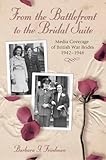
Barbara G. Friedman. From the Battlefront to the Bridal Suite: Media Coverage of British War Brides, 1942-1946. Columbia: University of Missouri Press, 2007. 154 pp. $29.95 (paper), ISBN 978-0-8262-1718-9.
Reviewed by Agnes Hooper Gottlieb (Seton Hall University)
Published on Jhistory (February, 2008)
World War II, it seems, is a national preoccupation. The History Channel pays nightly homage to its heroes in documentaries that look microscopically at battles and strategies. Feature films celebrate its victories, humanize its victims, and glorify its soldiers. News commentator Tom Brokaw dubbed its participants "The Greatest Generation" and earned himself a recent bestseller. As a people, we never tire of rehashing this glorious moment when Americans were united in a common enemy. Perhaps, that is why we find all facets of that war appealing--because it was the last time (except for a brief moment after 11 September 2001) that patriotism and a common goal overrode any selfish or political interests. While battle strategies and diplomatic intrigues have always been the stuff of history books, World War II is really the first war that sparked the interest of researchers to extend beyond the usual analysis. Perhaps, it was the rising popularity of oral history coupled with the invention of new media that gave rise to this extensive social history of war. Whatever the genesis, the human price of war provides the theme for hundreds of movies, documentaries, and books. Journalism historians have also done their part to inform readers about the media role in the social history of war.
Barbara G. Friedman, assistant professor of journalism and mass communication at the University of North Carolina at Chapel Hill, adds to our understanding of the complexity of war and society with her new book From the Battlefront to the Bridal Suite. This book tells the public story--that is, the media story--of war brides, an often overlooked yet seductively romantic group of women. The book, which could be used as a companion in a modern U.S. or journalism history survey course, focuses on how media coverage of war brides was framed. It also provides the reader with stories of real women whose lives were shaped by World War II. To be sure, American soldiers abroad during World War II fell in love with and wooed women from many countries--Italy, Japan, the Philippines, and Germany, to name but a few. World War II spawned one million marriages between American soldiers and foreign women, Friedman reports. But the largest bloc was from Great Britain, which lost seventy thousand of its women to new homes in the United States (p. 2).
While the term "war bride" reeks of romance and adventure, Friedman points out that reality was sometimes anything but. Coverage of the phenomenon portrayed the women as temptresses and as loose women. They were blamed for the rise in venereal disease and sometimes seen as a distraction to men whose focus had to be on war. British publications chastised these women for cavorting with foreigners while their own men were away at the front. American newspapers predicted that U.S. women would have to go without men because their future husbands were being snapped up by these predators. Of note was the story of a U.S. soldier who fathered quadruplets with a British woman despite an American wife waiting for him at home (p. 81).
By bringing the public experience of war brides to light, Friedman states that she is helping "recast the paradigm" so that the experience of war "is neither supremely nor strictly male" (p. 12). Friedman relies heavily on articles from elite newspapers on both sides of the Atlantic, including the Times of London, the New York Times, the London Telegraph, and the Christian Science Monitor, as well as mainstream magazines, including Life, Reader's Digest, and Time. Women's magazines, both American and British, also provided perspectives on what women were saying about other women. Military publications, including Yank magazine and Stars and Stripes newspaper, help paint a clear portrait of how various audiences framed the story of British war brides.
The American military frowned upon but did not prohibit the fraternization that naturally led to marriages. The British public often looked down upon the young women who kept company with American soldiers. British men were in scarce supply, and young women assumed more public roles in the workplace because of the absence of their men. American G.I.s came to town with candy bars in their hands, coins jingling in their pockets, and prospect of an evening of food and a little innocent fun. They reminded British women of "the incarnation of innumerable Hollywood films" (p. 19). They were, in short, hard to resist.
The press did not approve. Friedman reports that the New York Times found the situation "worrisome" and framed the brides as "predators" (p. 86). One article, for example, reported that these brides were "attracted by the big money the soldiers were earning" (p. 86). On the British side, initial calls to the British people to warmly welcome troops were set aside when it became clear that some folks were getting too friendly indeed. That kind of fraternization could only serve as a distraction from the war effort.
Both British and American publications agreed on one thing--war marriages were not good. British newspapers fretted that "silly girls" were raising promiscuity concerns and causing rising rates of venereal disease. London newspapers were also concerned what the flight of women would do to morale among British soldiers and, ultimately, to birth rates. British publications, thus, framed their positions around the general topics of morality, hygiene, and patriotism. When thousands of war brides began seeking visas to enter the United States early in the war, the New York Times insinuated that the women could cause an outbreak of venereal disease in the United States and that the women were of poor moral character. The coverage in the newspaper slowly shifted to a more favorable light later in the war when it began publishing poignant human interest stories about the plight of families wrenched apart by the war.
This study, underpinned by the media theory of framing, tells the story of British war brides through their portrayal in various accessible media. Friedman's work, which aims to expand our understanding of the role of women in war, is informed by several interesting studies that are worth mentioning. Jean Bethke Elshtain's Women and War (1987) creates the model of concentric circles to explain war. Combat is at the center, but "women still encircle, they are needed to keep the whole thing going," according to Friedman (p. 132). Equally useful to a discussion of women and war is the image of the double helix that is employed by Margaret Higonnet and Patrice Higonnet in Behind the Lines: Gender and the Two World Wars (1987). Although Friedman only alludes to this model, it bears explanation. Like a twisting strand of DNA, gender roles in wartime represent complex processes that cannot be separated.
Most recently, the subject of World War II and the romantic emotions it engendered returned to bestseller lists, this time in the form of the newly discovered work of fiction by Holocaust victim Irene Nemirovsky. I happened to be reading Nemirovsky's Suite Francaise (2006) when I picked up From the Battlefront to the Bridal Suite to review. The parallels are stark. Nemirovsky describes in a riveting story how it was possible for young French women to be attracted to and ultimately make excuses for German soldiers who were occupying France in early World War II. She takes the vaguely repulsive concept of cavorting with the enemy and paints a nuanced picture that begs understanding. Friedman, in her slim volume, does just the opposite. She uncovers a rather dismal reality of what I always thought was a hugely romantic phenomenon of handsome American soldiers being comforted during wartime by lonely British women. Friedman states at the outset that her goal is to bring the experiences of the British war brides "into the mainstream of historical inquiry." She has succeeded in From the Battlefront to the Bridal Suite.
If there is additional discussion of this review, you may access it through the network, at: https://networks.h-net.org/jhistory.
Citation:
Agnes Hooper Gottlieb. Review of Friedman, Barbara G., From the Battlefront to the Bridal Suite: Media Coverage of British War Brides, 1942-1946.
Jhistory, H-Net Reviews.
February, 2008.
URL: http://www.h-net.org/reviews/showrev.php?id=14125
Copyright © 2008 by H-Net, all rights reserved. H-Net permits the redistribution and reprinting of this work for nonprofit, educational purposes, with full and accurate attribution to the author, web location, date of publication, originating list, and H-Net: Humanities & Social Sciences Online. For any other proposed use, contact the Reviews editorial staff at hbooks@mail.h-net.org.

