



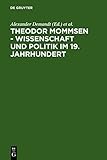
Alexander Demandt, Andreas Goltz, Heinrich Schlange-Schöningen. Theodor Mommsen: Wissenschaft und Politik im 19. Jahrhundert. Berlin: de Gruyter, 2005. 361 S. $78.30 (cloth), ISBN 978-3-11-017766-4.
Reviewed by Gary Beckman
Published on H-German (January, 2008)
Historian as Super-Star
The death of what public intellectual today would rate front-page, above-the-fold headlines? What contemporary historian would be considered for the Nobel Prize in literature? What living scholar of ancient history could occupy a respected place in a national legislature? Even to pose such questions within the anti-intellectual civic culture of the United States invites laughter. Yet in another time and another place, neither all that distant, Theodor Mommsen, in addition to composing some 1,600 scholarly contributions and political writings and initiating many basic research projects in Classical Studies, sat in the Prussian Landtag (1863-66; 1873-79) and the Reichstag (1881-84), and in 1902 was awarded the Nobel Prize for his Römische Geschichte(1854-56). As Hans Kloft puts it in his contribution to this collection of essays growing out of a lecture series delivered in 2003-04 at the Friedrich Meineke Institut of the Freie Universität, Berlin, in commemoration of the one-hundredth anniversary of the great scholar's passing, Mommsen may be seen as "ein Medienereignis des 19. Jahrhunderts" (p. 284).
The essays gathered here treat various aspects of Mommsen's long career, including his fraught relationship to Bismarck (Demandt) and to the Hohenzollern (Schlange-Schoeningen), his friendships and rivalries with Rudolf Virchow (Christian Andree) and with Max Weber (Juergen Deiniger), and his ideas concerning the ancient Germans (Goltz) and about contemporary imperialism (Ernst Baltrusch). There are also considerations of his contributions as a historian of law (Wilfried Nippel) and of his prose style (Gert Mattenklott).
What emerges from the sum of the discussions presented in this volume is that Mommsen owed his prominent public profile to the fact that he was the standard-bearer for a significant, if minority, stream of political opinion in the young German Reich: that of liberal nationalism. A veteran of the upheavals of 1848, he believed that the national state was the ultimate goal of historical development, for Germany as well as for Rome, but was distressed by the ever more authoritarian direction taken by many of his fellow countrymen and their government. Mommsen's (classical) liberal opinions were well known to the educated public thanks to his prolific output of lectures and pamphlets for a general audience, as in the 1879-80 Antisemitismusstreit that he engaged in with Heinrich von Treitschke (see the essay by Christhard Hoffmann).
Indeed, for Mommsen, the writing of history was not an ivory-tower enterprise, but a tool for engaging in the politics of the day. Mommsen mined history for lessons applicable to the present, and a political argument always backgrounds his historiography. His concern with addressing non-specialists led to his often-mocked practice of utilizing contemporary terminology to describe Roman conditions and institutions, such as calling Senators the "Junkerklasse" or Equites "Kapitalisten" (p. 3). Although in the decades following the foundation of the Reich his brand of liberalism steadily lost ground to both Left and Right, Mommsen had become such a towering figure in German political and intellectual life that his opinions continued to attract respectful attention, and his death on November 1, 1903, brought forth (sometimes rather grudging) tributes from all sides (see the essay by Hans Kloft). Egon Flaig points out that for Mommsen the danger of losing what had been achieved was "eine maßgebliche geschichtsphilolosophische Kategorie, and auch eine politische Befürchtung, eine Obsession" (p. 197). The fragility of his beloved united German polity would indeed be demonstrated clearly during the course of the new century.
It should be noted that another collection of essays concerning the life and work of Mommsen, including contributions from several of the same authors, was published at about the same time as this volume.[1] One essay, that by Christian Andree, even appears in both books.
Note
[1]. Josef Wiesehoefer, ed., Theodor Mommsen. Gelehrter, Politiker und Literat (Stuttgart: Franz Steiner, 2005). See the review by Corinne Bonnet at http://ccat.sas.upenn.edu/bmcr/2007/2007-04-07.html .
If there is additional discussion of this review, you may access it through the network, at: https://networks.h-net.org/h-german.
Citation:
Gary Beckman. Review of Demandt, Alexander; Goltz, Andreas; Schlange-Schöningen, Heinrich, Theodor Mommsen: Wissenschaft und Politik im 19. Jahrhundert.
H-German, H-Net Reviews.
January, 2008.
URL: http://www.h-net.org/reviews/showrev.php?id=14120
Copyright © 2008 by H-Net, all rights reserved. H-Net permits the redistribution and reprinting of this work for nonprofit, educational purposes, with full and accurate attribution to the author, web location, date of publication, originating list, and H-Net: Humanities & Social Sciences Online. For any other proposed use, contact the Reviews editorial staff at hbooks@mail.h-net.org.

