



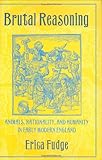
Erica Fudge. Brutal Reasoning: Animals, Rationality, and Humanity in Early Modern England. Ithaca: Cornell University Press, 2006. x + 224 pp. $45.00 (cloth), ISBN 978-0-8014-4454-8.
Reviewed by Anita Guerrini (Department of History and Program in Environmental Studies, University of California, Santa Barbara)
Published on H-Environment (January, 2008)
Beastly Humans and Humane Beasts
The literary scholar Erica Fudge is a well-known practitioner in the burgeoning new field known as animal studies. Her prolific writings over the past decade have helped to define the field, and her attention to the early modern period--usually characterized as the era between 1500 and 1800--has helped to anchor animal studies in history. In particular, her influential essay "A Left-Handed Blow: Writing the History of Animals" has helped to define how humans might write a history of animals. In this essay, Fudge emphasized the ethical dimension such work entails and the rethinking of the human place in nature that such work requires.[1] Her newest work, Brutal Reasoning examines the definition of the human and the animal in English philosophical, theological, and literary texts from about 1550 to 1630, with a final chapter on Descartes' Discourse on the Method (first published in French in 1637) and its influence. Fudge's premise, that the animal in this period is defined in relation to the human--and vice-versa--is not new, but her tight focus on a distinct time and place lead to some interesting insights.
Fudge builds her argument with parallel chapters on "being" and "becoming" human and animal. Premodern culture defined the human, she argues, in terms of the possession of reason. Her first chapter, "Being Human," offers a nice survey of Aristotelian-Galenic ideas about humanness, reason, and the soul. Looking especially at Robert Burton's 1621 Anatomy of Melancholy, Fudge unpacks the implications of rationality and its relationship to the possession of an immaterial (rather confusingly referred to by Fudge as "inorganic") soul. However, this unpacking sows seeds of doubt about human superiority as she compares evidence of rational behavior in humans and animals. These seeds take root in the next chapter, "Becoming Human," which examines humanness as a process. Infants do not display those qualities, such as reason and speech, that are defined as distinctly human. Fudge argues that these qualities are in fact imposed by culture, not nature, by means of education, and that humans can lose these qualities and become, in behavior, very much like animals, as numerous texts of the late sixteenth and early seventeenth century detailed. However, her discussion of "savages," which continues her argument that one learns to be human, is superficial. She contends that because Native Americans lacked human status, they were seen as fair game for exploitation by Europeans. But this conclusion is based on an examination of only a few texts and ignores the complexity of the post-Columbian encounter.
Fudge's third chapter, "Becoming Animals," examines metaphors of animality as applied to humans whose passions overrule their reason, such as drunkards. Fudge wants to go beyond metaphor and symbol to find real animals in this discourse. She focuses on the French philosopher Michel de Montaigne, but it is not clear that Montaigne's animals are any less symbolic than those of other writers. She uses Montaigne's example of "stag's tears" to assert that he spoke of real animals, but those tears had a long history in myth. The next chapter, "Being Animal," gives examples of how "empirical observation begins to undercut assertions of animal rationality" (p. 85). But most of these examples are literary or philosophical; she looks at few works of natural history or natural philosophy, which are filled with empirical descriptions of animals. Her main example of natural philosophy is Thomas Topsell's 1607 Historie of Foure-Footed Beastes, itself a translation of the Swiss naturalist Konrad Gesner's 1551 Historia animalium. As an example of natural history, Topsell's work is part of an old encyclopedic tradition stretching back to the Roman Pliny. These works attempted to include all possible information, mingling empirical observation with myth, symbol, and use in its descriptions. Therefore it is not really surprising that such works were not terribly reliable guides to "real" animals. But Fudge ignores other writers of natural history who described animals, such as Thevet, Pierre Belon, Thomas Hariot, or Charles de l'Ecluse, or such natural philosophers as William Harvey.
Fudge finally describes a real animal in chapter 5, where she discusses Morocco the Intelligent Horse, who wowed audiences between about 1590 and 1610. Morocco's story leads Fudge to works on literature, theology, and horsemanship, and indicates that there was a multiplicity of points of view about animals' capacity for reason around 1600. The opposition between reason and unreason does not hold. But did Descartes really silence these voices? Although in chapter 6 Fudge wishes to prove that Descartes' notion of the "animal machine" profoundly changed the way people viewed animals, she has to admit that not everyone accepted Descartes' ideas (her claim that these were "used to support the increase in vivisection in France" is simply wrong [p. 158]). She proves her case that early modern discourse on animals was more complicated than a simple binary of reason versus unreason, and even Descartes could not undo that complexity. In her conclusion, Fudge offers a critique of modern analysis of early modern literature, which, she believes, has failed to engage fully the idea of the animal as a historical actor, employing Bruno Latour's actor-network theory to argue for the interconnections between humans and the natural world.
In his recent review of Fudge's book in Renaissance Quarterly, Bruce Boehrer refers to it as a "major intervention in the growing fields of early modern ecocriticism and animal studies."[2] But is it? Do ecocriticism and animal studies in fact have much in common? Over twenty years ago, the environmental philosopher J. Baird Callicott launched a philosophical grenade with his article "Animal Liberation: A Triangular Affair," which argued that animal liberation had very little to do with environmental ethics. In particular, he noted that the emphasis of animal activists on domestic animals was irrelevant to Aldo Leopold's land ethic that privileged the biota.[3] Despite her quest for the "real animal" in early modern thought, Fudge discusses animals largely in generic terms, and when she does look at individual species, they are all domestic: dogs, horses, pigs. The larger context of the natural world only appears in her discussion of Latour in her conclusion. Although ecocriticism has been defined broadly, it does seem to imply some engagement with the contexts in which animals live as well as the animals themselves. Fudge's work sticks closely to texts and has very little context, either historical or ecological. For example, she cites John Donne's comparison of wisdom to a "disafforestation" of the mind, but does not follow up on the broader implications of this comparison (p. 59).
Fudge's learning is impressive, and she offers some new and fruitful ways to look at early modern texts. But ultimately I found Brutal Reasoning to be too narrowly focused. For animal studies to have an impact on historical writing, its practitioners must, paradoxically, look beyond animals to broader social and ecological contexts.
Notes
[1]. Erica Fudge, "A Left-Handed Blow: Writing the History of Animals," in Representing Animals, ed. Nigel Rothfels (Bloomington: Indiana University Press, 2002), 3-18.
[2]. Bruce Boehrer, review of Brutal Reasoning, by Erica Fudge, Renaissance Quarterly 60, no. 2 (2007): 656-657.
[3]. J. Baird Callicott, "Animal Liberation: A Triangular Affair," in In Defense of the Land Ethic (Albany: State University of New York Press, 1989), 15-39 (originally published in ¬Environmental Ethics 1980).
If there is additional discussion of this review, you may access it through the network, at: https://networks.h-net.org/h-environment.
Citation:
Anita Guerrini. Review of Fudge, Erica, Brutal Reasoning: Animals, Rationality, and Humanity in Early Modern England.
H-Environment, H-Net Reviews.
January, 2008.
URL: http://www.h-net.org/reviews/showrev.php?id=14078
Copyright © 2008 by H-Net, all rights reserved. H-Net permits the redistribution and reprinting of this work for nonprofit, educational purposes, with full and accurate attribution to the author, web location, date of publication, originating list, and H-Net: Humanities & Social Sciences Online. For any other proposed use, contact the Reviews editorial staff at hbooks@mail.h-net.org.

