



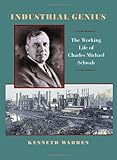
Kenneth Warren. Industrial Genius: The Working Life of Charles Michael Schwab. Pittsburgh: University of Pittsburgh Press, 2007. xiv + 285 pp. $35.00 (cloth), ISBN 978-0-8229-4326-6.
Reviewed by David Hochfelder (State University of New York at Albany)
Published on H-SHGAPE (January, 2008)
America's Forgotten Industrial Genius
Charles Michael Schwab (1862-1939) was at the center of the steel industry for all of his working life. He began his career at age seventeen as a stake driver at Andrew Carnegie's Edgar Thomson Works and quickly rose up the managerial ranks. He played a central role in the violent 1892 Homestead strike. Afterward, he became president of Carnegie Steel Company, helped form U.S. Steel Corporation after the turn of the century, and headed the Emergency Fleet Corporation during World War I. During his day, he was the most important and well-known steel executive except for Carnegie himself. Unlike Carnegie, however, he lacked an expansive vision of the social role of the modern industrial statesman or of socially beneficent uses for his wealth. Schwab died in debt and obscurity, and remains largely forgotten today.
As a young manager at Edgar Thomson, Schwab's driving concern was to increase productivity and efficiency. He pursued this goal through a combination of plant improvements and tough labor practices. Kenneth Warren in Industrial Genius notes that Schwab created a media image of himself as "a more understanding and sympathetic employer than most," but rejects this image as a "myth" (p. 14). Instead, Warren describes Schwab's labor relations methods as exhibiting "scant regard for the long-term well-being of his men" (p. 15). Carnegie described him as his "'Number One' superintendent" for his skill at boosting output while containing labor costs (p. 18). Despite Schwab's labor practices, he commanded respect (if not affection) from his workers. In his autobiography written some twenty years later, Carnegie claimed that had Schwab been at Homestead in July 1892, instead of Henry Clay Frick, the violent strike would have never occurred. Indeed, the company brought Schwab back to Homestead in October 1892 to resolve the strike and return the plant to production.
Over the next five years, he increased output dramatically at Homestead, through his usual combination of capital improvements and worker speedups. By 1897, Warren notes, Homestead was "a remarkable steel making operation," a "world leader" (p. 47). Yet from workers' perspective, it was "a soulless industrial monster. Men, like machinery, became items to use, write off, and replace" (p. 47).
Because of his success at Homestead, in early 1897, Schwab ascended to the presidency of Carnegie Steel. From this position he played a key role in the formation of U.S. Steel in 1901, at the time the world's largest corporation. Carnegie Steel, after all, was the most important single interest within the new corporation. However, managerial and personal conflicts with Frick and Elbert Gary cut his tenure short at U.S. Steel. In 1903, Schwab resigned as president of U.S. Steel and the following year resigned from the board of directors. Even before giving up his positions at U.S. Steel, he acquired controlling interest in Bethlehem Steel, a smaller company that specialized in naval armor and shipbuilding. During his tenure at Bethlehem, he expanded the company until it became the second largest steel producer behind U.S. Steel.
During the First World War, Bethlehem's business soared due to munitions sales to the British military. Volume increased dramatically, and in the first year of the war, profits nearly tripled from prewar levels. His success as an industrial statesman and munitions producer led President Woodrow Wilson to appoint him as head of the Emergency Fleet Corporation (EFC) after America's entry into the war. Schwab's main task was to modernize the 151 shipyards he controlled, over half of which built wooden vessels. After scoring his characteristic success at boosting output dramatically, Schwab resigned one month after the November 1918 armistice. Schwab never again took a leading role in the steel industry that he had helped to create and modernize.
Evaluating a figure like Schwab is a challenging task. Warren's biography deals primarily with his business career and devotes much less attention to his personal life. This is mainly because Schwab threw most of his energies into his work, and paid less attention to his personal relationships or philanthropic activities than many of his contemporary industrial giants. Regarding himself as a self-made man, Schwab addressed a Chicago crowd in June 1918: "The aristocrat of the future will not be the man of wealth but the man who has done and is doing something worthwhile. I've grown to be a wealthy man but my greatest pleasure does not come from it. It comes from the recollection of the duties I have done well" (p. 173). Schwab regarded himself as a fair-minded and approachable boss; he often remarked that "no man had ever worked for [me], but thousands had worked with [me]" (p. 174). Yet, Warren argues that he "regarded labor as a commodity.... Though certainly more approachable than many of his contemporaries, time and again throughout his career he proved he had little time for workers' rights" (p. 185).
Warren does an excellent job at narrating Schwab's life and reaching balanced conclusions about his subject as a business leader and as a human being. Admitting that Schwab was "in many ways ... limited," Warren finds it "impossible to be unimpressed by Charlie Schwab" (p. 242). Business historians, particularly those interested in the rise of the American steel industry, will share Warren's guarded enthusiasm for America's forgotten industrial genius.
If there is additional discussion of this review, you may access it through the network, at: https://networks.h-net.org/h-shgape.
Citation:
David Hochfelder. Review of Warren, Kenneth, Industrial Genius: The Working Life of Charles Michael Schwab.
H-SHGAPE, H-Net Reviews.
January, 2008.
URL: http://www.h-net.org/reviews/showrev.php?id=14048
Copyright © 2008 by H-Net, all rights reserved. H-Net permits the redistribution and reprinting of this work for nonprofit, educational purposes, with full and accurate attribution to the author, web location, date of publication, originating list, and H-Net: Humanities & Social Sciences Online. For any other proposed use, contact the Reviews editorial staff at hbooks@mail.h-net.org.

