



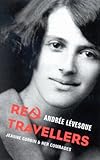
Andrée Lévesque. Red Travellers: Jeanne Corbin and Her Comrades. Montreal: McGill-Queen's University Press, 2006. 233 pp. $34.95 (cloth), ISBN 978-0-7735-3125-3.
Reviewed by Chris Powell (Department of History, University of New Brunswick)
Published on H-Canada (January, 2008)
Canadian Comrades
Andrée Lévesque is no stranger to the writing of biographies about Canadians on the left. A specialist in women and labor in the history department at McGill University, she has authored, co-edited and edited works on Stanley Ryerson ("Stanley Bréhaut Ryerson 1911-1998" Labour/Le Travail [1998]), Norman Bethune (co-edited with David A. E. Shepherd Norman Bethune: His Times and His Legacy [1982]), and Madeleine Parent (Madeleine Parent: Activist [2005]). Her latest publication, Red Travellers, is a translation of the original book Scènes de la vie en rouge: l'époque de Jeanne Corbin, 1906-1944 published in French in 1999. In the preface to this English translation, she warns the reader that she is hesitant to call the book a biography, largely due to the scarcity of personal sources available on Corbin. Rather, Lévesque is more interested in recreating the society of Canadian Communists within which Corbin spent most of her life. While Lévesque is moderately successful in this endeavor, she certainly succeeds in using Corbin as a vehicle for telling the history of the Communist Party of Canada (CPC) from the late 1920s to the early 1940s.
Corbin was born in Cellettes, France, in 1906. Her father, a bankrupt grape farmer, immigrated with his wife and the young Jeanne to Canada in 1911, establishing a homestead in Lyndbrook, Alberta. As a unilingual francophone child in a predominantly English-speaking area, Corbin did not begin her formal education until the age of eleven. Due to her inability to speak English, school authorities placed her in the first grade. By age fifteen she reached grade six. At that time, her parents sent her to Edmonton where she stayed in a boarding home until finishing high school at the age of twenty. Among others resident at the boarding home were several Communist Party activists who must have exerted an influence on Corbin. By age fifteen, the Royal Canadian Mounted Police already had a file on her and had branded her "a dangerous Communist Agitator" (p. 16). By age sixteen, she had joined the Young Communist League (YCL) and was responsible for organizing young children into the Young Pioneers, a party organization for those too young for the YCL. She joined the party itself at eighteen years of age. Upon graduating from high school, the party hired her to assist Becky Buhay, one of the ranking women activists in the CPC, in running a camp at Sylvan Lake, Alberta, to train young party activists. It was in this capacity that the party leadership took notice of her and called her to party headquarters in Toronto in September 1929.
It is tragic that such an individual as Corbin never kept a diary as a young girl, or if she did, that it did not survive. What inspires a fifteen-year-old girl anywhere to join the Communist Party? Lévesque, to her credit, does not venture into the world of conjecture, stating only what the historical record has left for scholars. Obviously, Corbin was intelligent, as she was able to excel in school in a language that was learned outside of the home, graduating from high school, as Lévesque tells us, "at a time when most Albertans did not finish high school" (p. 16). Perhaps, it was that Corbin was used to being an outsider: a francophone in an English-speaking province, an older than average student among her peers as a preteen and teenager, living in a big city with no family. "The YCL and the party," Lévesque asserts, "offered a community to Jeanne Corbin, an only child and a member of a tiny minority in Alberta" (p. 38).
Upon her arrival in Toronto, Corbin began her association with the Canadian Labour Defense League (CLDL), a relationship that would last until her tragically young death little more than a decade later. The CPC had established the league in 1925 to defend workers, particularly foreign-born ones, from an aggressive state apparatus that was intent on imprisoning and deporting militant workers. It was affiliated with the Moscow-based International Red Aid. It was during Corbin's time in Toronto that she was first arrested during one of the many free speech demonstrations at Queen's Park that Toronto police broke up. Corbin served twenty days at the Concord Industrial Farm for Women. Again, during this part of Corbin's life we learn little about Corbin, but much about Communist Party activity in Toronto. However, much of this has been previously described by Lita-Rose Betcherman (in The Little Band: The Clashes Between the Communists and the Canadian Establishment, 1928-1932 [1982]), Norman Penner (in Canadian Communism: The Stalin Years and Beyond [1988]), and Ivan Avakumovic (in The Communist Party in Canada: A History [1975]). Also during this period, Corbin made her first contacts in northern Ontario and northwestern Quebec, where she returned a few years later on a full-time basis. In the meantime, as a reward for her labors, the party assigned her to Montreal upon her release from jail.
The CPC's rationale in sending Corbin to Montreal was based largely on the fact that she was a francophone. In addition to being put in charge of the party's organ The Worker, much of her activity involved translation work and encouragement of other francophone workers to join industrial unions and organizations for the unemployed. Lévesque's coverage of this portion of Corbin's life is particularly useful in elucidating the prescience of the Communist understanding of the relationship of French-speaking workers in Canada to their home and native land. Earl Browder, head of the American party, compared the degree of exploitation French-Canadian workers experienced to that of African Americans in his own country--forty years before Pierre Vallières wrote White Niggers of America (1968). The COMINTERN (Communist International) insisted that French-Canadians not be organized as a language group like other ethnic groups. Indeed, its instructions to the Canadian party prefigured national policy in Canada by almost half a century: "Upon no account must French-Canadian Party units be regarded as 'language' units in the 'immigrant' sense because Canada is a bilingual country and the French-Canadians are native masses" (p. 53).
In December 1932, the party leadership recalled Corbin and reassigned her to Timmins, Ontario, the center of the party's fourth district of northern Ontario and northwestern Quebec. The economy of this region was based on resource extraction, specifically forestry and mining. Its workforce was a diverse range of many cultures: English and French, as well as various immigrant groups. During the Great Depression, Timmins was an anomaly; at a time when businesses were closing across the country, the local goldmines kept the town booming. Despite the distance from Montreal, Corbin was still in charge of the francophone press centered there. The dogged suppression of Communism, and the Communist press in particular, by the Liberal government under Alexandre Taschereau ultimately led to the closing of La Vie ouvirère. Still, Corbin was kept busy with her responsibilities as regional secretary for the CLDL as well as the Workers' Unity League. In this latter capacity, she organized mine and forestry workers. During one of the forestry strikes that she helped organize, police arrested her and she served three months in jail. It is possibly during this period of incarceration that she contracted the tuberculosis that would eventually kill her ten years later. Upon her release, she resumed her duties with the CLDL. Her release coincided with the adoption by the COMINTERN of the popular front policy, enabling Communist parties to work with social democratic and liberal elements that the party previously viewed as "social fascists."
It is this portion of Lévesque's book where she is at her best. The chapters on party activity in the fourth district, and Timmins in particular, not only show an excellent regional history of the Communist Party in northern Ontario, but also provide a profile of the social, economic, and cultural roles the party played in Ontario's northern frontier. The author's account of the New Ontario Workers' Co-operative Store in Timmins illustrates how during the popular front era Communists and their fellow progressives could come together and provide the community with such a dynamic focal point and service.
Lévesque's discussion of women in the Communist Party nicely complements the work of Joan Sangster (in Dreams of Equality: Women on the Canadian Left [1989]) in this area. Corbin saw herself first and foremost as a Communist, not as a woman. She was a "comrade." Issues of gender were always secondary to the larger class struggle. A chapter entitled "Women in a Men's Party" focuses on how the party's projection of the place of women in society changed as the image that Moscow wanted to project of women changed. Central to this discussion is Moscow's dissolution of the semiautonomous women's departments in 1929 and its championing of International Women's Day (IWD). In Canada, IWD was used as a vehicle to praise the condition of women in the Soviet Union. As with the issue of French-Canadians, the Communist Party was well ahead of the rest of society in its demands for equal pay for equal work. However, this sense of egalitarianism did not continue into Communist homes, where traditional domestic work remained the sole purview of women. "(S)exual equality," the author tells us, "referred more to wages than the laundry" (p. 137).
Issues of sexuality were cause for a degree of apprehension for the party. Ironically, concern for its reputation led to a moral conservatism among the party leadership. In turn, leaders pressured comrades in common-law relationships to make their unions respectable by exchanging marital vows. Still, the party attempted to exercise control over the libidos of the members, who were expected to consult with the secretary general before exchanging vows. As for homosexuality, the party outright condemned it.
It is within this discussion that Corbin is noticeably absent. As a young, attractive woman (one of the features of the book is a generous supply of photographs), Corbin's possible asexuality is quickly noticeable. In fact, the only man of any mention in Corbin's life is her father. Certainly the lack of personal records is the major reason for this absence, but the absence of this aspect of Corbin's life from Red Travellers, either intentional or not on Lévesque's part, adds to the image of the sexually puritan comrade.
Corbin was admitted to the Queen Alexandra Sanatorium in London, Ontario, in the fall of 1942. The ailments she had been suffering for the past decade had been misdiagnosed, and by the time she entered the facility her tuberculosis was well advanced. It is in Corbin's last days that we see her most as an individual. This is partly due to her forced retirement from party activism, but also due to the survival of much personal correspondence from the period. She died on May 6, 1944.
Red Travellers represents an important contribution to the small but growing literature chronicling the lives of Canadian women on the left. It joins Lévesque's previously edited collection of articles on Parent, and Faith Johnston's recent work on Dorise Nielsen (A Great Restlessness: The Life and Politics of Dorise Nielsen [2006]). It is a fast read, only 179 pages of text, and would work well in an undergraduate class on Canadian labor history. It is also balanced. While acknowledging the CPC's slavish adherence to the Moscow line, Lévesque also gives credit to the many anonymous Communist activists of the 1920s, 1930s, 1940s who tried to make Canada a better place, and who indeed were able to influence politicians of their day on social, political, and economic issues and help drag them kicking and screaming into the twentieth century. The amount of research that went into the book is staggering. In addition to availing herself of the expected archival sources and publications in Canada, Lévesque traveled to France and Belgium for background information on Corbin's family. She even accessed her record in the COMINTERN's collection in Moscow, where a three-page file, including a small photo of Corbin, is stored.
The greatest weakness of Red Travellers is at times its greatest strength. Due to the paucity of personal material on Corbin, the book becomes a history of the Communist movement of the period from the late 1920s to the early 1940s. Sometimes its focus is international, sometimes national, and sometimes regional. It is at its best when it focuses on the regional. Again, owing to the absence of Corbin the person, at times the book has a tendency to read like a collection of essays, rather than as a larger work. Indeed, as a reader it is frustrating in that with every turning of the page one wants to know more of Corbin the individual, only to be continually frustrated with the absence of historical data. In part, this is Lévesque's cruel genius, for it is the story of the collective, and not the individual, that the author has written. Concluding her discussion of Corbin, Lévesque reminds us, "she was a Communist, pure and simple" and that is how Corbin would want to be remembered (p. 176). Ultimately, Red Travellers is much more about Corbin's comrades than about the woman herself.
If there is additional discussion of this review, you may access it through the network, at: https://networks.h-net.org/h-canada.
Citation:
Chris Powell. Review of Lévesque, Andrée, Red Travellers: Jeanne Corbin and Her Comrades.
H-Canada, H-Net Reviews.
January, 2008.
URL: http://www.h-net.org/reviews/showrev.php?id=14007
Copyright © 2008 by H-Net, all rights reserved. H-Net permits the redistribution and reprinting of this work for nonprofit, educational purposes, with full and accurate attribution to the author, web location, date of publication, originating list, and H-Net: Humanities & Social Sciences Online. For any other proposed use, contact the Reviews editorial staff at hbooks@mail.h-net.org.

